

Stein et at.: Late Ouaternary Organic Carbon and Biomarker Records from the Laplev Sea
Unit
a ~
~ c:
E 0
t-- .e ..
"""
0
0
<.>
£!. 'c .. '"
t-- 0
"
..
(f) 0
a. la ~
~ c
E
€
"
OJ 0
"
'c
..
"
t-- 0
"
0;
(f)
(5
a. la ~
~ c
E
0
.e
.... ..
N
0
~
<.>
'c
ID
.. '"
t-0
"
0;
en 0
a. le
N
"l
~
"l
e
e
0
e
N
"l
~
on
0
e
0
e
N
"l
~
10
0
e
0 0
100
200
300
400
Depth (cmbsf)
500
500
o Turbidites
600
700
600
700
643
800
800
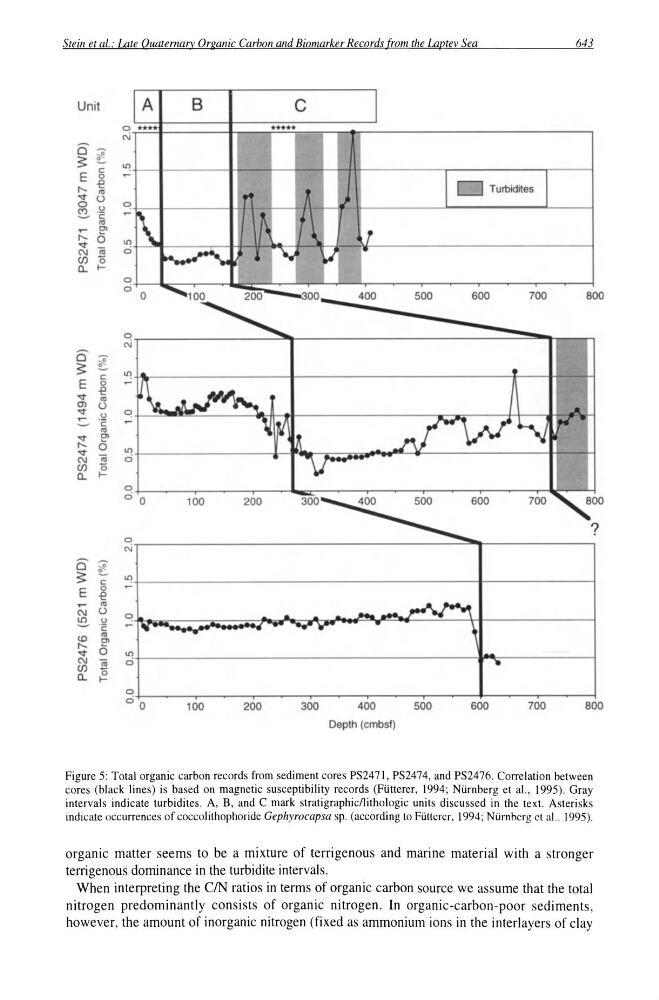
Figure 5: Total organic carbon records from sediment cores PS2471, PS2474, and PS2476. Correlation between
cores (black lines) is based on magnetic susceptibility records (Ftitterer, 1994; Ntirnberg et aI., 1995). Gray
intervals indicate turbidites. A, B, and C mark stratigraphic/lithologic units discussed in the text. Asterisks
indIcate occurrences of coccolithophoride Gephyrocapsa sp. (according to Ftillcrcr, 1994; Niirnbcrg ct ai, 1995).
organic matter seems to be a mixture of terrigenous and marine material with a stronger
terrigenous dominance in the turbidite intervals.
When interpreting the CfN ratios in terms of organic carbon source we assume that the total
nitrogen predominantly consists of organic nitrogen. In organic-carbon-poor sediments,
however, the amount of inorganic nitrogen (fixed as ammonium ions in the interlayers of clay
Unit
a ~
~ c:
E 0
t-- .e ..
"""
0
0
<.>
£!. 'c .. '"
t-- 0
"
..
(f) 0
a. la ~
~ c
E
€
"
OJ 0
"
'c
..
"
t-- 0
"
0;
(f)
(5
a. la ~
~ c
E
0
.e
.... ..
N
0
~
<.>
'c
ID
.. '"
t-0
"
0;
en 0
a. le
N
"l
~
"l
e
e
0
e
N
"l
~
on
0
e
0
e
N
"l
~
10
0
e
0 0
100
200
300
400
Depth (cmbsf)
500
500
o Turbidites
600
700
600
700
643
800
800
Figure 5: Total organic carbon records from sediment cores PS2471, PS2474, and PS2476. Correlation between
cores (black lines) is based on magnetic susceptibility records (Ftitterer, 1994; Ntirnberg et aI., 1995). Gray
intervals indicate turbidites. A, B, and C mark stratigraphic/lithologic units discussed in the text. Asterisks
indIcate occurrences of coccolithophoride Gephyrocapsa sp. (according to Ftillcrcr, 1994; Niirnbcrg ct ai, 1995).
organic matter seems to be a mixture of terrigenous and marine material with a stronger
terrigenous dominance in the turbidite intervals.
When interpreting the CfN ratios in terms of organic carbon source we assume that the total
nitrogen predominantly consists of organic nitrogen. In organic-carbon-poor sediments,
however, the amount of inorganic nitrogen (fixed as ammonium ions in the interlayers of clay