

Polyakova: Holocene Diatom StratigraphY and Paleoceanography
619
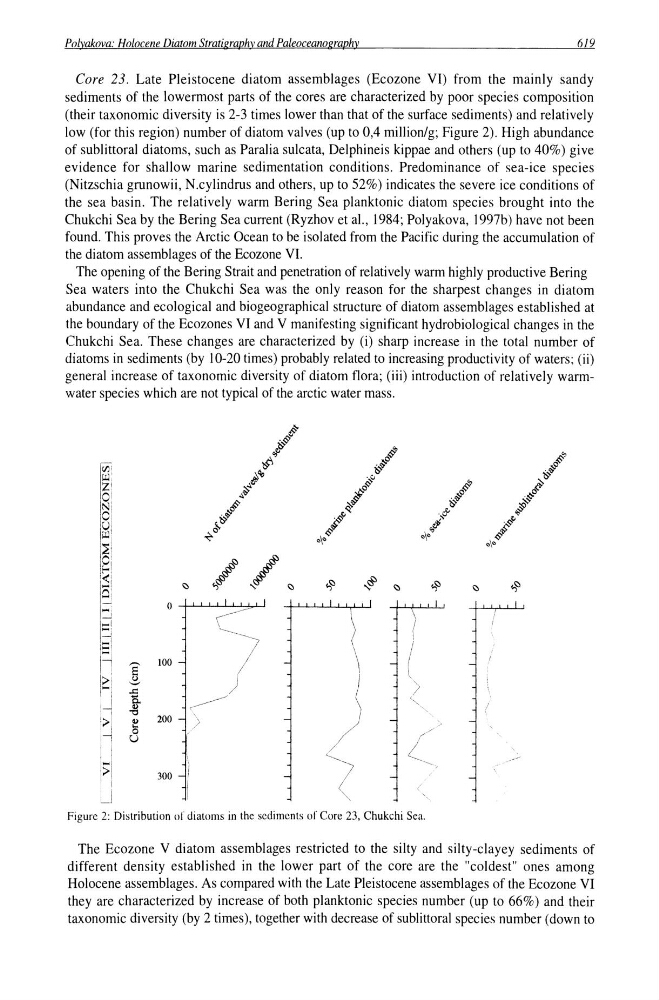
Core 23. Late Pleistocene diatom assemblages (Ecozone VI) from the mainly sandy
sediments of the lowermost parts of the cores are characterized by poor species composition
(their taxonomic diversity is 2-3 times lower than that of the surface sediments) and relatively
low (for this region) number of diatom valves (up to 0,4 million/g; Figure 2). High abundance
of sublittoral diatoms, such as Paralia sulcata, Delphineis kippae and others (up to 40%) give
evidence for shallow marine sedimentation conditions. Predominance of sea-ice species
(Nitzschia grunowii, N.cylindrus and others, up to 52%) indicates the severe ice conditions of
the sea basin. The relatively warm Bering Sea planktonic diatom species brought into the
Chukchi Sea by the Bering Sea current (Ryzhov et aI., 1984; Polyakova, 1997b) have not been
found. This proves the Arctic Ocean to be isolated from the Pacific during the accumulation of
the diatom assemblages of the Ecozone VI.
The opening of the Bering Strait and penetration of relatively warm highly productive Bering
Sea waters into the Chukchi Sea was the only reason for the sharpest changes in diatom
abundance and ecological and biogeographical structure of diatom assemblages established at
the boundary of the Ecozones VI and V manifesting significant hydrobiological changes in the
Chukchi Sea. These changes are characterized by (i) sharp increase in the total number of
diatoms in sediments (by 10-20 times) probably related to increasing productivity of waters; (ii)
general increase of taxonomic diversity of diatom flora; (iii) introduction of relatively warmwater species which are not typical of the arctic water mass.
I~ ~;
Z!
101
I~ y,1
"'I
;;1
o!
foo!
' <:'
1 .... 1
I' "
.... 1
:J
I"
-#
oq
'0"
#
' "
:#
, . 0
ill(;
#
,/
~#
~
,,0
oi!"
.. ">
il
~>!Jo
,.~
~
~
·V~
"3
~,&'Ij
I'
'o"~
.~
~o
.,.<$'
-,J'
.,#~
,/ ~
~
.,<§5
.,~
, ~
'l~
~
.,~
0
1;::1
I" 1
~
>i
'- ..<::
100
j g.
~
."
., .... a
U
200
>1
300
,
Figure 2: Distributiun uf diatums in the sediments of Core 23, Chukchi Sea.
The Ecozone V diatom assemblages restricted to the silty and silty-clayey sediments of
different density established in the lower part of the core are the "coldest" ones among
Holocene assemblages. As compared with the Late Pleistocene assemblages of the Ecozone VI
they are characterized by increase of both planktonic species number (up to 66%) and their
taxonomic diversity (by 2 times), together with decrease of sublittoral species number (down to
619
Core 23. Late Pleistocene diatom assemblages (Ecozone VI) from the mainly sandy
sediments of the lowermost parts of the cores are characterized by poor species composition
(their taxonomic diversity is 2-3 times lower than that of the surface sediments) and relatively
low (for this region) number of diatom valves (up to 0,4 million/g; Figure 2). High abundance
of sublittoral diatoms, such as Paralia sulcata, Delphineis kippae and others (up to 40%) give
evidence for shallow marine sedimentation conditions. Predominance of sea-ice species
(Nitzschia grunowii, N.cylindrus and others, up to 52%) indicates the severe ice conditions of
the sea basin. The relatively warm Bering Sea planktonic diatom species brought into the
Chukchi Sea by the Bering Sea current (Ryzhov et aI., 1984; Polyakova, 1997b) have not been
found. This proves the Arctic Ocean to be isolated from the Pacific during the accumulation of
the diatom assemblages of the Ecozone VI.
The opening of the Bering Strait and penetration of relatively warm highly productive Bering
Sea waters into the Chukchi Sea was the only reason for the sharpest changes in diatom
abundance and ecological and biogeographical structure of diatom assemblages established at
the boundary of the Ecozones VI and V manifesting significant hydrobiological changes in the
Chukchi Sea. These changes are characterized by (i) sharp increase in the total number of
diatoms in sediments (by 10-20 times) probably related to increasing productivity of waters; (ii)
general increase of taxonomic diversity of diatom flora; (iii) introduction of relatively warmwater species which are not typical of the arctic water mass.
I~ ~;
Z!
101
I~ y,1
"'I
;;1
o!
foo!
' <:'
1 .... 1
I' "
.... 1
:J
I"
-#
oq
'0"
#
' "
:#
, . 0
ill(;
#
,/
~#
~
,,0
oi!"
.. ">
il
~>!Jo
,.~
~
~
·V~
"3
~,&'Ij
I'
'o"~
.~
~o
.,.<$'
-,J'
.,#~
,/ ~
~
.,<§5
.,~
,
'l~
~
.,~
0
1;::1
I" 1
~
>i
'- ..<::
100
j g.
~
."
., .... a
U
200
>1
300
,
Figure 2: Distributiun uf diatums in the sediments of Core 23, Chukchi Sea.
The Ecozone V diatom assemblages restricted to the silty and silty-clayey sediments of
different density established in the lower part of the core are the "coldest" ones among
Holocene assemblages. As compared with the Late Pleistocene assemblages of the Ecozone VI
they are characterized by increase of both planktonic species number (up to 66%) and their
taxonomic diversity (by 2 times), together with decrease of sublittoral species number (down to