

Polvakova: Holocene Diatom Stratigraphy and Paleoceanography
617
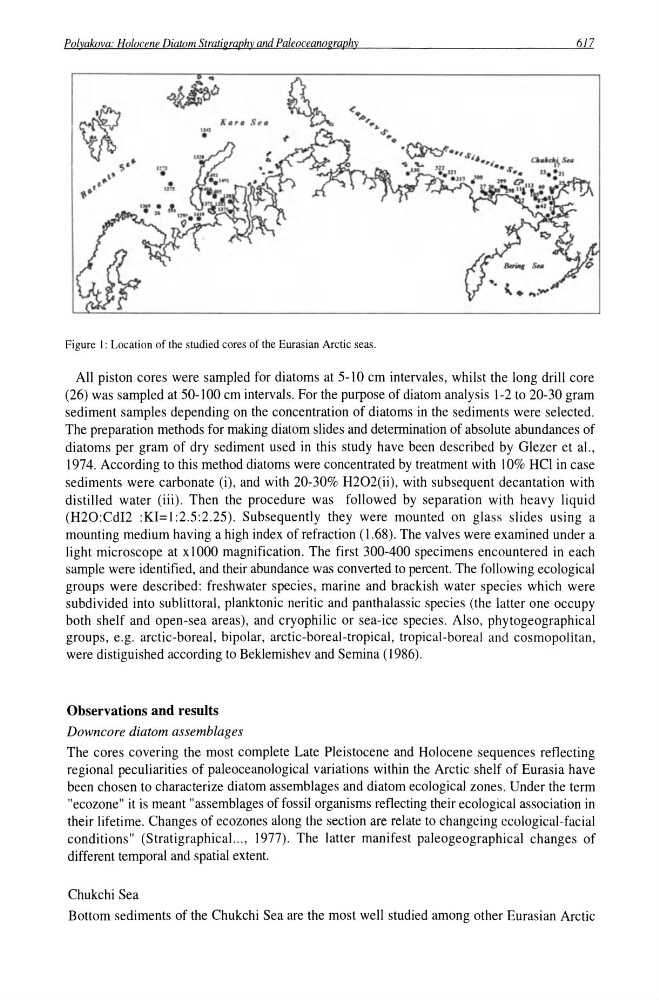
Figure 1: Location of the studied cores of the Eurasian Arctic seas.
All piston cores were sampled for diatoms at 5-10 cm intervales, whilst the long drill core
(26) was sampled at 50-100 cm intervals. For the purpose of diatom analysis 1-2 to 20-30 gram
sediment samples depending on the concentration of diatoms in the sediments were selected.
The preparation methods for making diatom slides and determination of absolute abundances of
diatoms per gram of dry sediment used in this study have been described by Glezer et aI.,
1974. According to this method diatoms were concentrated by treatment with 10% HCl in case
sediments were carbonate (i), and with 20-30% H202(ii), with subsequent decantation with
distilled water (iii). Then the procedure was followed by separation with heavy liquid
(H20:CdI2 :KI= 1:2.5:2.25). Subsequently they were mounted on glass slides using a
mounting medium having a high index of refraction (1.68). The valves were examined under a
light microscope at x 1000 magnification. The first 300-400 specimens encountered in each
sample were identified, and their abundance was converted to percent. The following ecological
groups were described: freshwater species, marine and brackish water species which were
subdivided into sublittoral, planktonic neritic and panthalassic species (the latter one occupy
both shelf and open-sea areas), and cryophilic or sea-ice species. Also, phytogeographical
groups, e.g. arctic-boreal, bipolar, arctic-boreal-tropical, tropical-boreal and cosmopolitan,
were distiguished according to Beklemishev and Semina (1986).
Observations and results
Downcore diatom assemblages
The cores covering the most complete Late Pleistocene and Holocene sequences reflecting
regional peculiarities of paleoceanological variations within the Arctic shelf of Eurasia have
been chosen to characterize diatom assemblages and diatom ecological zones. Under the term
"ecozone" it is meant "assemblages of fossil organisms reflecting their ecological association in
their lifetime. Changes of ecozones along the section are relate to changeing ecological-facial
conditions" (Stratigraphical..., 1977). The latter manifest paleogeographical changes of
different temporal and spatial extent.
Chukchi Sea
Bottom sediments of the Chukchi Sea are the most well studied among other Eurasian Arctic
617
Figure 1: Location of the studied cores of the Eurasian Arctic seas.
All piston cores were sampled for diatoms at 5-10 cm intervales, whilst the long drill core
(26) was sampled at 50-100 cm intervals. For the purpose of diatom analysis 1-2 to 20-30 gram
sediment samples depending on the concentration of diatoms in the sediments were selected.
The preparation methods for making diatom slides and determination of absolute abundances of
diatoms per gram of dry sediment used in this study have been described by Glezer et aI.,
1974. According to this method diatoms were concentrated by treatment with 10% HCl in case
sediments were carbonate (i), and with 20-30% H202(ii), with subsequent decantation with
distilled water (iii). Then the procedure was followed by separation with heavy liquid
(H20:CdI2 :KI= 1:2.5:2.25). Subsequently they were mounted on glass slides using a
mounting medium having a high index of refraction (1.68). The valves were examined under a
light microscope at x 1000 magnification. The first 300-400 specimens encountered in each
sample were identified, and their abundance was converted to percent. The following ecological
groups were described: freshwater species, marine and brackish water species which were
subdivided into sublittoral, planktonic neritic and panthalassic species (the latter one occupy
both shelf and open-sea areas), and cryophilic or sea-ice species. Also, phytogeographical
groups, e.g. arctic-boreal, bipolar, arctic-boreal-tropical, tropical-boreal and cosmopolitan,
were distiguished according to Beklemishev and Semina (1986).
Observations and results
Downcore diatom assemblages
The cores covering the most complete Late Pleistocene and Holocene sequences reflecting
regional peculiarities of paleoceanological variations within the Arctic shelf of Eurasia have
been chosen to characterize diatom assemblages and diatom ecological zones. Under the term
"ecozone" it is meant "assemblages of fossil organisms reflecting their ecological association in
their lifetime. Changes of ecozones along the section are relate to changeing ecological-facial
conditions" (Stratigraphical..., 1977). The latter manifest paleogeographical changes of
different temporal and spatial extent.
Chukchi Sea
Bottom sediments of the Chukchi Sea are the most well studied among other Eurasian Arctic