

Bauch: Planktic Foraminifera in Holocene Sediments from Laptev Sea
609
the central Arctic foraminiferal productivity is not known. There are no reports regarding
planktic foraminiferal species in sediments from the Chukchi and East Siberian seas which
could give information on this issue. But as can be deduced from the modern sub-surface
circulation in the eastern Arctic Ocean (see Figure I), the site of PS2185-3 is is under influence
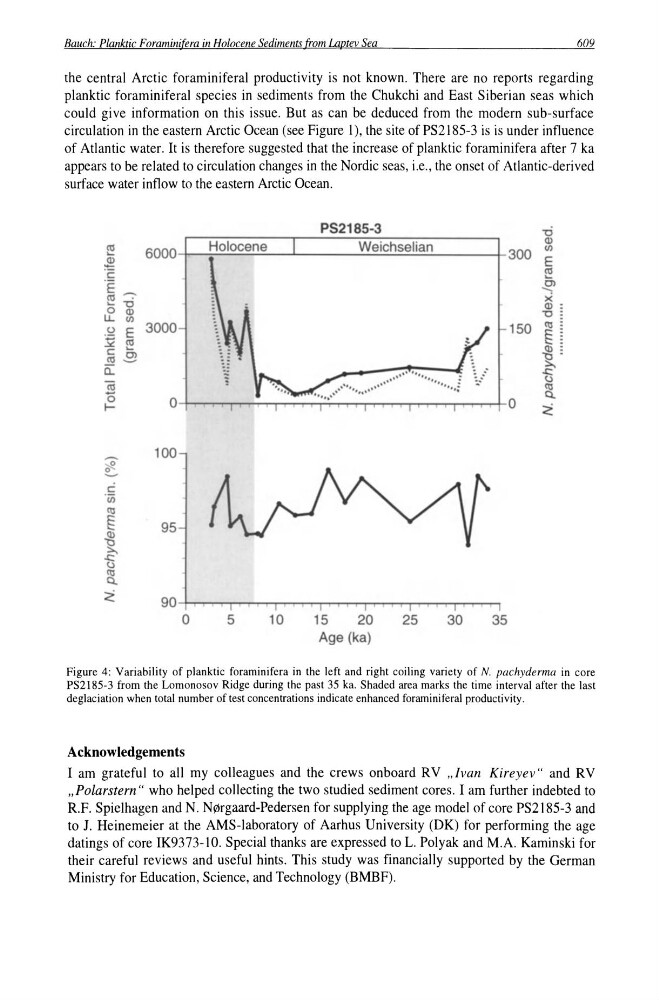
of Atlantic water. It is therefore suggested that the increase of planktic foraminifera after 7 ka
appears to be related to circulation changes in the Nordic seas, i.e., the onset of Atlantic-derived
surface water inflow to the eastern Arctic Ocean.
PS2185-3
-d
Weichselian
Q)
co
6000
300 '"
....
2
E
'2
ro
'E
C,
-.,
ro
x
;:; -c
ell
ell
-c
u.
'"
~ co
~
c: ....
l
ro.9
a:::
"iii
0
~
I0
<:
~
100
~
c:
'Ii)
111
~
95
l
Cl..
<:
90
0
5
10
15
20
25
30
35
Age (ka)
Figure 4: Variability of planktic foraminifera in the left and right coiling variety of N. pachyderma in core
PS2185-3 from the Lomonosov Ridge during the past 35 ka. Shaded area marks the time interval after the last
deglaciation when total number of test concentrations indicate enhanced foraminiferal productivity.
Acknowledgements
I am grateful to all my colleagues and the crews onboard RV "Ivan Kireyev" and RV
"Polarstern" who helped collecting the two studied sediment cores. I am further indebted to
R.F. Spielhagen and N. Ns:;rgaard-Pedersen for supplying the age model of core PS2185-3 and
to 1. Heinemeier at the AMS-Iaboratory of Aarhus University (DK) for performing the age
datings of core IK9373-J O. Special thanks are expressed to L. Polyak and M.A. Kaminski for
their careful reviews and useful hints. This study was financially supported by the German
Ministry for Education, Science, and Technology (BMBF).
609
the central Arctic foraminiferal productivity is not known. There are no reports regarding
planktic foraminiferal species in sediments from the Chukchi and East Siberian seas which
could give information on this issue. But as can be deduced from the modern sub-surface
circulation in the eastern Arctic Ocean (see Figure I), the site of PS2185-3 is is under influence
of Atlantic water. It is therefore suggested that the increase of planktic foraminifera after 7 ka
appears to be related to circulation changes in the Nordic seas, i.e., the onset of Atlantic-derived
surface water inflow to the eastern Arctic Ocean.
PS2185-3
-d
Weichselian
Q)
co
6000
300 '"
....
2
E
'2
ro
'E
C,
-.,
ro
x
;:; -c
ell
ell
-c
u.
'"
~ co
~
c: ....
l
ro.9
a:::
"iii
0
~
I0
<:
~
100
~
c:
'Ii)
111
~
95
l
Cl..
<:
90
0
5
10
15
20
25
30
35
Age (ka)
Figure 4: Variability of planktic foraminifera in the left and right coiling variety of N. pachyderma in core
PS2185-3 from the Lomonosov Ridge during the past 35 ka. Shaded area marks the time interval after the last
deglaciation when total number of test concentrations indicate enhanced foraminiferal productivity.
Acknowledgements
I am grateful to all my colleagues and the crews onboard RV "Ivan Kireyev" and RV
"Polarstern" who helped collecting the two studied sediment cores. I am further indebted to
R.F. Spielhagen and N. Ns:;rgaard-Pedersen for supplying the age model of core PS2185-3 and
to 1. Heinemeier at the AMS-Iaboratory of Aarhus University (DK) for performing the age
datings of core IK9373-J O. Special thanks are expressed to L. Polyak and M.A. Kaminski for
their careful reviews and useful hints. This study was financially supported by the German
Ministry for Education, Science, and Technology (BMBF).