

562
Land-Ocean Systems in the Siberian Arctic: Dynamics and History
environments as their cyst walls and coenobia consist of very stable sporopollenin-Iike organic
material. Thus, they are more resistent to degradation and dissolution than skeletons of siliceous
and calcareous microfossils _ The goal of this study is to document the principal composition
and distribution of aquatic palynomorph assemblages in surface sediments from the Laptev Sea.
Detailed information about the distribution pattern of the individual taxa is given in KunzPirrung (1998).
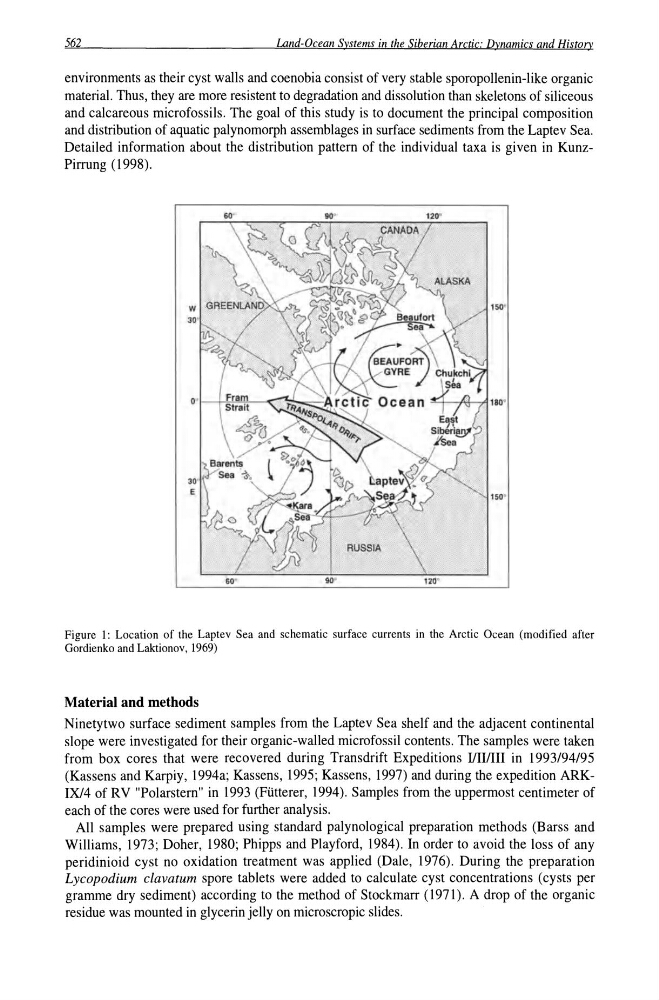
Figure 1: Location of the Laptev Sea and schematic surface currents in the Arctic Ocean (modified after
Gordienko and Laktionov, 1969)
Material and methods
Ninetytwo surface sediment samples from the Laptev Sea shelf and the adjacent continental
slope were investigated for their organic-walled microfossil contents. The samples were taken
from box cores that were recovered during Transdrift Expeditions I/II1III in 1993/94/95
(Kassens and Karpiy, 1994a; Kassens, 1995; Kassens, 1997) and during the expedition ARKIXl4 of RV "Polarstern" in 1993 (Fiitterer, 1994). Samples from the uppermost centimeter of
each of the cores were used for further analysis.
All samples were prepared using standard palynological preparation methods (Barss and
Williams, 1973; Doher, 1980; Phipps and Playford, 1984). In order to avoid the loss of any
peridinioid cyst no oxidation treatment was applied (Dale, 1976). During the preparation
Lycopodium clavatum spore tablets were added to calculate cyst concentrations (cysts per
gramme dry sediment) according to the method of Stockmarr (1971). A drop of the organic
residue was mounted in glycerin jelly on microscropic slides.
Land-Ocean Systems in the Siberian Arctic: Dynamics and History
environments as their cyst walls and coenobia consist of very stable sporopollenin-Iike organic
material. Thus, they are more resistent to degradation and dissolution than skeletons of siliceous
and calcareous microfossils _ The goal of this study is to document the principal composition
and distribution of aquatic palynomorph assemblages in surface sediments from the Laptev Sea.
Detailed information about the distribution pattern of the individual taxa is given in KunzPirrung (1998).
Figure 1: Location of the Laptev Sea and schematic surface currents in the Arctic Ocean (modified after
Gordienko and Laktionov, 1969)
Material and methods
Ninetytwo surface sediment samples from the Laptev Sea shelf and the adjacent continental
slope were investigated for their organic-walled microfossil contents. The samples were taken
from box cores that were recovered during Transdrift Expeditions I/II1III in 1993/94/95
(Kassens and Karpiy, 1994a; Kassens, 1995; Kassens, 1997) and during the expedition ARKIXl4 of RV "Polarstern" in 1993 (Fiitterer, 1994). Samples from the uppermost centimeter of
each of the cores were used for further analysis.
All samples were prepared using standard palynological preparation methods (Barss and
Williams, 1973; Doher, 1980; Phipps and Playford, 1984). In order to avoid the loss of any
peridinioid cyst no oxidation treatment was applied (Dale, 1976). During the preparation
Lycopodium clavatum spore tablets were added to calculate cyst concentrations (cysts per
gramme dry sediment) according to the method of Stockmarr (1971). A drop of the organic
residue was mounted in glycerin jelly on microscropic slides.