

554
Land-Ocean Systems in the Siberian Arctic: Dynamics and History
12H 2 0 (5%). To extract the diatom frustules, the sediment was treated by heavy liquid (2.6
g/cm3) according to the method described by Glejzer et al. (1974). The counting of diatoms per
I gram of dry sediment was done according to a formula proposed by Kvasov and
Iakovshikova (1971):
K= b • n • y / a * m • x
where
b = dilution in ml
n = the number of rows in a slide
y = the number of counted frustules
a = weight of sediment in grams
m = the volume of a drop (0.02-0.03 ml)
x = the number of analyzed rows.
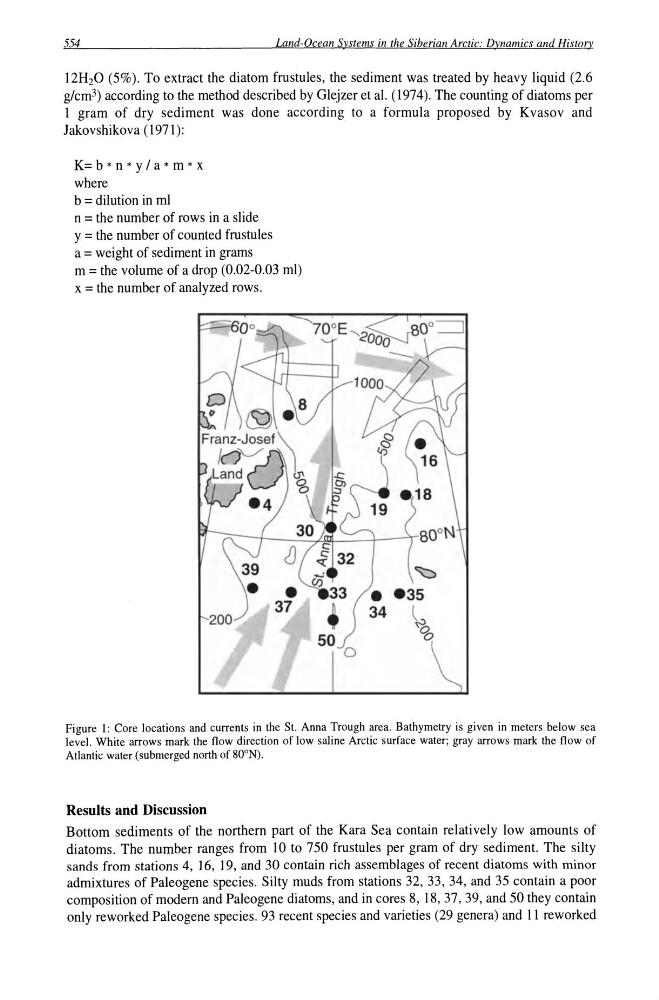
Figure 1: Core locations and currents in the St. Anna Trough area. Bathymetry is given in meters below sea
level. White arrows mark the flow direction of low saline Arctic surface water; gray arrows mark the flow of
Atlantic water (submerged north of 80 0 N).
Results and Discussion
Bottom sediments of the northern part of the Kara Sea contain relatively low amounts of
diatoms. The number ranges from 10 to 750 frustules per gram of dry sediment. The silty
sands from stations 4, 16, 19, and 30 contain rich assemblages of recent diatoms with minor
admixtures of Paleogene species. Silty muds from stations 32, 33, 34, and 35 contain a poor
composition of modern and Paleogene diatoms, and in cores 8, 18,37,39, and 50 they contain
only reworked Paleogene species. 93 recent species and varieties (29 genera) and 11 reworked
Land-Ocean Systems in the Siberian Arctic: Dynamics and History
12H 2 0 (5%). To extract the diatom frustules, the sediment was treated by heavy liquid (2.6
g/cm3) according to the method described by Glejzer et al. (1974). The counting of diatoms per
I gram of dry sediment was done according to a formula proposed by Kvasov and
Iakovshikova (1971):
K= b • n • y / a * m • x
where
b = dilution in ml
n = the number of rows in a slide
y = the number of counted frustules
a = weight of sediment in grams
m = the volume of a drop (0.02-0.03 ml)
x = the number of analyzed rows.
Figure 1: Core locations and currents in the St. Anna Trough area. Bathymetry is given in meters below sea
level. White arrows mark the flow direction of low saline Arctic surface water; gray arrows mark the flow of
Atlantic water (submerged north of 80 0 N).
Results and Discussion
Bottom sediments of the northern part of the Kara Sea contain relatively low amounts of
diatoms. The number ranges from 10 to 750 frustules per gram of dry sediment. The silty
sands from stations 4, 16, 19, and 30 contain rich assemblages of recent diatoms with minor
admixtures of Paleogene species. Silty muds from stations 32, 33, 34, and 35 contain a poor
composition of modern and Paleogene diatoms, and in cores 8, 18,37,39, and 50 they contain
only reworked Paleogene species. 93 recent species and varieties (29 genera) and 11 reworked