

Cremer: Spatial Distribution of Diatom Sud ace Sediment Assemblages
105 E
110
115°
120
125
78 N
I
)
"
.. 0""
77
76
75
74'
73
.'. Polynya
.......
72
Sampling
• station
71 N
Factor 4
lOS" E
110"
115"
120"
125"
130
135"
140
)
130"
140"
547
14S· E
-
78 ' N
I
177•
I
1 74 •
I
72"
14S" E
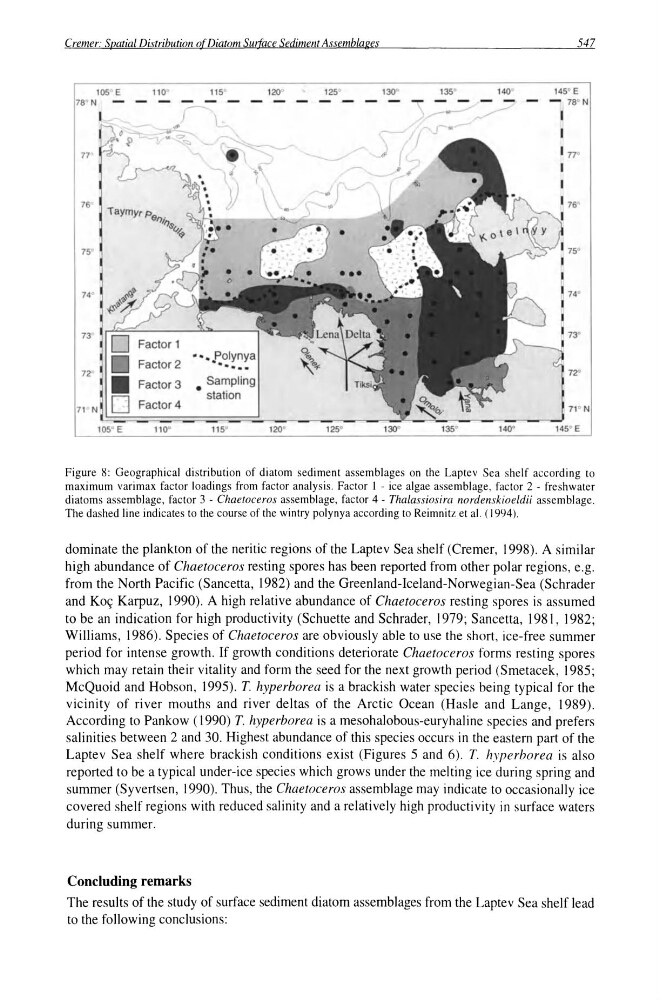
Figure 8: Geographical distribution of diatom sediment assemblages on the Laptev Sea shelf according to
maximum varimax factor loadings from factor analysis. Factor I - ice algae assemblage, factor 2 - freshwater
diatoms assemblage, factor 3 - Chaetoceros assemblage, factor 4 - Thalassiosira nordenskioeldii assemblage.
The dashed line indicates to the course of the wintry polynya according to Reimnitz ct al. (1994).
dominate the plankton of the neritic regions of the Laptev Sea shelf (Cremer, 1998). A similar
high abundance of Chaetoceros resting spores has been reported from other polar regions, e.g.
from the North Pacific (Sancetta, 1982) and the Greenland-Iceland-Norwegian-Sea (Schrader
and Ko~ Karpuz, 1990). A high relative abundance of Chaetoceros resting spores is assumed
to be an indication for high productivity (Schuette and Schrader, 1979; Sancetta, 1981, 1982;
Williams, 1986), Species of Chaetoceros are obviously able to use the short, ice-free summer
period for intense growth. If growth conditions deteriorate Chaetoceros forms resting spores
which may retain their vitality and form the seed for the next growth period (Smetacek, 1985;
McQuoid and Hobson, 1995). T. hyperborea is a brackish water species being typical for the
vicinity of river mouths and river deltas of the Arctic Ocean (Hasle and Lange, 1989).
According to Pankow (1990) T. hyperborea is a mesohalobous-euryhaline species and prefers
salinities between 2 and 30. Highest abundance of this species occurs in the eastern part of the
Laptev Sea shelf where brackish conditions exist (Figures 5 and 6). T. hvperborea is also
reported to be a typical under-ice species which grows under the melting ice during spring and
summer (Syvertsen, 1990). Thus, the Chaetoceros assemblage may indicate to occasionally ice
covered shelf regions with reduced salinity and a relatively high productivity in surface waters
during summer.
Concluding remarks
The results of the study of surface sediment diatom assemblages from the Laptev Sea shelf lead
to the following conclusions:
105 E
110
115°
120
125
78 N
I
)
"
.. 0""
77
76
75
74'
73
.'. Polynya
.......
72
Sampling
• station
71 N
Factor 4
lOS" E
110"
115"
120"
125"
130
135"
140
)
130"
140"
547
14S· E
-
78 ' N
I
177•
I
1 74 •
I
72"
14S" E
Figure 8: Geographical distribution of diatom sediment assemblages on the Laptev Sea shelf according to
maximum varimax factor loadings from factor analysis. Factor I - ice algae assemblage, factor 2 - freshwater
diatoms assemblage, factor 3 - Chaetoceros assemblage, factor 4 - Thalassiosira nordenskioeldii assemblage.
The dashed line indicates to the course of the wintry polynya according to Reimnitz ct al. (1994).
dominate the plankton of the neritic regions of the Laptev Sea shelf (Cremer, 1998). A similar
high abundance of Chaetoceros resting spores has been reported from other polar regions, e.g.
from the North Pacific (Sancetta, 1982) and the Greenland-Iceland-Norwegian-Sea (Schrader
and Ko~ Karpuz, 1990). A high relative abundance of Chaetoceros resting spores is assumed
to be an indication for high productivity (Schuette and Schrader, 1979; Sancetta, 1981, 1982;
Williams, 1986), Species of Chaetoceros are obviously able to use the short, ice-free summer
period for intense growth. If growth conditions deteriorate Chaetoceros forms resting spores
which may retain their vitality and form the seed for the next growth period (Smetacek, 1985;
McQuoid and Hobson, 1995). T. hyperborea is a brackish water species being typical for the
vicinity of river mouths and river deltas of the Arctic Ocean (Hasle and Lange, 1989).
According to Pankow (1990) T. hyperborea is a mesohalobous-euryhaline species and prefers
salinities between 2 and 30. Highest abundance of this species occurs in the eastern part of the
Laptev Sea shelf where brackish conditions exist (Figures 5 and 6). T. hvperborea is also
reported to be a typical under-ice species which grows under the melting ice during spring and
summer (Syvertsen, 1990). Thus, the Chaetoceros assemblage may indicate to occasionally ice
covered shelf regions with reduced salinity and a relatively high productivity in surface waters
during summer.
Concluding remarks
The results of the study of surface sediment diatom assemblages from the Laptev Sea shelf lead
to the following conclusions: