

Strobl et al.: Determination ot'Depositional Bervl/ium-JO Fluxes in the Area olthe Laptev Sea
521
of the radionuclides and lead to apparent larger accumulation rates (Berner, 1980; Benninger et
a!., 1980; Mangini et aI., 1986). The apparent contribution due to mixing can be evaluated as an
additional accumulation rate (Sdiff) (Mangini et a!., 1988) given as:
Sdiff = D • Ie / S
(6)
where S is the accumulation rate derived from the depth profile of the radioisotope and D is
the effective diffusion coefficient.
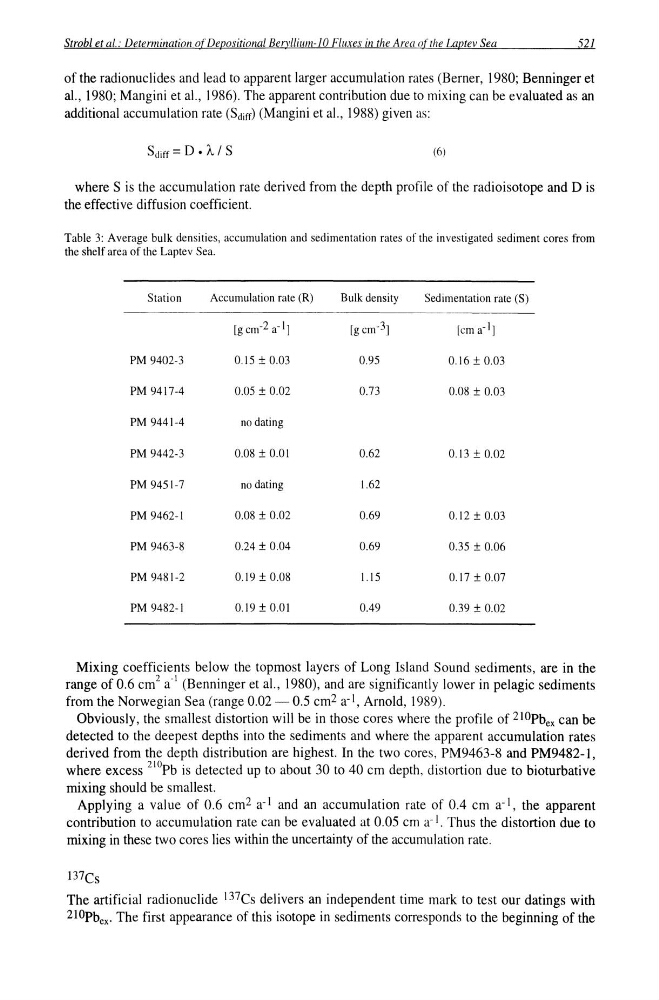
Table 3: Average bulk densities, accumulation and sedimentation rates of the investigated sediment cores from
the shelf area of the Laptev Sea.
Station
Accumulation rate (R)
Bulk density
Sedimentation rate (S)
Ig cm-2 a-I]
[g cm- 3]
[em a-I]
PM 9402-3
0.15 ± 0.03
0.95
0.16 ± 0.03
PM 9417-4
0.05 ± 0.02
0.73
0.08 ± 0.03
PM 9441-4
no dating
PM 9442-3
0.08 ± 0.01
0.62
0.13 ± 0.02
PM 9451-7
no dating
1.62
PM 9462-1
0.08 ± 0.02
0.69
0.12 ± 0.03
PM 9463-8
0.24 ± 0.04
0.69
0.35 ± 0.06
PM 9481-2
0.19 ± 0.08
1.15
0.17 ± 0.07
PM 9482-1
0.19±0.01
0.49
0.39 ± 0.02
Mixing coefficients below the topmost layers of Long Island Sound sediments, are in the
range of 0.6 cm 2 a-I (Benninger et a!., 1980), and are significantly lower in pelagic sediments
from the Norwegian Sea (range 0.02 - 0.5 cm 2 a-I, Arnold, 1989).
Obviously, the smallest distortion will be in those cores where the profile of 210Pb ex can be
detected to the deepest depths into the sediments and where the apparent accumulation rates
derived from the depth distribution are highest. In the two cores, PM9463-8 and PM9482-1,
where excess 210Pb is detected up to about 30 to 40 cm depth. distortion due to bioturbative
mixing should be smallest.
Applying a value of 0.6 cm 2 a-I and an accumulation rate of 0.4 cm a-I, the apparent
contribution to accumulation rate can be evaluated at 0.05 cm a-I. Thus the distortion due to
mixing in these two cores lies within the uncertainty of the accumulation rate.
137CS
The artificial radionuc!ide 137Cs delivers an independent time mark to test our datings with
2lOPb ex . The first appearance of this isotope in sediments corresponds to the beginning of the
521
of the radionuclides and lead to apparent larger accumulation rates (Berner, 1980; Benninger et
a!., 1980; Mangini et aI., 1986). The apparent contribution due to mixing can be evaluated as an
additional accumulation rate (Sdiff) (Mangini et a!., 1988) given as:
Sdiff = D • Ie / S
(6)
where S is the accumulation rate derived from the depth profile of the radioisotope and D is
the effective diffusion coefficient.
Table 3: Average bulk densities, accumulation and sedimentation rates of the investigated sediment cores from
the shelf area of the Laptev Sea.
Station
Accumulation rate (R)
Bulk density
Sedimentation rate (S)
Ig cm-2 a-I]
[g cm- 3]
[em a-I]
PM 9402-3
0.15 ± 0.03
0.95
0.16 ± 0.03
PM 9417-4
0.05 ± 0.02
0.73
0.08 ± 0.03
PM 9441-4
no dating
PM 9442-3
0.08 ± 0.01
0.62
0.13 ± 0.02
PM 9451-7
no dating
1.62
PM 9462-1
0.08 ± 0.02
0.69
0.12 ± 0.03
PM 9463-8
0.24 ± 0.04
0.69
0.35 ± 0.06
PM 9481-2
0.19 ± 0.08
1.15
0.17 ± 0.07
PM 9482-1
0.19±0.01
0.49
0.39 ± 0.02
Mixing coefficients below the topmost layers of Long Island Sound sediments, are in the
range of 0.6 cm 2 a-I (Benninger et a!., 1980), and are significantly lower in pelagic sediments
from the Norwegian Sea (range 0.02 - 0.5 cm 2 a-I, Arnold, 1989).
Obviously, the smallest distortion will be in those cores where the profile of 210Pb ex can be
detected to the deepest depths into the sediments and where the apparent accumulation rates
derived from the depth distribution are highest. In the two cores, PM9463-8 and PM9482-1,
where excess 210Pb is detected up to about 30 to 40 cm depth. distortion due to bioturbative
mixing should be smallest.
Applying a value of 0.6 cm 2 a-I and an accumulation rate of 0.4 cm a-I, the apparent
contribution to accumulation rate can be evaluated at 0.05 cm a-I. Thus the distortion due to
mixing in these two cores lies within the uncertainty of the accumulation rate.
137CS
The artificial radionuc!ide 137Cs delivers an independent time mark to test our datings with
2lOPb ex . The first appearance of this isotope in sediments corresponds to the beginning of the