

512
Land-Ocean Systems in the Siberian Arctic: Dynamics and History
and forming a bottom water layer sufficiently persistent to contribute to the benthic isotope
signature.
On transect L, station 6 in the upper outer Eastern Lena Valley is clearly affected by the
pelagic influence in contrast to station 4 which is situated only 1 ° south beyond an extended
submarine topographic high and from the bathymetrical point of view belongs to the channel
system of the inner southeastern Laptev Sea. Also noteworthy, OISO is relatively uniform in the
19 to 25 m water depth range along the eastern transect Y from station 3 through station 10, a
long distance ranging from 72,5 ON in the Yana Bight to 76,soE north of Kotelnyy. This finding
possibly relates to the oceanographic conditions in the eastern Laptev Sea, i.e. the effect of
bottom topography and bathymetric boundary conditions of the eastern margin on the outflow
and the density structure of the eastern Laptev Sea waters.
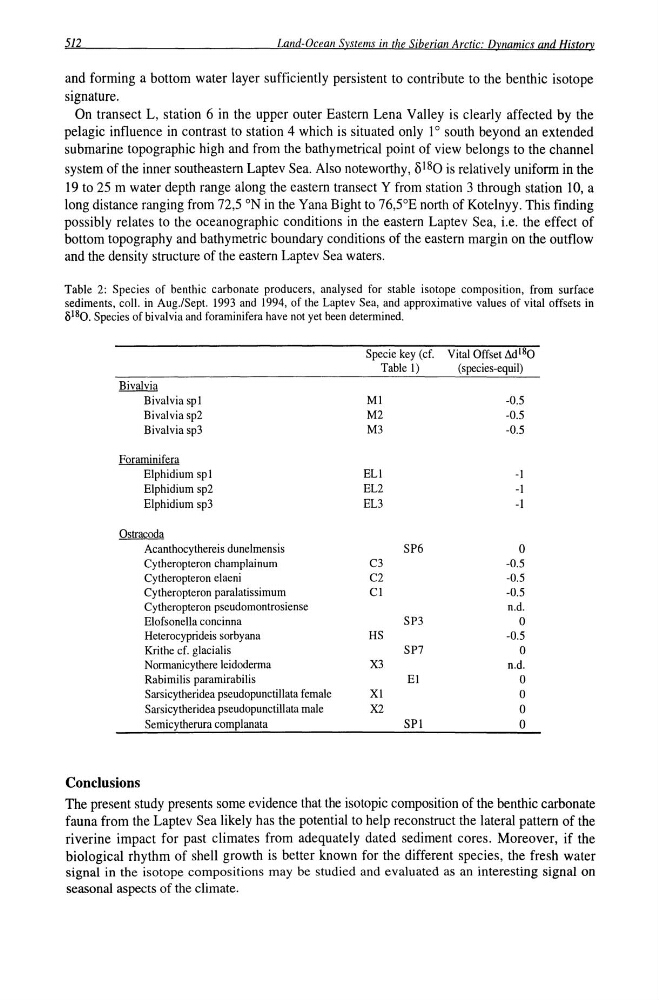
Table 2: Species of benthic carbonate producers, analysed for stable isotope composition, from surface
sediments, colI. in Aug./Sept. 1993 and 1994, of the Laptev Sea, and approximative values of vital offsets in
1) 18 0. Species of bivalvia and foraminifera have not yet been determined.
Specie key (cf. Vital Offset M I8 0
Table I)
(species-equil)
Bivalvia
Bivalvia sp I
MI
-0.5
Bivalvia sp2
M2
-0.5
Bivalvia sp3
M3
-0.5
Foraminifera
Elphidium spl
ELl
-I
Elphidium sp2
EL2
-I
Elphidium sp3
EL3
-I
Ostracoda
Acanthocythereis dunelmensis
SP6
0
Cytheropteron champlainum
C3
-0.5
Cytheropteron elaeni
C2
-0.5
Cytheropteron paralatissimum
CI
-0.5
Cytheropteron pseudomontrosiense
n.d.
Elofsonella concinna
SP3
0
Heterocyprideis sorbyana
HS
-0.5
Krithe cf. glacialis
SP7
0
Normanicythere leidoderma
X3
n.d.
Rabimilis paramirabilis
EI
0
Sarsicytheridea pseudopunctillata female
XI
0
Sarsicytheridea pseudopunctillata male
X2
0
Semicytherura complanata
SPI
0
Conclusions
The present study presents some evidence that the isotopic composition of the benthic carbonate
fauna from the Laptev Sea likely has the potential to help reconstruct the lateral pattern of the
riverine impact for past climates from adequately dated sediment cores. Moreover, if the
biological rhythm of shell growth is better known for the different species, the fresh water
signal in the isotope compositions may be studied and evaluated as an interesting signal on
seasonal aspects of the climate.
Land-Ocean Systems in the Siberian Arctic: Dynamics and History
and forming a bottom water layer sufficiently persistent to contribute to the benthic isotope
signature.
On transect L, station 6 in the upper outer Eastern Lena Valley is clearly affected by the
pelagic influence in contrast to station 4 which is situated only 1 ° south beyond an extended
submarine topographic high and from the bathymetrical point of view belongs to the channel
system of the inner southeastern Laptev Sea. Also noteworthy, OISO is relatively uniform in the
19 to 25 m water depth range along the eastern transect Y from station 3 through station 10, a
long distance ranging from 72,5 ON in the Yana Bight to 76,soE north of Kotelnyy. This finding
possibly relates to the oceanographic conditions in the eastern Laptev Sea, i.e. the effect of
bottom topography and bathymetric boundary conditions of the eastern margin on the outflow
and the density structure of the eastern Laptev Sea waters.
Table 2: Species of benthic carbonate producers, analysed for stable isotope composition, from surface
sediments, colI. in Aug./Sept. 1993 and 1994, of the Laptev Sea, and approximative values of vital offsets in
1) 18 0. Species of bivalvia and foraminifera have not yet been determined.
Specie key (cf. Vital Offset M I8 0
Table I)
(species-equil)
Bivalvia
Bivalvia sp I
MI
-0.5
Bivalvia sp2
M2
-0.5
Bivalvia sp3
M3
-0.5
Foraminifera
Elphidium spl
ELl
-I
Elphidium sp2
EL2
-I
Elphidium sp3
EL3
-I
Ostracoda
Acanthocythereis dunelmensis
SP6
0
Cytheropteron champlainum
C3
-0.5
Cytheropteron elaeni
C2
-0.5
Cytheropteron paralatissimum
CI
-0.5
Cytheropteron pseudomontrosiense
n.d.
Elofsonella concinna
SP3
0
Heterocyprideis sorbyana
HS
-0.5
Krithe cf. glacialis
SP7
0
Normanicythere leidoderma
X3
n.d.
Rabimilis paramirabilis
EI
0
Sarsicytheridea pseudopunctillata female
XI
0
Sarsicytheridea pseudopunctillata male
X2
0
Semicytherura complanata
SPI
0
Conclusions
The present study presents some evidence that the isotopic composition of the benthic carbonate
fauna from the Laptev Sea likely has the potential to help reconstruct the lateral pattern of the
riverine impact for past climates from adequately dated sediment cores. Moreover, if the
biological rhythm of shell growth is better known for the different species, the fresh water
signal in the isotope compositions may be studied and evaluated as an interesting signal on
seasonal aspects of the climate.