

508
Land-Ocean Systems in the Siberian Arctic: Dynamics and History
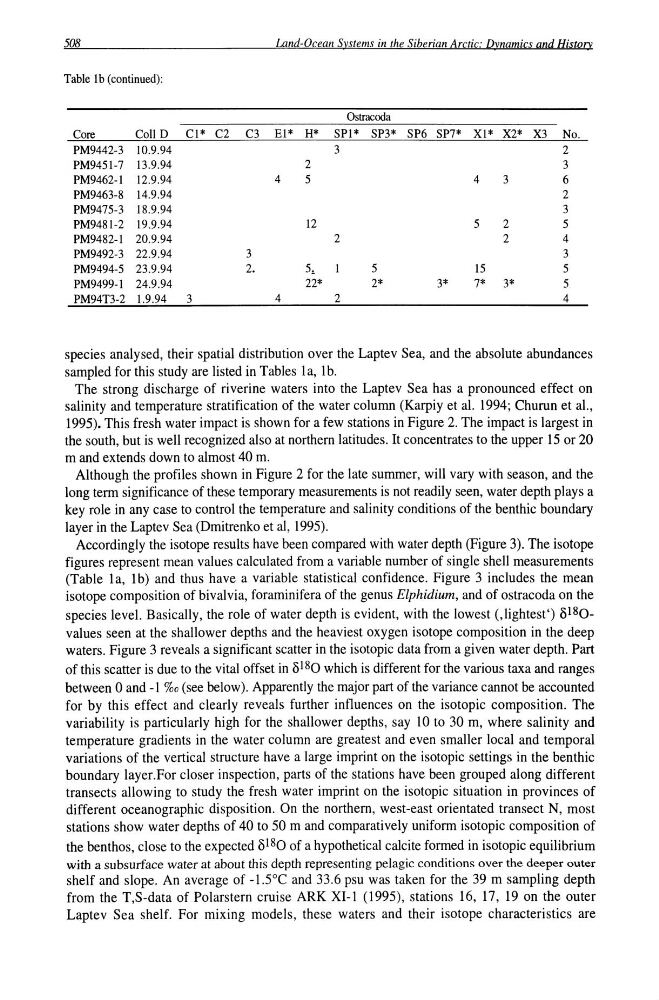
Table Ib (continued):
Ostracoda
Core
Coli D
Cl* C2 C3 El* H* SPl* SP3* SP6 SP7* Xl* X2* X3 No.
PM9442-3 10.9.94
3
2
PM9451-7 13.9.94
2
3
PM9462-1 12.9.94
4
5
4
3
6
PM9463-8 14.9.94
2
PM9475-3 18.9.94
3
PM9481-2 19.9.94
12
5
2
5
PM9482-1 20.9.94
2
2
4
PM9492-3 22.9.94
3
3
PM9494-5 23.9.94
2.
5~
5
15
5
PM9499-1 24.9.94
22*
2*
3*
7*
3*
5
PM94T3-2 1.9.94
3
4
2
4
species analysed, their spatial distribution over the Laptev Sea, and the absolute abundances
sampled for this study are listed in Tables I a, lb.
The strong discharge of riverine waters into the Laptev Sea has a pronounced effect on
salinity and temperature stratification of the water column (Karpiy et al. 1994; Churun et aI.,
1995). This fresh water impact is shown for a few stations in Figure 2. The impact is largest in
the south, but is well recognized also at northern latitudes. It concentrates to the upper 15 or 20
m and extends down to almost 40 m.
Although the profiles shown in Figure 2 for the late summer, will vary with season, and the
long term significance of these temporary measurements is not readily seen, water depth plays a
key role in any case to control the temperature and salinity conditions of the benthic boundary
layer in the Laptev Sea (Dmitrenko et aI, 1995).
Accordingly the isotope results have been compared with water depth (Figure 3). The isotope
figures represent mean values calculated from a variable number of single shell measurements
(Table 1 a, I b) and thus have a variable statistical confidence. Figure 3 includes the mean
isotope composition of bivalvia, foraminifera of the genus Elphidium, and of ostracoda on the
species level. Basically, the role of water depth is evident, with the lowest (,lightest') 0 18 0values seen at the shallower depths and the heaviest oxygen isotope composition in the deep
waters. Figure 3 reveals a significant scatter in the isotopic data from a given water depth. Part
of this scatter is due to the vital offset in 0 18 0 which is different for the various taxa and ranges
between 0 and -I %0 (see below). Apparently the major part of the variance cannot be accounted
for by this effect and clearly reveals further influences on the isotopic composition. The
variability is particularly high for the shallower depths, say 10 to 30 m, where salinity and
temperature gradients in the water column are greatest and even smaller local and temporal
variations of the vertical structure have a large imprint on the isotopic settings in the benthic
boundary layer.For closer inspection, parts of the stations have been grouped along different
transects allowing to study the fresh water imprint on the isotopic situation in provinces of
different oceanographic disposition. On the northern, west-east orientated transect N, most
stations show water depths of 40 to 50 m and comparatively uniform isotopic composition of
the benthos, close to the expected 0 18 0 of a hypothetical calcite formed in isotopic equilibrium
with a subsurface water at about this depth representing pelagic conditions over the deeper outer
shelf and slope. An average of -1.5°C and 33.6 psu was taken for the 39 m sampling depth
from the T,S-data of Polarstern cruise ARK XI-l (1995), stations 16, 17, 19 on the outer
Laptev Sea shelf. For mixing models, these waters and their isotope characteristics are
Land-Ocean Systems in the Siberian Arctic: Dynamics and History
Table Ib (continued):
Ostracoda
Core
Coli D
Cl* C2 C3 El* H* SPl* SP3* SP6 SP7* Xl* X2* X3 No.
PM9442-3 10.9.94
3
2
PM9451-7 13.9.94
2
3
PM9462-1 12.9.94
4
5
4
3
6
PM9463-8 14.9.94
2
PM9475-3 18.9.94
3
PM9481-2 19.9.94
12
5
2
5
PM9482-1 20.9.94
2
2
4
PM9492-3 22.9.94
3
3
PM9494-5 23.9.94
2.
5~
5
15
5
PM9499-1 24.9.94
22*
2*
3*
7*
3*
5
PM94T3-2 1.9.94
3
4
2
4
species analysed, their spatial distribution over the Laptev Sea, and the absolute abundances
sampled for this study are listed in Tables I a, lb.
The strong discharge of riverine waters into the Laptev Sea has a pronounced effect on
salinity and temperature stratification of the water column (Karpiy et al. 1994; Churun et aI.,
1995). This fresh water impact is shown for a few stations in Figure 2. The impact is largest in
the south, but is well recognized also at northern latitudes. It concentrates to the upper 15 or 20
m and extends down to almost 40 m.
Although the profiles shown in Figure 2 for the late summer, will vary with season, and the
long term significance of these temporary measurements is not readily seen, water depth plays a
key role in any case to control the temperature and salinity conditions of the benthic boundary
layer in the Laptev Sea (Dmitrenko et aI, 1995).
Accordingly the isotope results have been compared with water depth (Figure 3). The isotope
figures represent mean values calculated from a variable number of single shell measurements
(Table 1 a, I b) and thus have a variable statistical confidence. Figure 3 includes the mean
isotope composition of bivalvia, foraminifera of the genus Elphidium, and of ostracoda on the
species level. Basically, the role of water depth is evident, with the lowest (,lightest') 0 18 0values seen at the shallower depths and the heaviest oxygen isotope composition in the deep
waters. Figure 3 reveals a significant scatter in the isotopic data from a given water depth. Part
of this scatter is due to the vital offset in 0 18 0 which is different for the various taxa and ranges
between 0 and -I %0 (see below). Apparently the major part of the variance cannot be accounted
for by this effect and clearly reveals further influences on the isotopic composition. The
variability is particularly high for the shallower depths, say 10 to 30 m, where salinity and
temperature gradients in the water column are greatest and even smaller local and temporal
variations of the vertical structure have a large imprint on the isotopic settings in the benthic
boundary layer.For closer inspection, parts of the stations have been grouped along different
transects allowing to study the fresh water imprint on the isotopic situation in provinces of
different oceanographic disposition. On the northern, west-east orientated transect N, most
stations show water depths of 40 to 50 m and comparatively uniform isotopic composition of
the benthos, close to the expected 0 18 0 of a hypothetical calcite formed in isotopic equilibrium
with a subsurface water at about this depth representing pelagic conditions over the deeper outer
shelf and slope. An average of -1.5°C and 33.6 psu was taken for the 39 m sampling depth
from the T,S-data of Polarstern cruise ARK XI-l (1995), stations 16, 17, 19 on the outer
Laptev Sea shelf. For mixing models, these waters and their isotope characteristics are