

504
Land-Ocean Systems in the Siberian Arctic: Dynamics and History
Broadly speaking, the lateral distribution of salinity in the Laptev Sea results from the
competition of high marine waters advected from the Arctic Ocean and fresh waters discharged
by the rivers from the south. The spatial distribution pattern of salinity hence traces the balance
of these hydrological momenta and may provide an interesting aspect from the paleoclimatic/
paleohydrographic point of view which also relates to the hydrological development in the
catchment areas in inner Asia under the regime of central continental climate. The salinity signal
of the bottom waters is preserved in the sediments through the stable oxygen isotope
composition of carbonate in the shells of the benthic fauna.
Of particular interest are the ostracoda which inhabitate a broad variety of aquatic
environments, such as - among others - fresh water to shelf and deep sea marine habitats
(DeDeckker, Colin, and Peypouquet (Eds), 1988). These benthic crustaceans may provide
through their carapaces which are composed of crystalline calcite embedded in layers of
cuticular chitin (Benson, 1988), isotopic information on the physicochemical settings of the
benthic boundary layer, such as soft sediments, turbid bottom waters, low salinity conditions,
which are not usually tolerated by foraminifera and bivalvia.
This work studies the significance of the stable oxygen isotopes in the biogenic benthic
carbonates and the lateral distribution of the isotope signal under modern conditions. A brief
overview was presented in Erlenkeuser et al. (1997).
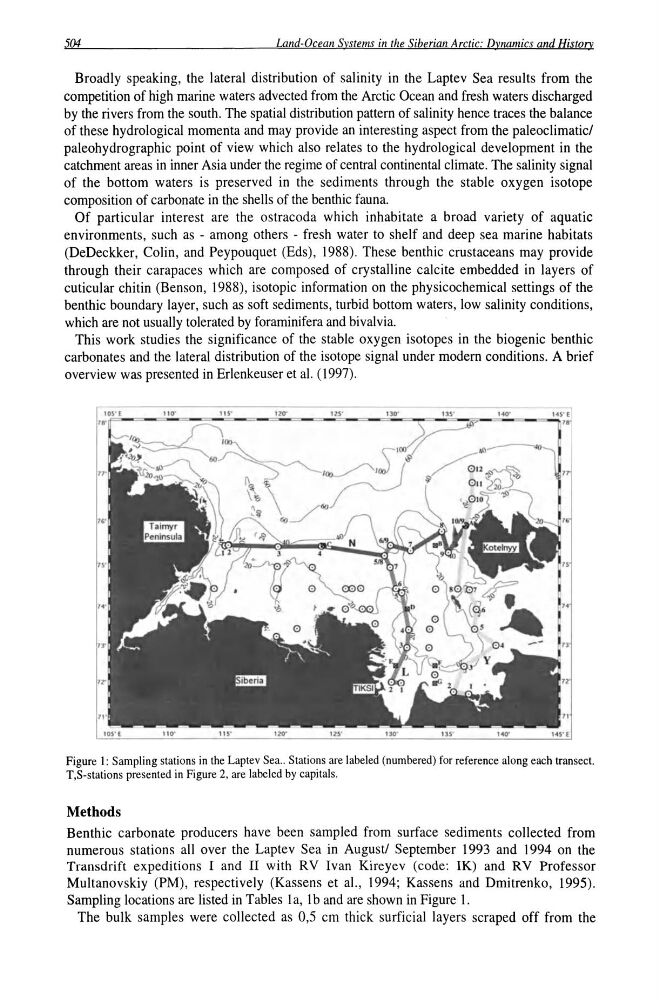
Figure 1: Sampling stations in the Laptev Sea .. Stations are labeled (numbered) for reference along each transect.
T,S-stations presented in Figure 2, are labeled by capitals.
Methods
Benthic carbonate producers have been sampled from surface sediments collected from
numerous stations all over the Laptev Sea in August! September 1993 and 1994 on the
Transdrift expeditions I and II with RV Ivan Kireyev (code: IK) and RV Professor
Multanovskiy (PM), respectively (Kassens et aI., 1994; Kassens and Dmitrenko, 1995).
Sampling locations are listed in Tables 1 a, 1 b and are shown in Figure 1.
The bulk samples were collected as 0,5 cm thick surficial layers scraped off from the
Land-Ocean Systems in the Siberian Arctic: Dynamics and History
Broadly speaking, the lateral distribution of salinity in the Laptev Sea results from the
competition of high marine waters advected from the Arctic Ocean and fresh waters discharged
by the rivers from the south. The spatial distribution pattern of salinity hence traces the balance
of these hydrological momenta and may provide an interesting aspect from the paleoclimatic/
paleohydrographic point of view which also relates to the hydrological development in the
catchment areas in inner Asia under the regime of central continental climate. The salinity signal
of the bottom waters is preserved in the sediments through the stable oxygen isotope
composition of carbonate in the shells of the benthic fauna.
Of particular interest are the ostracoda which inhabitate a broad variety of aquatic
environments, such as - among others - fresh water to shelf and deep sea marine habitats
(DeDeckker, Colin, and Peypouquet (Eds), 1988). These benthic crustaceans may provide
through their carapaces which are composed of crystalline calcite embedded in layers of
cuticular chitin (Benson, 1988), isotopic information on the physicochemical settings of the
benthic boundary layer, such as soft sediments, turbid bottom waters, low salinity conditions,
which are not usually tolerated by foraminifera and bivalvia.
This work studies the significance of the stable oxygen isotopes in the biogenic benthic
carbonates and the lateral distribution of the isotope signal under modern conditions. A brief
overview was presented in Erlenkeuser et al. (1997).
Figure 1: Sampling stations in the Laptev Sea .. Stations are labeled (numbered) for reference along each transect.
T,S-stations presented in Figure 2, are labeled by capitals.
Methods
Benthic carbonate producers have been sampled from surface sediments collected from
numerous stations all over the Laptev Sea in August! September 1993 and 1994 on the
Transdrift expeditions I and II with RV Ivan Kireyev (code: IK) and RV Professor
Multanovskiy (PM), respectively (Kassens et aI., 1994; Kassens and Dmitrenko, 1995).
Sampling locations are listed in Tables 1 a, 1 b and are shown in Figure 1.
The bulk samples were collected as 0,5 cm thick surficial layers scraped off from the