

Sie~ert et al.: Paleoclimatic Indicators from Permafrost SelJ.uences
491
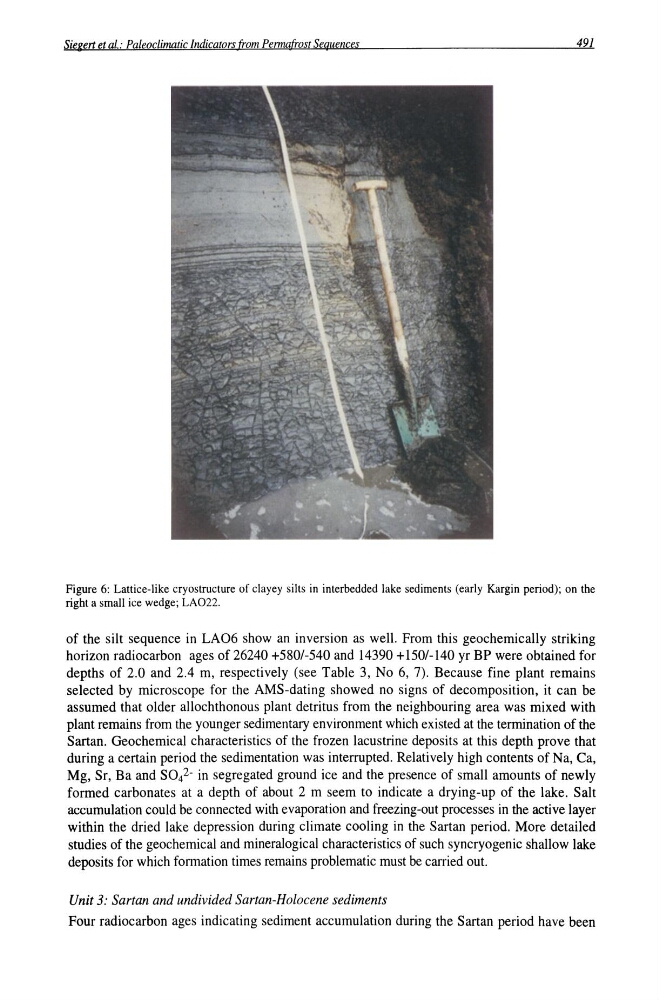
Figure 6: Lattice-like cryostructure of clayey silts in interbedded lake sediments (early Kargin period); on the
right a small ice wedge; LA022.
of the silt sequence in LA06 show an inversion as well. From this geochemically striking
horizon radiocarbon ages of 26240 +580/-540 and 14390 + 150/-140 yr BP were obtained for
depths of 2.0 and 2.4 m, respectively (see Table 3, No 6, 7). Because fine plant remains
selected by microscope for the AMS-dating showed no signs of decomposition, it can be
assumed that older allochthonous plant detritus from the neighbouring area was mixed with
plant remains from the younger sedimentary environment which existed at the termination of the
Sartan. Geochemical characteristics of the frozen lacustrine deposits at this depth prove that
during a certain period the sedimentation was interrupted. Relatively high contents of Na, Ca,
Mg, Sr, Ba and S042- in segregated ground ice and the presence of small amounts of newly
formed carbonates at a depth of about 2 m seem to indicate a drying-up of the lake. Salt
accumulation could be connected with evaporation and freezing-out processes in the active layer
within the dried lake depression during climate cooling in the Sartan period. More detailed
studies of the geochemical and mineralogical characteristics of such syncryogenic shallow lake
deposits for which formation times remains problematic must be carried out.
Unit 3: Sartan and undivided Sartan-Holocene sediments
Four radiocarbon ages indicating sediment accumulation during the Sartan period have been
491
Figure 6: Lattice-like cryostructure of clayey silts in interbedded lake sediments (early Kargin period); on the
right a small ice wedge; LA022.
of the silt sequence in LA06 show an inversion as well. From this geochemically striking
horizon radiocarbon ages of 26240 +580/-540 and 14390 + 150/-140 yr BP were obtained for
depths of 2.0 and 2.4 m, respectively (see Table 3, No 6, 7). Because fine plant remains
selected by microscope for the AMS-dating showed no signs of decomposition, it can be
assumed that older allochthonous plant detritus from the neighbouring area was mixed with
plant remains from the younger sedimentary environment which existed at the termination of the
Sartan. Geochemical characteristics of the frozen lacustrine deposits at this depth prove that
during a certain period the sedimentation was interrupted. Relatively high contents of Na, Ca,
Mg, Sr, Ba and S042- in segregated ground ice and the presence of small amounts of newly
formed carbonates at a depth of about 2 m seem to indicate a drying-up of the lake. Salt
accumulation could be connected with evaporation and freezing-out processes in the active layer
within the dried lake depression during climate cooling in the Sartan period. More detailed
studies of the geochemical and mineralogical characteristics of such syncryogenic shallow lake
deposits for which formation times remains problematic must be carried out.
Unit 3: Sartan and undivided Sartan-Holocene sediments
Four radiocarbon ages indicating sediment accumulation during the Sartan period have been