

Niessen et al: High-Resolution Seismic StratigraphY ofLake Sediments on the Taymyr Peninsula
449
from streams and rivers.
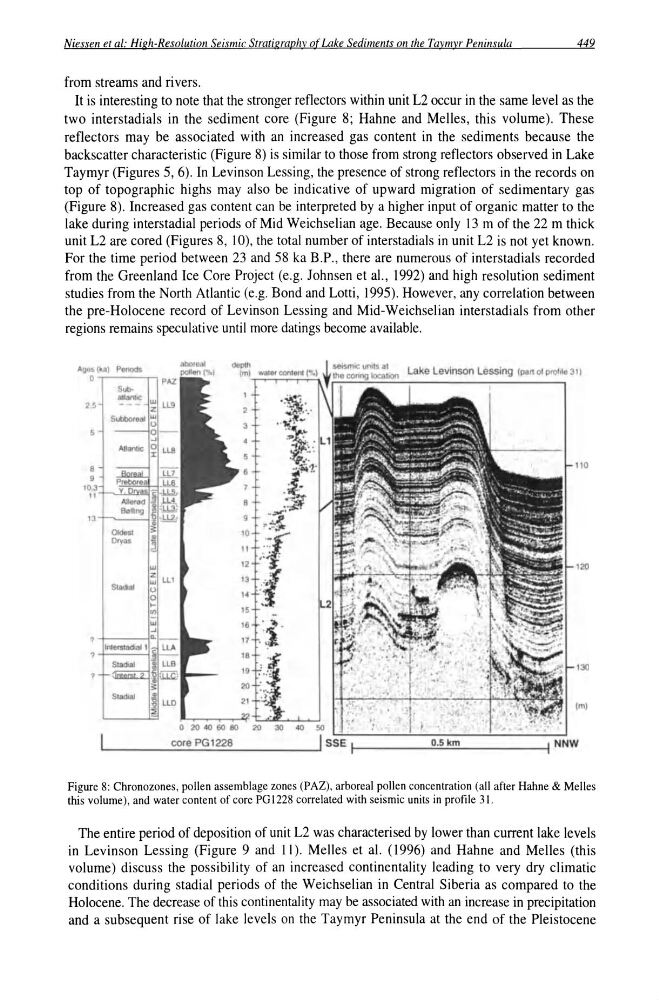
It is interesting to note that the stronger reflectors within unit L2 occur in the same level as the
two interstadials in the sediment core (Figure 8; Hahne and Melles, this volume). These
reflectors may be associated with an increased gas content in the sediments because the
backscatter characteristic (Figure 8) is similar to those from strong reflectors observed in Lake
Taymyr (Figures 5, 6). In Levinson Lessing, the presence of strong reflectors in the records on
top of topographic highs may also be indicative of upward migration of sedimentary gas
(Figure 8). Increased gas content can be interpreted by a higher input of organic matter to the
lake during interstadial periods of Mid Weichselian age. Because only 13 m of the 22 m thick
unit L2 are cored (Figures 8, 10), the total number of interstadials in unit L2 is not yet known.
For the time period between 23 and 58 ka B.P., there are numerous of interstadials recorded
from the Greenland Ice Core Project (e.g. Johnsen et aI., 1992) and high resolution sediment
studies from the North Atlantic (e.g. Bond and Lotti, 1995). However, any correlation between
the pre-Holocene record of Levinson Lessing and Mid-Weichselian interstadials from other
regions remains speculative until more datings become available.
Ageo(1
2.5
SuballanlJc
13-,---,----1
s ......
Sladial
doplh
(m) wall!< conlent (,..)
Lake Levinson Lessing (pM 01 ptOfite 31)
110
120
130
, ..
(m)
Figure 8: Chronozones, pollen assemblage zones (PAZ), arboreal pollen concentration (all after Hahne & Melles
this volume), and water content of core PG 1228 correlated with seismic units in profile 31.
The entire period of deposition of unit L2 was characterised by lower than current lake levels
in Levinson Lessing (Figure 9 and 11). Melles et al. (1996) and Hahne and Melles (this
volume) discuss the possibility of an increased continentality leading to very dry climatic
conditions during stadial periods of the Weichselian in Central Siberia as compared to the
Holocene. The decrease of this continentality may be associated with an increase in precipitation
and a subsequent rise of lake levels on the Taymyr Peninsula at the end of the Pleistocene
449
from streams and rivers.
It is interesting to note that the stronger reflectors within unit L2 occur in the same level as the
two interstadials in the sediment core (Figure 8; Hahne and Melles, this volume). These
reflectors may be associated with an increased gas content in the sediments because the
backscatter characteristic (Figure 8) is similar to those from strong reflectors observed in Lake
Taymyr (Figures 5, 6). In Levinson Lessing, the presence of strong reflectors in the records on
top of topographic highs may also be indicative of upward migration of sedimentary gas
(Figure 8). Increased gas content can be interpreted by a higher input of organic matter to the
lake during interstadial periods of Mid Weichselian age. Because only 13 m of the 22 m thick
unit L2 are cored (Figures 8, 10), the total number of interstadials in unit L2 is not yet known.
For the time period between 23 and 58 ka B.P., there are numerous of interstadials recorded
from the Greenland Ice Core Project (e.g. Johnsen et aI., 1992) and high resolution sediment
studies from the North Atlantic (e.g. Bond and Lotti, 1995). However, any correlation between
the pre-Holocene record of Levinson Lessing and Mid-Weichselian interstadials from other
regions remains speculative until more datings become available.
Ageo(1
2.5
SuballanlJc
13-,---,----1
s ......
Sladial
doplh
(m) wall!< conlent (,..)
Lake Levinson Lessing (pM 01 ptOfite 31)
110
120
130
, ..
(m)
Figure 8: Chronozones, pollen assemblage zones (PAZ), arboreal pollen concentration (all after Hahne & Melles
this volume), and water content of core PG 1228 correlated with seismic units in profile 31.
The entire period of deposition of unit L2 was characterised by lower than current lake levels
in Levinson Lessing (Figure 9 and 11). Melles et al. (1996) and Hahne and Melles (this
volume) discuss the possibility of an increased continentality leading to very dry climatic
conditions during stadial periods of the Weichselian in Central Siberia as compared to the
Holocene. The decrease of this continentality may be associated with an increase in precipitation
and a subsequent rise of lake levels on the Taymyr Peninsula at the end of the Pleistocene