

446
Land-Ocean Systems in the Siberian Arctic: Dynamics and History
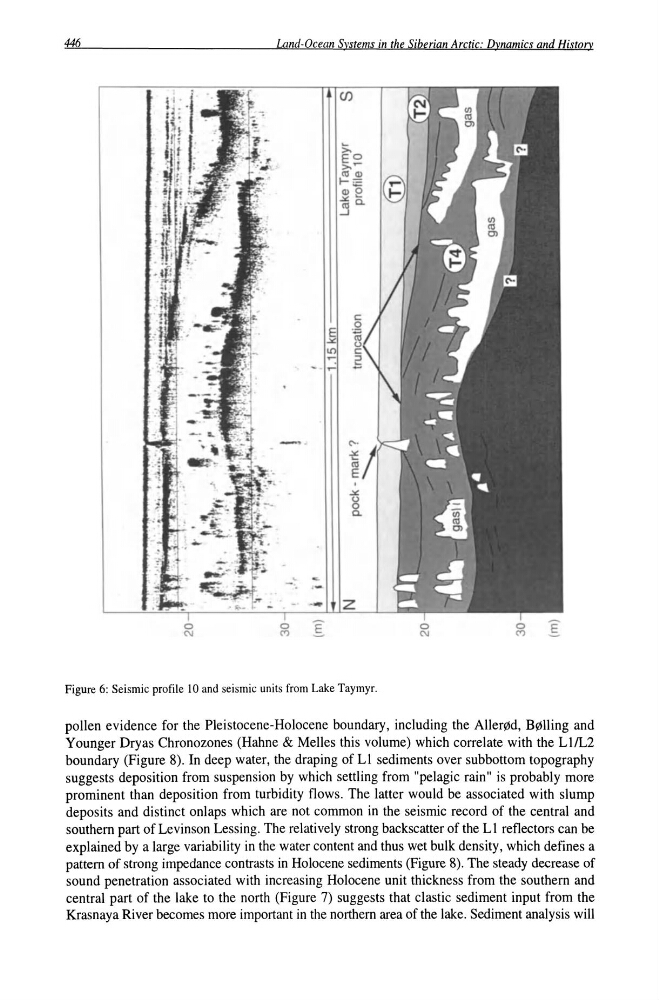
Figure 6: Seismic profile 10 and seismic units from Lake Taymyr.
pollen evidence for the Pleistocene-Holocene boundary, including the Alle[!!:)d, B~lling and
Younger Dryas Chronozones (Hahne & Melles this volume) which correlate with the LlIL2
boundary (Figure 8)_ In deep water, the draping of Ll sediments over subbottom topography
suggests deposition from suspension by which settling from "pelagic rain" is probably more
prominent than deposition from turbidity flows . The latter would be associated with slump
deposits and distinct onlaps which are not common in the seismic record of the central and
southern part of Levinson Lessing. The relatively strong backscatter of the Ll reflectors can be
explained by a large variability in the water content and thus wet bulk density, which defines a
pattern of strong impedance contrasts in Holocene sediments (Figure 8). The steady decrease of
sound penetration associated with increasing Holocene unit thickness from the southern and
central part of the lake to the north (Figure 7) suggests that clastic sediment input from the
Krasnaya River becomes more important in the northern area of the lake. Sediment analysis will
Land-Ocean Systems in the Siberian Arctic: Dynamics and History
Figure 6: Seismic profile 10 and seismic units from Lake Taymyr.
pollen evidence for the Pleistocene-Holocene boundary, including the Alle[!!:)d, B~lling and
Younger Dryas Chronozones (Hahne & Melles this volume) which correlate with the LlIL2
boundary (Figure 8)_ In deep water, the draping of Ll sediments over subbottom topography
suggests deposition from suspension by which settling from "pelagic rain" is probably more
prominent than deposition from turbidity flows . The latter would be associated with slump
deposits and distinct onlaps which are not common in the seismic record of the central and
southern part of Levinson Lessing. The relatively strong backscatter of the Ll reflectors can be
explained by a large variability in the water content and thus wet bulk density, which defines a
pattern of strong impedance contrasts in Holocene sediments (Figure 8). The steady decrease of
sound penetration associated with increasing Holocene unit thickness from the southern and
central part of the lake to the north (Figure 7) suggests that clastic sediment input from the
Krasnaya River becomes more important in the northern area of the lake. Sediment analysis will