

Ebel et al.: Laminated Sediments from Levinson-Lessing Lake
431
Ages I Periods
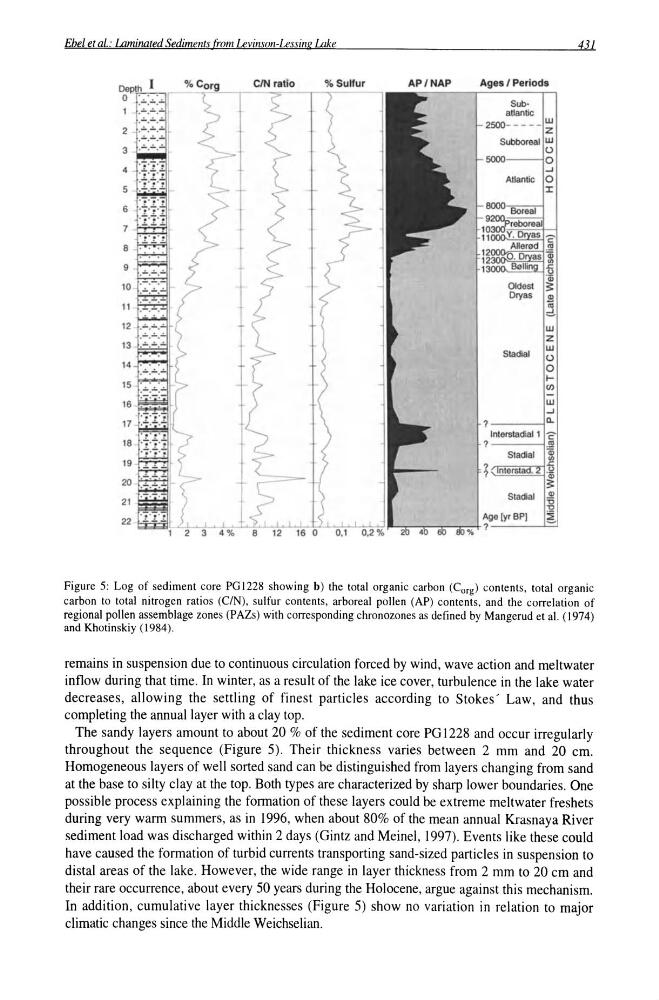
Figure 5: Log of sediment core PG 1228 showing b) the total organic carbon (Corgl contents, total organic
carbon to total nitrogen ratios (C/N), sulfur contents, arboreal pollen (AP) contents, and the correlation of
regional pollen assemblage zones (PAZs) with corresponding chronozones as defined by Mangerud et al. (1974)
and Khotinskiy (1984) .
remains in suspension due to continuous circulation forced by wind, wave action and meltwater
inflow during that time. In winter, as a result of the lake ice cover, turbulence in the lake water
decreases, allowing the settling of finest particles according to Stokes' Law, and thus
completing the annual layer with a clay top.
The sandy layers amount to about 20 % of the sediment core PG 1228 and occur irregularly
throughout the sequence (Figure 5). Their thickness varies between 2 mm and 20 cm.
Homogeneous layers of well sorted sand can be distinguished from layers changing from sand
at the base to silty clay at the top. Both types are characterized by sharp lower boundaries. One
possible process explaining the formation of these layers could be extreme meltwater freshets
during very warm summers, as in 1996, when about 80% of the mean annual Krasnaya River
sediment load was discharged within 2 days (Gintz and Meinel, 1997). Events like these could
have caused the formation of turbid currents transporting sand-sized particles in suspension to
distal areas of the lake . However, the wide range in layer thickness from 2 mm to 20 cm and
their rare occurrence, about every 50 years during the Holocene, argue against this mechanism.
In addition, cumulative layer thicknesses (Figure 5) show no variation in relation to major
climatic changes since the Middle Weichselian.
431
Ages I Periods
Figure 5: Log of sediment core PG 1228 showing b) the total organic carbon (Corgl contents, total organic
carbon to total nitrogen ratios (C/N), sulfur contents, arboreal pollen (AP) contents, and the correlation of
regional pollen assemblage zones (PAZs) with corresponding chronozones as defined by Mangerud et al. (1974)
and Khotinskiy (1984) .
remains in suspension due to continuous circulation forced by wind, wave action and meltwater
inflow during that time. In winter, as a result of the lake ice cover, turbulence in the lake water
decreases, allowing the settling of finest particles according to Stokes' Law, and thus
completing the annual layer with a clay top.
The sandy layers amount to about 20 % of the sediment core PG 1228 and occur irregularly
throughout the sequence (Figure 5). Their thickness varies between 2 mm and 20 cm.
Homogeneous layers of well sorted sand can be distinguished from layers changing from sand
at the base to silty clay at the top. Both types are characterized by sharp lower boundaries. One
possible process explaining the formation of these layers could be extreme meltwater freshets
during very warm summers, as in 1996, when about 80% of the mean annual Krasnaya River
sediment load was discharged within 2 days (Gintz and Meinel, 1997). Events like these could
have caused the formation of turbid currents transporting sand-sized particles in suspension to
distal areas of the lake . However, the wide range in layer thickness from 2 mm to 20 cm and
their rare occurrence, about every 50 years during the Holocene, argue against this mechanism.
In addition, cumulative layer thicknesses (Figure 5) show no variation in relation to major
climatic changes since the Middle Weichselian.