

Ebel et al.: Laminnted Sediments from Levinson-Lessing Lake
429
Most terrestrial material is transported into Levinson-Lessing Lake in early summer
(June/July) through meltwater supplied from snow fields and the thawing active layer
(Bolshiyanov et aI., 1995; Gintz et aI., 1996). Summer rain events result in irregularly
occurring surface runoff which contribute minorly to overall sedimentation. In contrast, direct
gravitational or cryogenic sediment supply to the lake (e.g. slumps, solifluction) is negligible,
as indicated by the low relief at the lake shores and the absence of ice-rafted gravels in sediment
core PG 1228.
From the lithology and sedimentary microstructures, two main sediment types are
distinguished in core PG 1228, reflecting two different sedimentary facies: fine-grained laminae
and sandy layers.
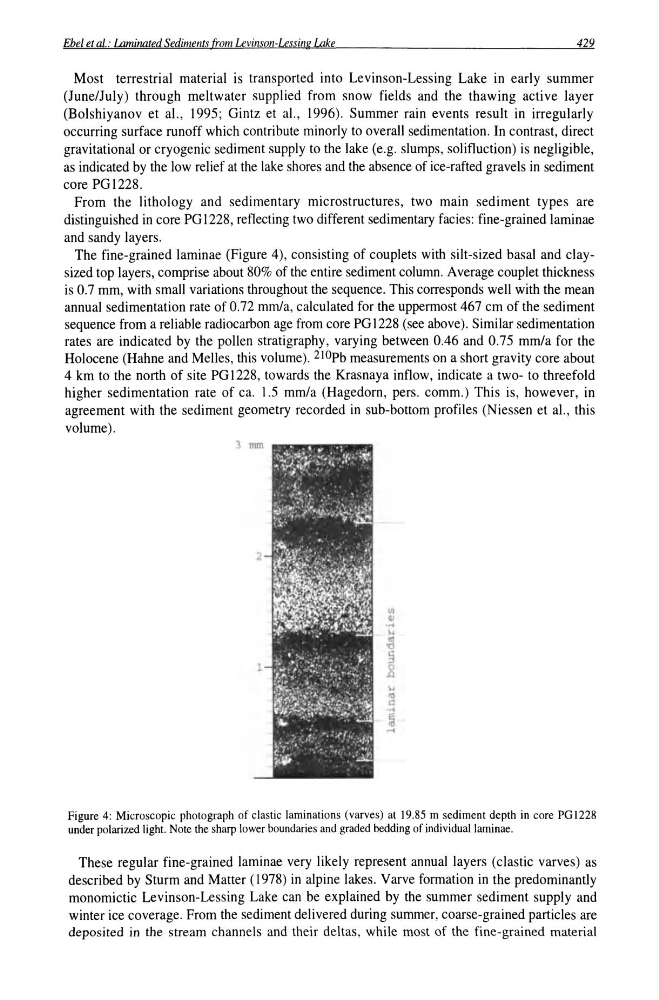
The fine-grained laminae (Figure 4), consisting of couplets with silt-sized basal and c1aysized top layers, comprise about 80% of the entire sediment column. Average couplet thickness
is 0.7 mm, with small variations throughout the sequence_ This corresponds well with the mean
annual sedimentation rate of 0.72 mm/a, calculated for the uppermost 467 cm of the sediment
sequence from a reliable radiocarbon age from core PG 1228 (see above). Similar sedimentation
rates are indicated by the pollen stratigraphy, varying between 0.46 and 0.75 mm/a for the
Holocene (Hahne and Melles, this volume). 210Pb measurements on a short gravity core about
4 km to the north of site PG1228, towards the Krasnaya inflow, indicate a two- to threefold
higher sedimentation rate of ca. 1.5 mm/a (Hagedorn, pers. comm.) This is, however, in
agreement with the sediment geometry recorded in sub-bottom profiles (Niessen et aI., this
volume).
Figure 4: Microscopic photograph of clastic laminations (varves) at 19.85 m sediment depth in core PG1228
under polarized light. Note the sharp lower boundaries and graded bedding of individual laminae.
These regular fine-grained laminae very likely represent annual layers (clastic varves) as
described by Sturm and Matter (1978) in alpine lakes. Varve formation in the predominantly
monomictic Levinson-Lessing Lake can be explained by the summer sediment supply and
winter ice coverage. From the sediment delivered during summer, coarse-grained particles are
deposited in the stream channels and their deltas, while most of the fine-grained material
429
Most terrestrial material is transported into Levinson-Lessing Lake in early summer
(June/July) through meltwater supplied from snow fields and the thawing active layer
(Bolshiyanov et aI., 1995; Gintz et aI., 1996). Summer rain events result in irregularly
occurring surface runoff which contribute minorly to overall sedimentation. In contrast, direct
gravitational or cryogenic sediment supply to the lake (e.g. slumps, solifluction) is negligible,
as indicated by the low relief at the lake shores and the absence of ice-rafted gravels in sediment
core PG 1228.
From the lithology and sedimentary microstructures, two main sediment types are
distinguished in core PG 1228, reflecting two different sedimentary facies: fine-grained laminae
and sandy layers.
The fine-grained laminae (Figure 4), consisting of couplets with silt-sized basal and c1aysized top layers, comprise about 80% of the entire sediment column. Average couplet thickness
is 0.7 mm, with small variations throughout the sequence_ This corresponds well with the mean
annual sedimentation rate of 0.72 mm/a, calculated for the uppermost 467 cm of the sediment
sequence from a reliable radiocarbon age from core PG 1228 (see above). Similar sedimentation
rates are indicated by the pollen stratigraphy, varying between 0.46 and 0.75 mm/a for the
Holocene (Hahne and Melles, this volume). 210Pb measurements on a short gravity core about
4 km to the north of site PG1228, towards the Krasnaya inflow, indicate a two- to threefold
higher sedimentation rate of ca. 1.5 mm/a (Hagedorn, pers. comm.) This is, however, in
agreement with the sediment geometry recorded in sub-bottom profiles (Niessen et aI., this
volume).
Figure 4: Microscopic photograph of clastic laminations (varves) at 19.85 m sediment depth in core PG1228
under polarized light. Note the sharp lower boundaries and graded bedding of individual laminae.
These regular fine-grained laminae very likely represent annual layers (clastic varves) as
described by Sturm and Matter (1978) in alpine lakes. Varve formation in the predominantly
monomictic Levinson-Lessing Lake can be explained by the summer sediment supply and
winter ice coverage. From the sediment delivered during summer, coarse-grained particles are
deposited in the stream channels and their deltas, while most of the fine-grained material