

Hahne and Melles: Climate and Vegetation History ofthe Taymvr Peninsula
419
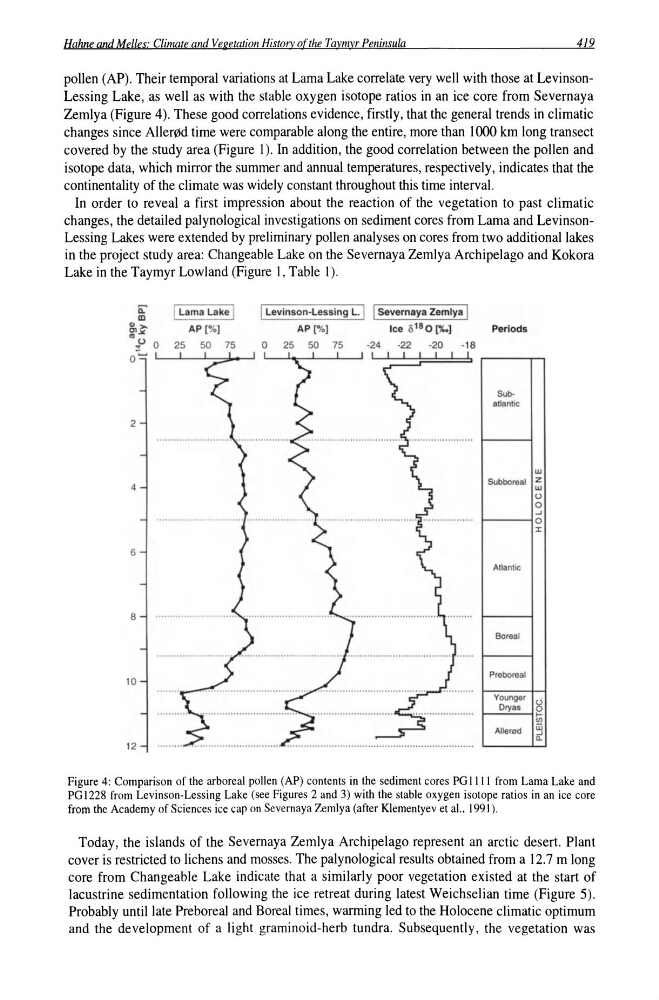
pollen (AP). Their temporal variations at Lama Lake correlate very well with those at LevinsonLessing Lake, as well as with the stable oxygen isotope ratios in an ice core from Severnaya
Zemlya (Figure 4). These good correlations evidence, firstly, that the general trends in climatic
changes since Aller~d time were comparable along the entire, more than 1000 km long transect
covered by the study area (Figure I). In addition, the good correlation between the pollen and
isotope data, which mirror the summer and annual temperatures, respectively, indicates that the
continentality of the climate was widely constant throughout this time interval.
In order to reveal a first impression about the reaction of the vegetation to past climatic
changes, the detailed palynological investigations on sediment cores from Lama and LevinsonLessing Lakes were extended by preliminary pollen analyses on cores from two additional lakes
in the project study area: Changeable Lake on the Severnaya Zemlya Archipelago and Kokora
Lake in the Taymyr Lowland (Figure I, Table I).
~
I Lama Lake I I
Levinson-Lessing L. I I
Severnaya Zemlya I
~~
AP ["!oj
AP ["!oj
Ice ~ 180 [%oj
~u 0
25 50 75
0
25 50 75
-24
·22
·20
· 18
Periods
O-~ L.--'-_~~---'
Subatlantic
2
'"
4
Subboreai z
w
0
0
...I
0
:J:
6
AUantic
8
Boreal
Preboreal
10
Younger
g
Oryas
~
Aller0d
w
...I
"12
Figure 4: Comparison of the arboreal pollen (AP) contents in the sediment cores PG IIII from Lama Lake and
PGI228 from Levinson-Lessing Lake (see Figures 2 and 3) with the stable oxygen isotope ratios in an ice core
from the Academy of Sciences ice cap on Severnaya Zemlya (after K1ementyev et aI., 1991).
Today, the islands of the Severnaya Zemlya Archipelago represent an arctic desert. Plant
cover is restricted to lichens and mosses. The palynological results obtained from a 12.7 m long
core from Changeable Lake indicate that a similarly poor vegetation existed at the start of
lacustrine sedimentation following the ice retreat during latest Weichselian time (Figure 5).
Probably until late Preboreal and Boreal times, warming led to the Holocene climatic optimum
and the development of a light graminoid-herb tundra. Subsequently, the vegetation was
419
pollen (AP). Their temporal variations at Lama Lake correlate very well with those at LevinsonLessing Lake, as well as with the stable oxygen isotope ratios in an ice core from Severnaya
Zemlya (Figure 4). These good correlations evidence, firstly, that the general trends in climatic
changes since Aller~d time were comparable along the entire, more than 1000 km long transect
covered by the study area (Figure I). In addition, the good correlation between the pollen and
isotope data, which mirror the summer and annual temperatures, respectively, indicates that the
continentality of the climate was widely constant throughout this time interval.
In order to reveal a first impression about the reaction of the vegetation to past climatic
changes, the detailed palynological investigations on sediment cores from Lama and LevinsonLessing Lakes were extended by preliminary pollen analyses on cores from two additional lakes
in the project study area: Changeable Lake on the Severnaya Zemlya Archipelago and Kokora
Lake in the Taymyr Lowland (Figure I, Table I).
~
I Lama Lake I I
Levinson-Lessing L. I I
Severnaya Zemlya I
~~
AP ["!oj
AP ["!oj
Ice ~ 180 [%oj
~u 0
25 50 75
0
25 50 75
-24
·22
·20
· 18
Periods
O-~ L.--'-_~~---'
Subatlantic
2
'"
4
Subboreai z
w
0
0
...I
0
:J:
6
AUantic
8
Boreal
Preboreal
10
Younger
g
Oryas
~
Aller0d
w
...I
"12
Figure 4: Comparison of the arboreal pollen (AP) contents in the sediment cores PG IIII from Lama Lake and
PGI228 from Levinson-Lessing Lake (see Figures 2 and 3) with the stable oxygen isotope ratios in an ice core
from the Academy of Sciences ice cap on Severnaya Zemlya (after K1ementyev et aI., 1991).
Today, the islands of the Severnaya Zemlya Archipelago represent an arctic desert. Plant
cover is restricted to lichens and mosses. The palynological results obtained from a 12.7 m long
core from Changeable Lake indicate that a similarly poor vegetation existed at the start of
lacustrine sedimentation following the ice retreat during latest Weichselian time (Figure 5).
Probably until late Preboreal and Boreal times, warming led to the Holocene climatic optimum
and the development of a light graminoid-herb tundra. Subsequently, the vegetation was