

398
Land-Ocean Systems in the Siberian Arctic: Dynamics and History
A recovery of euplanktonic diatoms with EplNp values approximating 1 was recorded for the
early Subatlantic (DAZ-8). In this planktonic diatom complex, C. comensis and C. cf.
kuetzingiana var. radiosa were abundant. The proportions of taxa with oligo/ beta mesotrophic
tolerances decreased.
Contemporary with increasing abundances of Sphagnum spores (an indicator for moist
conditions commonly occurring in peat and bog communities), acidophilous taxa comprised 3%
of the assemblages (Figure 9).
The increasing proportions of Artemisia and Cyperaceae in the pollen assemblages recorded
as ,second Holocene NAP maximum' mark the higher Subatlantic (Hahne and Melles, this
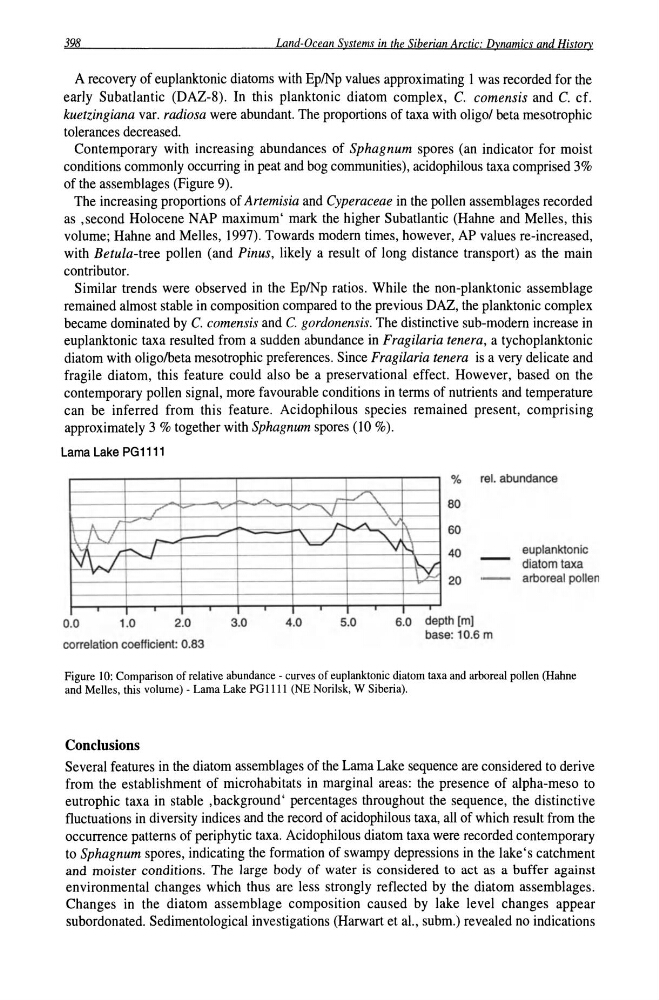
volume; Hahne and Melles, 1997). Towards modern times, however, AP values re-increased,
with Betula-tree pollen (and Pinus, likely a result of long distance transport) as the main
contributor.
Similar trends were observed in the Ep/Np ratios. While the non-planktonic assemblage
remained almost stable in composition compared to the previous DAZ, the planktonic complex
became dominated by C. comensis and C. gordonensis. The distinctive sub-modem increase in
euplanktonic taxa resulted from a sudden abundance in Fragilaria tenera, a tychoplanktonic
diatom with oligo/beta mesotrophic preferences. Since Fragilaria tenera is a very delicate and
fragile diatom, this feature could also be a preservational effect. However, based on the
contemporary pollen signal, more favourable conditions in terms of nutrients and temperature
can be inferred from this feature. Acidophilous species remained present, comprising
approximately 3 % together with Sphagnum spores (10 %).
Lama Lake PG1111
..,...
/'
""
r---'
A
r ......
l\ I\./
~
'\
.'1..
r... I
lY-\. /
0.0
1.0
2.0
3.0
4.0
correlation coefficient: 0.83
%
reI. abundance
,-V ,
'V
'\
80
"
A
v
60
/
'\.
5.0
\
v N l
40
I :t- 20
6.0 depth [m)
base: 10.6 m
euplanktonic
diatom taxa
arboreal pollen
Figure 10: Comparison of relative abundance - curves of euplanktonic diatom taxa and arboreal pollen (Hahne
and Melles, this volume) - Lama Lake PO 1111 (NE Norilsk, W Siberia).
Conclusions
Several features in the diatom assemblages of the Lama Lake sequence are considered to derive
from the establishment of microhabitats in marginal areas: the presence of alpha-meso to
eutrophic taxa in stable ,background' percentages throughout the sequence, the distinctive
fluctuations in diversity indices and the record of acidophilous taxa, all of which result from the
occurrence patterns of periphytic taxa. Acidophilous diatom taxa were recorded contemporary
to Sphagnum spores, indicating the formation of swampy depressions in the lake's catchment
and moister conditions. The large body of water is considered to act as a buffer against
environmental changes which thus are less strongly reflected by the diatom assemblages.
Changes in the diatom assemblage composition caused by lake level changes appear
subordonated. Sedimentological investigations (Harwart et aI., subm.) revealed no indications
Land-Ocean Systems in the Siberian Arctic: Dynamics and History
A recovery of euplanktonic diatoms with EplNp values approximating 1 was recorded for the
early Subatlantic (DAZ-8). In this planktonic diatom complex, C. comensis and C. cf.
kuetzingiana var. radiosa were abundant. The proportions of taxa with oligo/ beta mesotrophic
tolerances decreased.
Contemporary with increasing abundances of Sphagnum spores (an indicator for moist
conditions commonly occurring in peat and bog communities), acidophilous taxa comprised 3%
of the assemblages (Figure 9).
The increasing proportions of Artemisia and Cyperaceae in the pollen assemblages recorded
as ,second Holocene NAP maximum' mark the higher Subatlantic (Hahne and Melles, this
volume; Hahne and Melles, 1997). Towards modern times, however, AP values re-increased,
with Betula-tree pollen (and Pinus, likely a result of long distance transport) as the main
contributor.
Similar trends were observed in the Ep/Np ratios. While the non-planktonic assemblage
remained almost stable in composition compared to the previous DAZ, the planktonic complex
became dominated by C. comensis and C. gordonensis. The distinctive sub-modem increase in
euplanktonic taxa resulted from a sudden abundance in Fragilaria tenera, a tychoplanktonic
diatom with oligo/beta mesotrophic preferences. Since Fragilaria tenera is a very delicate and
fragile diatom, this feature could also be a preservational effect. However, based on the
contemporary pollen signal, more favourable conditions in terms of nutrients and temperature
can be inferred from this feature. Acidophilous species remained present, comprising
approximately 3 % together with Sphagnum spores (10 %).
Lama Lake PG1111
..,...
/'
""
r---'
A
r ......
l\ I\./
~
'\
.'1..
r... I
lY-\. /
0.0
1.0
2.0
3.0
4.0
correlation coefficient: 0.83
%
reI. abundance
,-V ,
'V
'\
80
"
A
v
60
/
'\.
5.0
\
v N l
40
I :t- 20
6.0 depth [m)
base: 10.6 m
euplanktonic
diatom taxa
arboreal pollen
Figure 10: Comparison of relative abundance - curves of euplanktonic diatom taxa and arboreal pollen (Hahne
and Melles, this volume) - Lama Lake PO 1111 (NE Norilsk, W Siberia).
Conclusions
Several features in the diatom assemblages of the Lama Lake sequence are considered to derive
from the establishment of microhabitats in marginal areas: the presence of alpha-meso to
eutrophic taxa in stable ,background' percentages throughout the sequence, the distinctive
fluctuations in diversity indices and the record of acidophilous taxa, all of which result from the
occurrence patterns of periphytic taxa. Acidophilous diatom taxa were recorded contemporary
to Sphagnum spores, indicating the formation of swampy depressions in the lake's catchment
and moister conditions. The large body of water is considered to act as a buffer against
environmental changes which thus are less strongly reflected by the diatom assemblages.
Changes in the diatom assemblage composition caused by lake level changes appear
subordonated. Sedimentological investigations (Harwart et aI., subm.) revealed no indications