

Kienel: Late Weichselian to Holocene Diatom Succession in a Sediment Core
393
Lama Lake
relative abundance (%)
DAZ chronoKhotinsky (1984)
PG1111
zones·)
and Mangerud et al.
0 10 20 30 40 SO 60 70 80 90100
(1974)
0.0
9
(eyrBP)
u
-= c:
'"
76
1.0
8
.c
:::J
CI)
e2500
2.0
~
7
l!!
.8 .c :::J
~ > 50% relative
CI)
3.0
25000
abundance of
non-planktonic
6
taxa
4.0
u
~
. .."
> 50% relative
c:
' "
~
abundance of
euplanktonic
5
taxa
~~I!.09_
DAZ = local diatom
5.0
4
assemblage
Boreal
zones
6.0 l~I~~~I~I~~~~~~~
cE Q) ~
EJ::.
~ g. euplanktonic
(/) "0
taxa
non-planktonic laxa
3
Q9200
*)
Pre-- -as inferred from
2
boreal
palynology
elO300
V~unger
Drvas
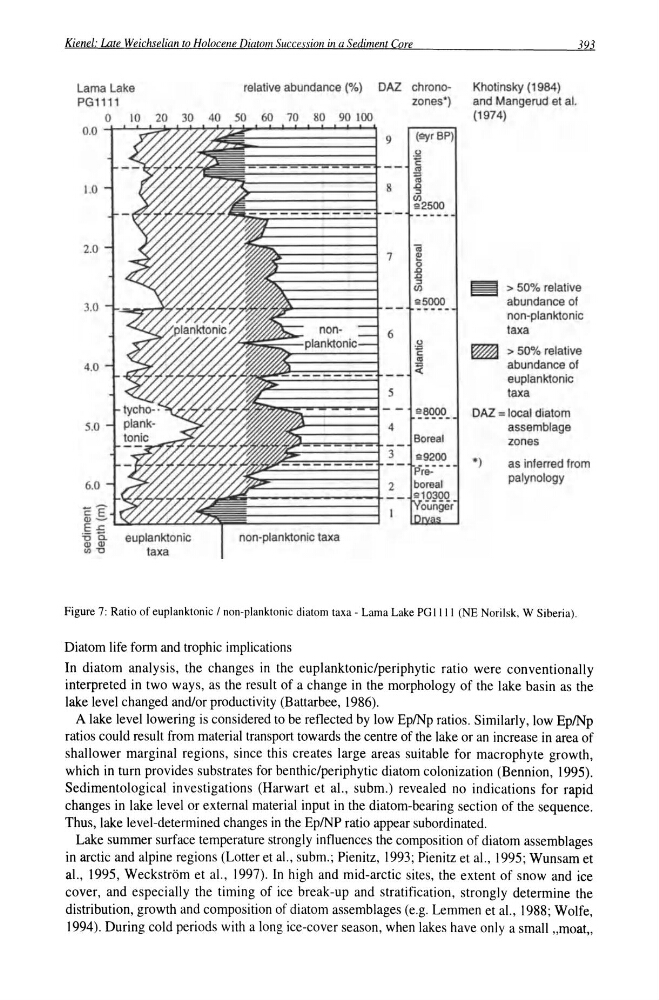
Figure 7: Ratio of euplanktonic / non-planktonic diatom taxa - Lama Lake PG 1111 (NE Norilsk, W Siberia).
Diatom life form and trophic implications
In diatom analysis, the changes in the euplanktonic/periphytic ratio were conventionally
interpreted in two ways, as the result of a change in the morphology of the lake basin as the
lake level changed and/or producti vity (Battarbee, 1986).
A lake level lowering is considered to be reflected by low Ep/Np ratios. Similarly, low Ep/Np
ratios could result from material transport towards the centre of the lake or an increase in area of
shallower marginal regions, since this creates large areas suitable for macrophyte growth,
which in turn provides substrates for benthic/periphytic diatom colonization (Bennion, 1995).
Sedimentological investigations (Harwart et a\., subm.) revealed no indications for rapid
changes in lake level or external material input in the diatom-bearing section of the sequence.
Thus, lake level-determined changes in the Ep/NP ratio appear subordinated.
Lake summer surface temperature strongly influences the composition of diatom assemblages
in arctic and alpine regions (Lotter et a\., subm.; Pienitz, 1993; Pienitz et a\., 1995; Wunsam et
a\., 1995, Weckstrom et a\., 1997). In high and mid-arctic sites, the extent of snow and ice
cover, and especially the timing of ice break-up and stratification, strongly determine the
distribution, growth and composition of diatom assemblages (e.g. Lemmen et a\., 1988; Wolfe,
1994). During cold periods with a long ice-cover season, when lakes have only a small "moat"
393
Lama Lake
relative abundance (%)
DAZ chronoKhotinsky (1984)
PG1111
zones·)
and Mangerud et al.
0 10 20 30 40 SO 60 70 80 90100
(1974)
0.0
9
(eyrBP)
u
-= c:
'"
76
1.0
8
.c
:::J
CI)
e2500
2.0
~
7
l!!
.8 .c :::J
~ > 50% relative
CI)
3.0
25000
abundance of
non-planktonic
6
taxa
4.0
u
~
. .."
> 50% relative
c:
' "
~
abundance of
euplanktonic
5
taxa
~~I!.09_
DAZ = local diatom
5.0
4
assemblage
Boreal
zones
6.0 l~I~~~I~I~~~~~~~
cE Q) ~
EJ::.
~ g. euplanktonic
(/) "0
taxa
non-planktonic laxa
3
Q9200
*)
Pre-- -as inferred from
2
boreal
palynology
elO300
V~unger
Drvas
Figure 7: Ratio of euplanktonic / non-planktonic diatom taxa - Lama Lake PG 1111 (NE Norilsk, W Siberia).
Diatom life form and trophic implications
In diatom analysis, the changes in the euplanktonic/periphytic ratio were conventionally
interpreted in two ways, as the result of a change in the morphology of the lake basin as the
lake level changed and/or producti vity (Battarbee, 1986).
A lake level lowering is considered to be reflected by low Ep/Np ratios. Similarly, low Ep/Np
ratios could result from material transport towards the centre of the lake or an increase in area of
shallower marginal regions, since this creates large areas suitable for macrophyte growth,
which in turn provides substrates for benthic/periphytic diatom colonization (Bennion, 1995).
Sedimentological investigations (Harwart et a\., subm.) revealed no indications for rapid
changes in lake level or external material input in the diatom-bearing section of the sequence.
Thus, lake level-determined changes in the Ep/NP ratio appear subordinated.
Lake summer surface temperature strongly influences the composition of diatom assemblages
in arctic and alpine regions (Lotter et a\., subm.; Pienitz, 1993; Pienitz et a\., 1995; Wunsam et
a\., 1995, Weckstrom et a\., 1997). In high and mid-arctic sites, the extent of snow and ice
cover, and especially the timing of ice break-up and stratification, strongly determine the
distribution, growth and composition of diatom assemblages (e.g. Lemmen et a\., 1988; Wolfe,
1994). During cold periods with a long ice-cover season, when lakes have only a small "moat"