

Kienel: Late Weichselian to Holocene Diatom Succession in a Sediment Core
385
Among the periphytic taxa, Cymbella minuta and C. silesiaca (abundant), Achnanthes
minutissima vaL minutissima (abundant to frequent), Amphora inariensis, A. fogediana,
Fragilaria construens and F. pinnata (frequent) were present throughout the sequence.
Periphytic taxa dominated in the diatom assemblages of the DAZ-l, DAZ-2, DAZ-7 and DAZS.
In DAZ-l, the periphytic assemblage consisted of abundant small Achnanthes species (A.
calcar, A. clevei, A. oblongella, A. laevis), Cymbella species (c. minuta*, C. silesiaca*) ,
Amphora species (A. inariensis*, A. fogediana) and Nitzschia angustata*. Abundant
Achnanthes minutissima vaL minutissima, Fragilaria construens* and Nitzschia palea*,
together with the frequent small Achnanthes species mentioned above, Amphora inariensis*
and A.fogediana accounted for the high percentage of periphytic diatoms in DAZ-2.
Again in DAZ-S and 9, the small Achnanthes species and A. minutissima var. minutissima
became abundant and predominated the periphytic diatom assemblages in association with
Cymbella minuta and C. silesiaca. They were associated with few Gomphonema pumilum, G.
olivaceum, Nitzschia palea, Fragilaria arcus (*) and Caloneis silesiaca (*). Taxa belonging to
the genera Eunotia, Neidium and Pinnularia, together with Tabellaria fenestrata and T.
ventricosa comprised up to 3% of the assemblages.
Diatom concentration
Semi-quantitative approximations of diatom valve and chrysophycean cyst concentrations are
given in Figure 5. Both parameters show generally similar trends, whilst the ratio of diatom
sversus chrysophycean cysts increases upwards in the sequence. Only two significant
decreases are visible in DAZ-S.
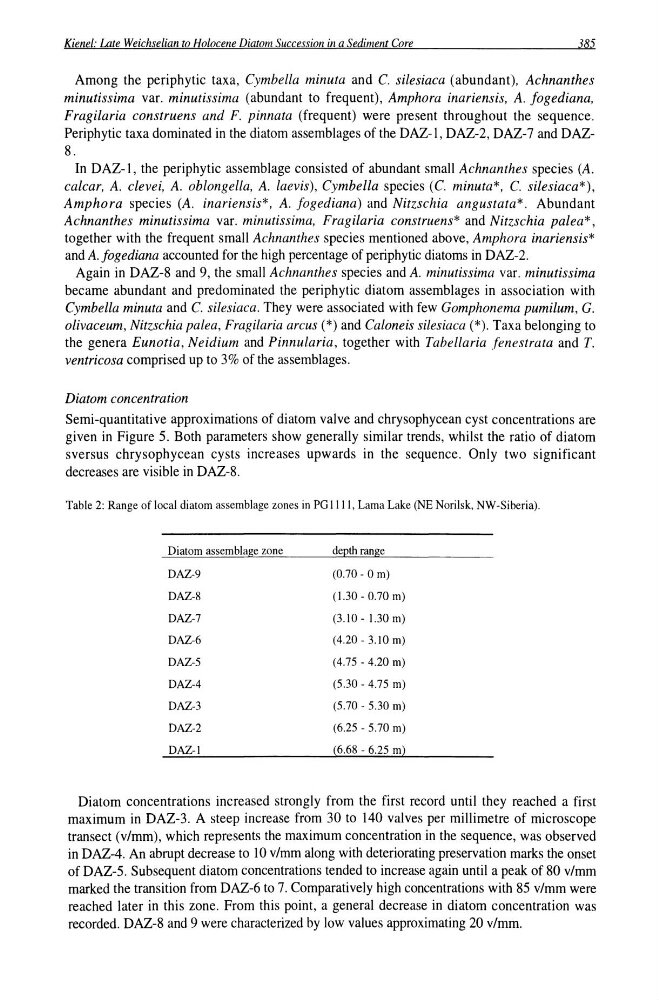
Table 2: Range of local diatom assemblage zones in PO 1111, Lama Lake (NE Norilsk, NW -Siberia).
Diatom assemblage zone
depth range
DAZ-9
(0.70 - 0 m)
DAZ-8
(1.30 - 0.70 m)
DAZ-7
(3.10 - 1.30 m)
DAZ-6
(4.20 - 3.10 m)
DAZ-5
(4.75 - 4.20 m)
DAZ-4
(5.30 - 4.75 m)
DAZ-3
(5.70 - 5.30 m)
DAZ-2
(6.25 - 5.70 m)
DAZ-J
(6.68 - 6.25 m)
Diatom concentrations increased strongly from the first record until they reached a first
maximum in DAZ-3. A steep increase from 30 to 140 valves per millimetre of microscope
transect (v/mm), which represents the maximum concentration in the sequence, was observed
in DAZ-4. An abrupt decrease to 10 vlmm along with deteriorating preservation marks the onset
of DAZ-5. Subsequent diatom concentrations tended to increase again until a peak of SO vlmm
marked the transition from DAZ-6 to 7. Comparatively high concentrations with S5 vlmm were
reached later in this zone. From this point, a general decrease in diatom concentration was
recorded. DAZ-S and 9 were characterized by low values approximating 20 v/mm.
385
Among the periphytic taxa, Cymbella minuta and C. silesiaca (abundant), Achnanthes
minutissima vaL minutissima (abundant to frequent), Amphora inariensis, A. fogediana,
Fragilaria construens and F. pinnata (frequent) were present throughout the sequence.
Periphytic taxa dominated in the diatom assemblages of the DAZ-l, DAZ-2, DAZ-7 and DAZS.
In DAZ-l, the periphytic assemblage consisted of abundant small Achnanthes species (A.
calcar, A. clevei, A. oblongella, A. laevis), Cymbella species (c. minuta*, C. silesiaca*) ,
Amphora species (A. inariensis*, A. fogediana) and Nitzschia angustata*. Abundant
Achnanthes minutissima vaL minutissima, Fragilaria construens* and Nitzschia palea*,
together with the frequent small Achnanthes species mentioned above, Amphora inariensis*
and A.fogediana accounted for the high percentage of periphytic diatoms in DAZ-2.
Again in DAZ-S and 9, the small Achnanthes species and A. minutissima var. minutissima
became abundant and predominated the periphytic diatom assemblages in association with
Cymbella minuta and C. silesiaca. They were associated with few Gomphonema pumilum, G.
olivaceum, Nitzschia palea, Fragilaria arcus (*) and Caloneis silesiaca (*). Taxa belonging to
the genera Eunotia, Neidium and Pinnularia, together with Tabellaria fenestrata and T.
ventricosa comprised up to 3% of the assemblages.
Diatom concentration
Semi-quantitative approximations of diatom valve and chrysophycean cyst concentrations are
given in Figure 5. Both parameters show generally similar trends, whilst the ratio of diatom
sversus chrysophycean cysts increases upwards in the sequence. Only two significant
decreases are visible in DAZ-S.
Table 2: Range of local diatom assemblage zones in PO 1111, Lama Lake (NE Norilsk, NW -Siberia).
Diatom assemblage zone
depth range
DAZ-9
(0.70 - 0 m)
DAZ-8
(1.30 - 0.70 m)
DAZ-7
(3.10 - 1.30 m)
DAZ-6
(4.20 - 3.10 m)
DAZ-5
(4.75 - 4.20 m)
DAZ-4
(5.30 - 4.75 m)
DAZ-3
(5.70 - 5.30 m)
DAZ-2
(6.25 - 5.70 m)
DAZ-J
(6.68 - 6.25 m)
Diatom concentrations increased strongly from the first record until they reached a first
maximum in DAZ-3. A steep increase from 30 to 140 valves per millimetre of microscope
transect (v/mm), which represents the maximum concentration in the sequence, was observed
in DAZ-4. An abrupt decrease to 10 vlmm along with deteriorating preservation marks the onset
of DAZ-5. Subsequent diatom concentrations tended to increase again until a peak of SO vlmm
marked the transition from DAZ-6 to 7. Comparatively high concentrations with S5 vlmm were
reached later in this zone. From this point, a general decrease in diatom concentration was
recorded. DAZ-S and 9 were characterized by low values approximating 20 v/mm.