

28
Land-Ocean Systems in the Siberian Arctic: Dynamics and History
the phase difference in degrees, T is the oscillation period in days.
Results
The long-period tides
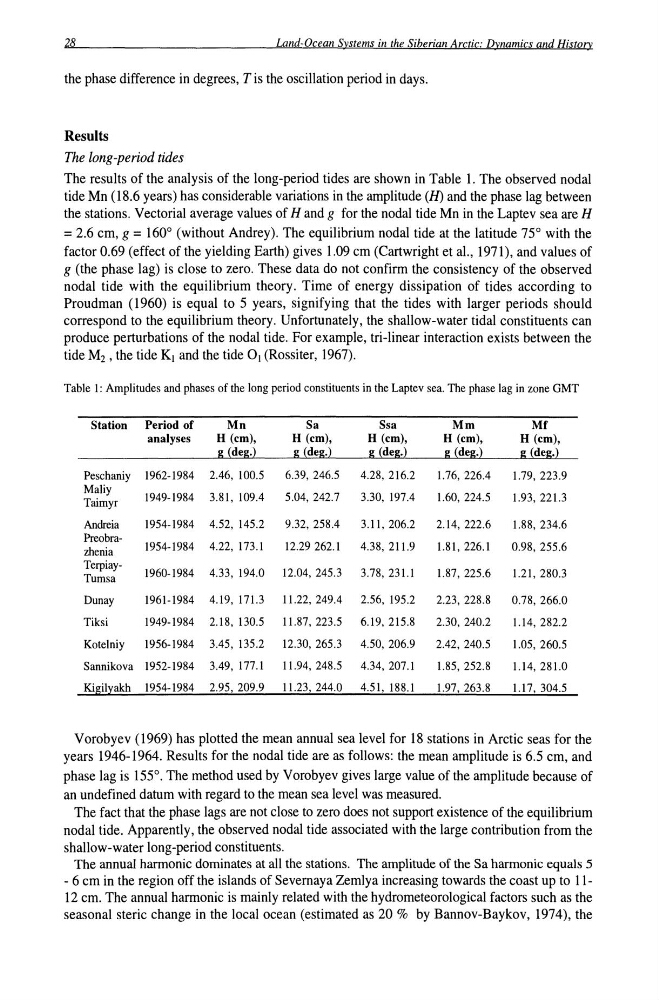
The results of the analysis of the long-period tides are shown in Table 1. The observed nodal
tide Mn (18.6 years) has considerable variations in the amplitude (N) and the phase lag between
the stations. Vectorial average values of Hand g for the nodal tide Mn in the Laptev sea are H
= 2.6 cm, g = 160 0 (without Andrey). The equilibrium nodal tide at the latitude 75 0 with the
factor 0.69 (effect of the yielding Earth) gives 1.09 cm (Cartwright et aI., 1971), and values of
g (the phase lag) is close to zero. These data do not confirm the consistency of the observed
nodal tide with the equilibrium theory. Time of energy dissipation of tides according to
Proudman (1960) is equal to 5 years, signifying that the tides with larger periods should
correspond to the equilibrium theory. Unfortunately, the shallow-water tidal constituents can
produce perturbations of the nodal tide. For example, tri-Iinear interaction exists between the
tide M2 , the tide KI and the tide 0 1 (Rossiter, 1967).
Table 1: Amplitudes and phases of the long period constituents in the Laptev sea. The phase lag in zone GMT
Station
Period of
Mn
Sa
Ssa
Mm
Mf
analyses
H (em),
H (em),
H (em),
H (em),
H (em),
g (deg.)
g (deg.)
g (deg.)
g (deg.)
g (deg.)
Peschaniy 1962-1984 2.46, 100.5
6.39, 246.5
4.28, 216.2
1.76, 226.4
1.79, 223.9
Maliy
1949-1984 3.81, 109.4
5.04,242.7
3.30, 197.4
1.60, 224.5
1.93, 221.3
Taimyr
Andreia
1954-1984 4.52, 145.2
9.32, 258.4
3.11,206.2
2.14,222.6
1.88, 234.6
Preobrazhenia
1954-1984 4.22, 173.1
12.29262.1
4.38,211.9
1.81, 226.1
0.98,255.6
Terpiay1960-1984 4.33, 194.0
12.04, 245.3
3.78,231.1
1.87, 225.6
1.21, 280.3
Tumsa
Dunay
1961-1984 4.19,171.3
11.22, 249.4
2.56, 195.2
2.23, 228.8
0.78,266.0
Tiksi
1949-1984 2.18, 130.5
11.87, 223.5
6.19,215.8
2.30, 240.2
1.14, 282.2
Kotelniy
1956-1984 3.45, 135.2
12.30, 265.3
4.50,206.9
2.42, 240.5
1.05, 260.5
Sannikova 1952-1984 3.49,177.1
11.94, 248.5
4.34, 207.1
1.85, 252.8
1.14, 281.0
Kigilyakh 1954-1984 2.95,209.9
11.23, 244.0
4.51, 188.1
1.97, 263.8
1.17, 304.5
Vorobyev (1969) has plotted the mean annual sea level for 18 stations in Arctic seas for the
years 1946-1964. Results for the nodal tide are as follows: the mean amplitude is 6.5 cm, and
phase lag is 155 0 • The method used by Vorobyev gives large value of the amplitude because of
an undefined datum with regard to the mean sea level was measured.
The fact that the phase lags are not close to zero does not support existence of the eqUilibrium
nodal tide. Apparently, the observed nodal tide associated with the large contribution from the
shallow-water long-period constituents.
The annual harmonic dominates at all the stations. The amplitude of the Sa harmonic equals 5
- 6 cm in the region off the islands of Severnaya Zemlya increasing towards the coast up to 1112 cm. The annual harmonic is mainly related with the hydrometeorological factors such as the
seasonal steric change in the local ocean (estimated as 20 % by Bannov-Baykov, 1974), the
Land-Ocean Systems in the Siberian Arctic: Dynamics and History
the phase difference in degrees, T is the oscillation period in days.
Results
The long-period tides
The results of the analysis of the long-period tides are shown in Table 1. The observed nodal
tide Mn (18.6 years) has considerable variations in the amplitude (N) and the phase lag between
the stations. Vectorial average values of Hand g for the nodal tide Mn in the Laptev sea are H
= 2.6 cm, g = 160 0 (without Andrey). The equilibrium nodal tide at the latitude 75 0 with the
factor 0.69 (effect of the yielding Earth) gives 1.09 cm (Cartwright et aI., 1971), and values of
g (the phase lag) is close to zero. These data do not confirm the consistency of the observed
nodal tide with the equilibrium theory. Time of energy dissipation of tides according to
Proudman (1960) is equal to 5 years, signifying that the tides with larger periods should
correspond to the equilibrium theory. Unfortunately, the shallow-water tidal constituents can
produce perturbations of the nodal tide. For example, tri-Iinear interaction exists between the
tide M2 , the tide KI and the tide 0 1 (Rossiter, 1967).
Table 1: Amplitudes and phases of the long period constituents in the Laptev sea. The phase lag in zone GMT
Station
Period of
Mn
Sa
Ssa
Mm
Mf
analyses
H (em),
H (em),
H (em),
H (em),
H (em),
g (deg.)
g (deg.)
g (deg.)
g (deg.)
g (deg.)
Peschaniy 1962-1984 2.46, 100.5
6.39, 246.5
4.28, 216.2
1.76, 226.4
1.79, 223.9
Maliy
1949-1984 3.81, 109.4
5.04,242.7
3.30, 197.4
1.60, 224.5
1.93, 221.3
Taimyr
Andreia
1954-1984 4.52, 145.2
9.32, 258.4
3.11,206.2
2.14,222.6
1.88, 234.6
Preobrazhenia
1954-1984 4.22, 173.1
12.29262.1
4.38,211.9
1.81, 226.1
0.98,255.6
Terpiay1960-1984 4.33, 194.0
12.04, 245.3
3.78,231.1
1.87, 225.6
1.21, 280.3
Tumsa
Dunay
1961-1984 4.19,171.3
11.22, 249.4
2.56, 195.2
2.23, 228.8
0.78,266.0
Tiksi
1949-1984 2.18, 130.5
11.87, 223.5
6.19,215.8
2.30, 240.2
1.14, 282.2
Kotelniy
1956-1984 3.45, 135.2
12.30, 265.3
4.50,206.9
2.42, 240.5
1.05, 260.5
Sannikova 1952-1984 3.49,177.1
11.94, 248.5
4.34, 207.1
1.85, 252.8
1.14, 281.0
Kigilyakh 1954-1984 2.95,209.9
11.23, 244.0
4.51, 188.1
1.97, 263.8
1.17, 304.5
Vorobyev (1969) has plotted the mean annual sea level for 18 stations in Arctic seas for the
years 1946-1964. Results for the nodal tide are as follows: the mean amplitude is 6.5 cm, and
phase lag is 155 0 • The method used by Vorobyev gives large value of the amplitude because of
an undefined datum with regard to the mean sea level was measured.
The fact that the phase lags are not close to zero does not support existence of the eqUilibrium
nodal tide. Apparently, the observed nodal tide associated with the large contribution from the
shallow-water long-period constituents.
The annual harmonic dominates at all the stations. The amplitude of the Sa harmonic equals 5
- 6 cm in the region off the islands of Severnaya Zemlya increasing towards the coast up to 1112 cm. The annual harmonic is mainly related with the hydrometeorological factors such as the
seasonal steric change in the local ocean (estimated as 20 % by Bannov-Baykov, 1974), the