

Kienel: Late Weichselian to Holocene Diatom Succession in a Sediment Core
381
LAMA LAKE- CHARACTERISTICS
CONTINENTAL CLIMATE
FOREST TUNDRA
taiga trees (larch, birch. spruce)
grass stratum with blue berry
hydrothermal activities
therefore comparatively:
- lowered permalrost thickness
(300 - 400 m)
- hightened water temperature
• alkaline
oligotrophic
• el conductivity
mean annual temp.:
precipitation:
main wind direction :
max .
depth
254 m
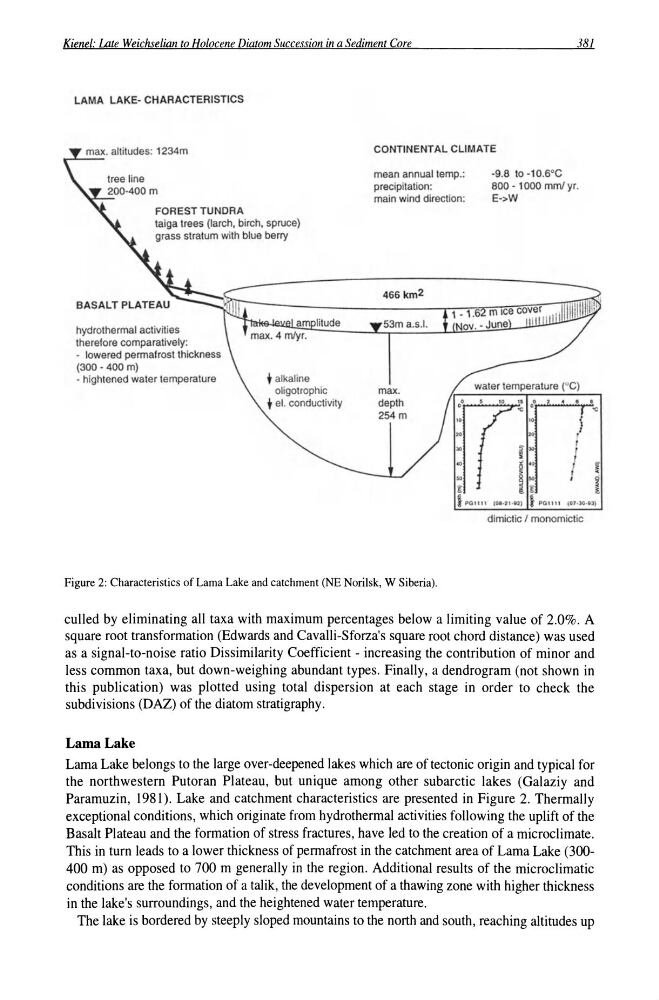
Figure 2: Characteristics of Lama Lake and catchment (NE Norilsk, W Siberia).
-9.8 to -10.6°C
600 - 1000 mml yr.
E->W
dimictic I monomictic
culled by eliminating all taxa with maximum percentages below a limiting value of 2.0%. A
square root transformation (Edwards and Cavalli-Sforza's square root chord distance) was used
as a signal-to-noise ratio Dissimilarity Coefficient - increasing the contribution of minor and
less common taxa, but down-weighing abundant types. Finally, a dendrogram (not shown in
this publication) was plotted using total dispersion at each stage in order to check the
subdivisions (DAZ) of the diatom stratigraphy.
Lama Lake
Lama Lake belongs to the large over-deepened lakes which are of tectonic origin and typical for
the northwestern Putoran Plateau, but unique among other subarctic lakes (Galaziy and
Paramuzin, 1981). Lake and catchment characteristics are presented in Figure 2. Thermally
exceptional conditions, which originate from hydrothermal activities following the uplift of the
Basalt Plateau and the formation of stress fractures, have led to the creation of a microclimate.
This in turn leads to a lower thickness of permafrost in the catchment area of Lama Lake (300400 m) as opposed to 700 m generally in the region. Additional results of the microclimatic
conditions are the formation of a talik, the development of a thawing zone with higher thickness
in the lake's surroundings, and the heightened water temperature.
The lake is bordered by steeply sloped mountains to the north and south, reaching altitudes up
381
LAMA LAKE- CHARACTERISTICS
CONTINENTAL CLIMATE
FOREST TUNDRA
taiga trees (larch, birch. spruce)
grass stratum with blue berry
hydrothermal activities
therefore comparatively:
- lowered permalrost thickness
(300 - 400 m)
- hightened water temperature
• alkaline
oligotrophic
• el conductivity
mean annual temp.:
precipitation:
main wind direction :
max .
depth
254 m
Figure 2: Characteristics of Lama Lake and catchment (NE Norilsk, W Siberia).
-9.8 to -10.6°C
600 - 1000 mml yr.
E->W
dimictic I monomictic
culled by eliminating all taxa with maximum percentages below a limiting value of 2.0%. A
square root transformation (Edwards and Cavalli-Sforza's square root chord distance) was used
as a signal-to-noise ratio Dissimilarity Coefficient - increasing the contribution of minor and
less common taxa, but down-weighing abundant types. Finally, a dendrogram (not shown in
this publication) was plotted using total dispersion at each stage in order to check the
subdivisions (DAZ) of the diatom stratigraphy.
Lama Lake
Lama Lake belongs to the large over-deepened lakes which are of tectonic origin and typical for
the northwestern Putoran Plateau, but unique among other subarctic lakes (Galaziy and
Paramuzin, 1981). Lake and catchment characteristics are presented in Figure 2. Thermally
exceptional conditions, which originate from hydrothermal activities following the uplift of the
Basalt Plateau and the formation of stress fractures, have led to the creation of a microclimate.
This in turn leads to a lower thickness of permafrost in the catchment area of Lama Lake (300400 m) as opposed to 700 m generally in the region. Additional results of the microclimatic
conditions are the formation of a talik, the development of a thawing zone with higher thickness
in the lake's surroundings, and the heightened water temperature.
The lake is bordered by steeply sloped mountains to the north and south, reaching altitudes up