

378
Land-Ocean Systems in the Siberian Arctic: Dynamics and History
expected to be particularly sensitive to changes in the magnitude and timing of available energy
and to changes in physical and geochemical conditions (e.g. Maxwell, 1992; Vincent and
Pienitz, 1996).
Besides cladocera and chironomids, diatoms are the most frequently used fossil group in
paleolimnology since they tend to be well preserved, diverse, ubiquitous, and identifiable to a
low taxonomic level. Because of their short life cycle, they respond quickly to environmental
change (Dixit et aI., 1992) and, due to the considerable volume of data on their ecological
characteristics, they are a sensitive tool in reconstructions of past environmental conditions. In
contrast to palynology, diatom analysis provides an autochtonous signal. The assemblage of
diatoms preserved in lake sediments can directly reflect the floristic composition and
productivity of lake diatom communities, and can indirectly reflect lake water quality in terms of
nutrient status, lake water pH and salinity (Battarbee, 1986).
Multivariate statistical methods (including canonical correspondence analysis and weighted
averaging techniques as given in e.g. Birks et aI., 1990 and ter Braak and Looman, 1986) have
been used to infer these parameters from fossil diatom assemblages (e.g. pH: Birks et aI.,
1990; Stevenson et aI., 1991; nutrients: Hall and Smol, 1992; Anderson et aI., 1993; Bennion,
1995; Reavie et aI., 1995).
90"
100"
high-arctic
Tundra
arctic
Tundra
typical
Tundra
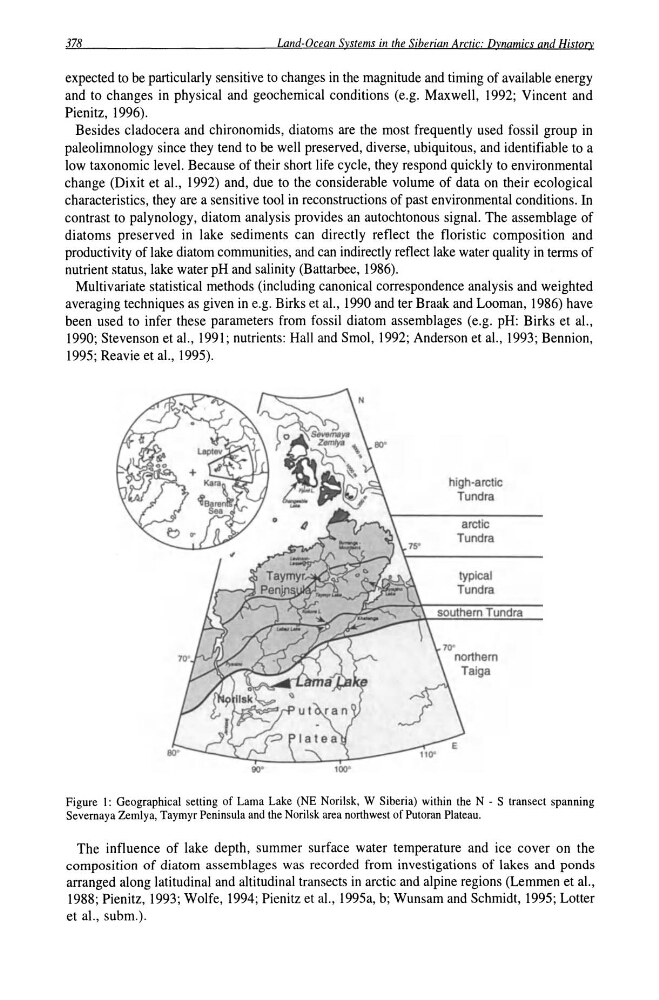
Figure 1: Geographical setting of Lama Lake (NE Norilsk, W Siberia) within the N - S transect spanning
Severnaya Zemlya, Taymyr Peninsula and the Norilsk area northwest of Putoran Plateau.
The influence of lake depth, summer surface water temperature and ice cover on the
composition of diatom assemblages was recorded from investigations of lakes and ponds
arranged along latitudinal and altitudinal transects in arctic and alpine regions (Lemmen et aI.,
1988; Pienitz, 1993; Wolfe, 1994; Pienitz et aI., 1995a, b; Wunsam and Schmidt, 1995; Lotter
et aI., subm.).
Land-Ocean Systems in the Siberian Arctic: Dynamics and History
expected to be particularly sensitive to changes in the magnitude and timing of available energy
and to changes in physical and geochemical conditions (e.g. Maxwell, 1992; Vincent and
Pienitz, 1996).
Besides cladocera and chironomids, diatoms are the most frequently used fossil group in
paleolimnology since they tend to be well preserved, diverse, ubiquitous, and identifiable to a
low taxonomic level. Because of their short life cycle, they respond quickly to environmental
change (Dixit et aI., 1992) and, due to the considerable volume of data on their ecological
characteristics, they are a sensitive tool in reconstructions of past environmental conditions. In
contrast to palynology, diatom analysis provides an autochtonous signal. The assemblage of
diatoms preserved in lake sediments can directly reflect the floristic composition and
productivity of lake diatom communities, and can indirectly reflect lake water quality in terms of
nutrient status, lake water pH and salinity (Battarbee, 1986).
Multivariate statistical methods (including canonical correspondence analysis and weighted
averaging techniques as given in e.g. Birks et aI., 1990 and ter Braak and Looman, 1986) have
been used to infer these parameters from fossil diatom assemblages (e.g. pH: Birks et aI.,
1990; Stevenson et aI., 1991; nutrients: Hall and Smol, 1992; Anderson et aI., 1993; Bennion,
1995; Reavie et aI., 1995).
90"
100"
high-arctic
Tundra
arctic
Tundra
typical
Tundra
Figure 1: Geographical setting of Lama Lake (NE Norilsk, W Siberia) within the N - S transect spanning
Severnaya Zemlya, Taymyr Peninsula and the Norilsk area northwest of Putoran Plateau.
The influence of lake depth, summer surface water temperature and ice cover on the
composition of diatom assemblages was recorded from investigations of lakes and ponds
arranged along latitudinal and altitudinal transects in arctic and alpine regions (Lemmen et aI.,
1988; Pienitz, 1993; Wolfe, 1994; Pienitz et aI., 1995a, b; Wunsam and Schmidt, 1995; Lotter
et aI., subm.).