

370
Land-Ocean Systems in the Siberian Arctic: Dynamics and History
Discussion
Hydrological investigations in July 1993 yielded a pH of 8.1 (water surface) and 7.8 (watersediment interface). As shown by Tessier et al. (1985), these conditions cause high adsorption
of the heavy metals by natural solids within the water column. The most important carriers of
heavy metals are Fe and Mn oxides, clay minerals and organic matter. The oxygen content of
12 mg 1-1 (water surface) and 2.8 mg 1-1 (water-sediment interface) indicate oxic conditions
over the whole water column during this time (Melles 1994).
According to McKee et al. (1989) and Williams (1992), the Mn peak at 7 cm depth indicates
the boundary between oxic (above) and anoxic (below) conditions in the sediment core. Within
the oxidized zone, algal degradation and Fe and Mn oxide precipitation occur. Burial in the
anoxic layer cause Fe and Mn reduction, with resultant upward migration to the oxic/anoxic
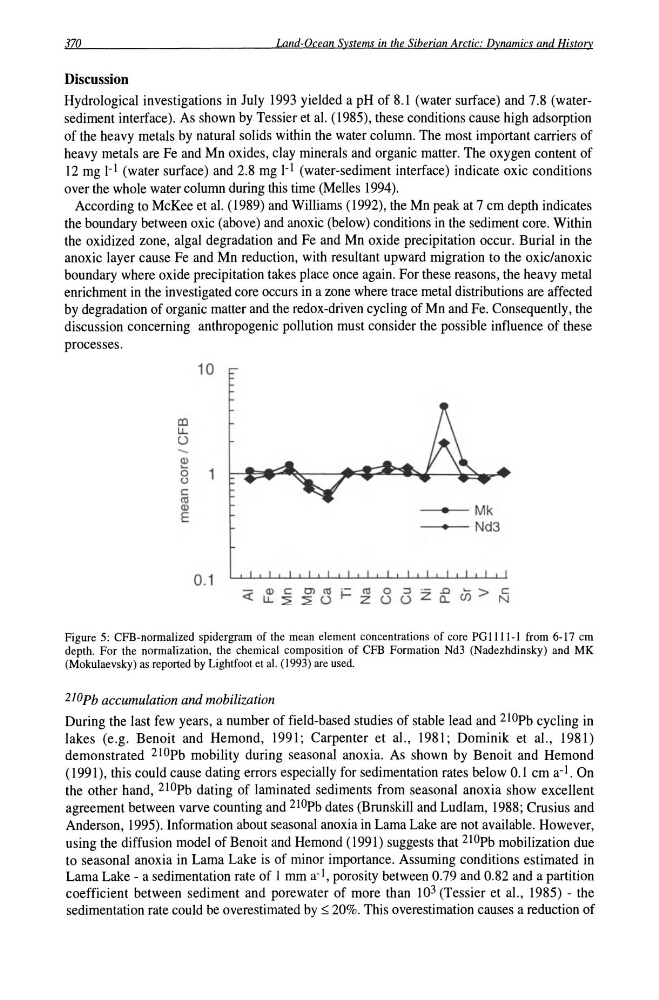
boundary where oxide precipitation takes place once again. For these reasons, the heavy metal
enrichment in the investigated core occurs in a zone where trace metal distributions are affected
by degradation of organic matter and the redox-driven cycling of Mn and Fe. Consequently, the
discussion concerning anthropogenic pollution must consider the possible influence of these
processes.
10
Cll
l.L
()
-- Q)
0 1
u
c:
CIl
Q)
• Mk
E
Nd3
0.1
Figure 5: CFB-nonnalized spidergram of the mean element concentrations of core PGIIII-I from 6-17 cm
depth. For the normalization, the chemical composition of CFB Formation Nd3 (Nadezhdinsky) and MK
(Mokulaevsky) as reported by Lightfoot et al. (1993) are used.
210Pb accumulation and mobilization
During the last few years, a number of field-based studies of stable lead and 210Pb cycling in
lakes (e.g. Benoit and Hemond, 1991; Carpenter et aI., 1981; Dominik et aI., 1981)
demonstrated 210Pb mobility during seasonal anoxia. As shown by Benoit and Hemond
(1991), this could cause dating errors especially for sedimentation rates below 0.1 cm a-I. On
the other hand, 210Pb dating of laminated sediments from seasonal anoxia show excellent
agreement between varve counting and 210Pb dates (Brunskill and Ludlam, 1988; Crusius and
Anderson, 1995). Information about seasonal anoxia in Lama Lake are not available. However,
using the diffusion model of Benoit and Hemond (1991) suggests that 21 0Pb mobilization due
to seasonal anoxia in Lama Lake is of minor importance. Assuming conditions estimated in
Lama Lake - a sedimentation rate of 1 mm a-I, porosity between 0.79 and 0.82 and a partition
coefficient between sediment and porewater of more than 10 3 (Tessier et aI., 1985) - the
sedimentation rate could be overestimated by ~ 20%. This overestimation causes a reduction of
Land-Ocean Systems in the Siberian Arctic: Dynamics and History
Discussion
Hydrological investigations in July 1993 yielded a pH of 8.1 (water surface) and 7.8 (watersediment interface). As shown by Tessier et al. (1985), these conditions cause high adsorption
of the heavy metals by natural solids within the water column. The most important carriers of
heavy metals are Fe and Mn oxides, clay minerals and organic matter. The oxygen content of
12 mg 1-1 (water surface) and 2.8 mg 1-1 (water-sediment interface) indicate oxic conditions
over the whole water column during this time (Melles 1994).
According to McKee et al. (1989) and Williams (1992), the Mn peak at 7 cm depth indicates
the boundary between oxic (above) and anoxic (below) conditions in the sediment core. Within
the oxidized zone, algal degradation and Fe and Mn oxide precipitation occur. Burial in the
anoxic layer cause Fe and Mn reduction, with resultant upward migration to the oxic/anoxic
boundary where oxide precipitation takes place once again. For these reasons, the heavy metal
enrichment in the investigated core occurs in a zone where trace metal distributions are affected
by degradation of organic matter and the redox-driven cycling of Mn and Fe. Consequently, the
discussion concerning anthropogenic pollution must consider the possible influence of these
processes.
10
Cll
l.L
()
-- Q)
0 1
u
c:
CIl
Q)
• Mk
E
Nd3
0.1
Figure 5: CFB-nonnalized spidergram of the mean element concentrations of core PGIIII-I from 6-17 cm
depth. For the normalization, the chemical composition of CFB Formation Nd3 (Nadezhdinsky) and MK
(Mokulaevsky) as reported by Lightfoot et al. (1993) are used.
210Pb accumulation and mobilization
During the last few years, a number of field-based studies of stable lead and 210Pb cycling in
lakes (e.g. Benoit and Hemond, 1991; Carpenter et aI., 1981; Dominik et aI., 1981)
demonstrated 210Pb mobility during seasonal anoxia. As shown by Benoit and Hemond
(1991), this could cause dating errors especially for sedimentation rates below 0.1 cm a-I. On
the other hand, 210Pb dating of laminated sediments from seasonal anoxia show excellent
agreement between varve counting and 210Pb dates (Brunskill and Ludlam, 1988; Crusius and
Anderson, 1995). Information about seasonal anoxia in Lama Lake are not available. However,
using the diffusion model of Benoit and Hemond (1991) suggests that 21 0Pb mobilization due
to seasonal anoxia in Lama Lake is of minor importance. Assuming conditions estimated in
Lama Lake - a sedimentation rate of 1 mm a-I, porosity between 0.79 and 0.82 and a partition
coefficient between sediment and porewater of more than 10 3 (Tessier et aI., 1985) - the
sedimentation rate could be overestimated by ~ 20%. This overestimation causes a reduction of