

332
Land-Ocean Systems in the Siberian Arctic: Dynamics and History
technique (McAuliffe, 1971) by a portable XPM-4 Gas Chromatograph (Chromatograph
Company, Russia) equipped with a flame ionization detector (FID) and a 2 m long stainless
steel column filled with Poropack Q resin.
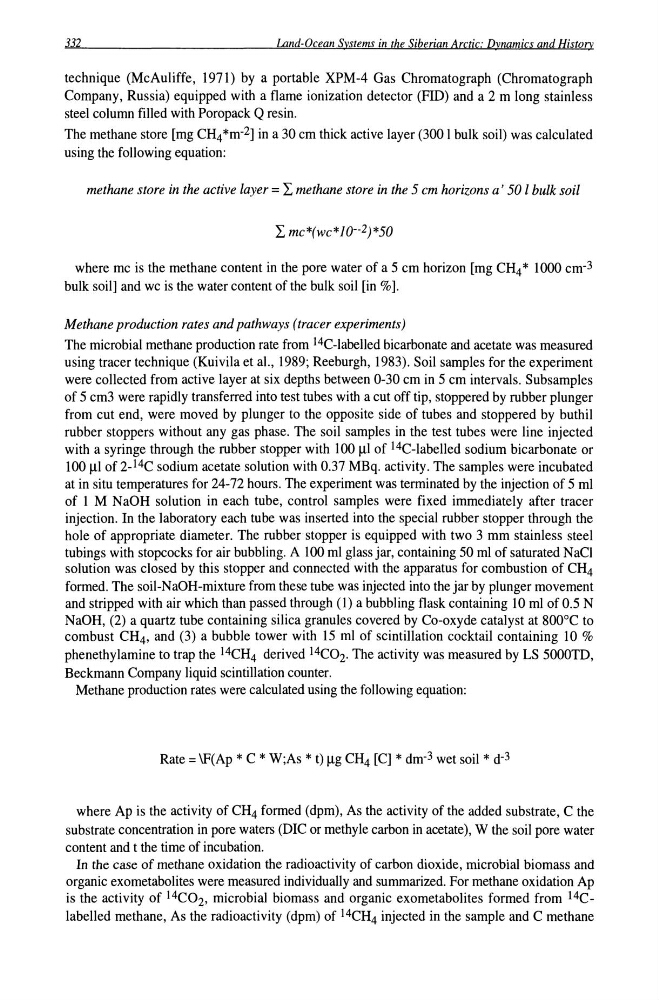
The methane store [mg CH 4 *m- 2 ] in a 30 cm thick active layer (300 I bulk soil) was calculated
using the following equation:
methane store in the active layer = L methane store in the 5 cm horizons a' 50 I bulk soil
L mc *(wc *10--2) *50
where mc is the methane content in the pore water of a 5 cm horizon [mg CH4* 1000 cm-3
bulk soil] and wc is the water content of the bulk soil [in %].
Methane production rates and pathways (tracer experiments)
The microbial methane production rate from 14C-Iabelled bicarbonate and acetate was measured
using tracer technique (Kuivila et aI., 1989; Reeburgh, 1983). Soil samples for the experiment
were collected from active layer at six depths between 0-30 cm in 5 cm intervals. Subsamples
of 5 cm3 were rapidly transferred into test tubes with a cut off tip, stoppered by rubber plunger
from cut end, were moved by plunger to the opposite side of tubes and stoppered by buthil
rubber stoppers without any gas phase. The soil samples in the test tubes were line injected
with a syringe through the rubber stopper with 100 III of 14C-Iabelled sodium bicarbonate or
100 III of2-14C sodium acetate solution with 0.37 MBq. activity. The samples were incubated
at in situ temperatures for 24-72 hours. The experiment was terminated by the injection of 5 ml
of I M NaOH solution in each tube, control samples were fixed immediately after tracer
injection. In the laboratory each tube was inserted into the special rubber stopper through the
hole of appropriate diameter. The rubber stopper is equipped with two 3 mm stainless steel
tubings with stopcocks for air bubbling. A 100 ml glass jar, containing 50 ml of saturated NaCI
solution was closed by this stopper and connected with the apparatus for combustion of CH 4
formed. The soil-NaOH-mixture from these tube was injected into the jar by plunger movement
and stripped with air which than passed through (I) a bubbling flask containing 10 ml of 0.5 N
NaOH, (2) a quartz tube containing silica granules covered by Co-oxyde catalyst at 800 D C to
combust CH 4 , and (3) a bubble tower with 15 ml of scintillation cocktail containing 10 %
phenethylamine to trap the 14CH 4 derived 14C0 2 . The activity was measured by LS 5000TD,
Beckmann Company liquid scintillation counter.
Methane production rates were calculated using the following equation:
Rate = \F(Ap * C * W;As * t) Ilg CH 4 [C] * dm- 3 wet soil * d- 3
where Ap is the activity of CH 4 formed (dpm), As the activity of the added substrate, C the
substrate concentration in pore waters (DIC or methyle carbon in acetate), W the soil pore water
content and t the time of incubation.
In the case of methane oxidation the radioactivity of carbon dioxide, microbial biomass and
organic exometabolites were measured individually and summarized. For methane oxidation Ap
is the activity of 14C0 2 , microbial biomass and organic exometabolites formed from 14C_
labelled methane, As the radioactivity (dpm) of 14CH 4 injected in the sample and C methane
Land-Ocean Systems in the Siberian Arctic: Dynamics and History
technique (McAuliffe, 1971) by a portable XPM-4 Gas Chromatograph (Chromatograph
Company, Russia) equipped with a flame ionization detector (FID) and a 2 m long stainless
steel column filled with Poropack Q resin.
The methane store [mg CH 4 *m- 2 ] in a 30 cm thick active layer (300 I bulk soil) was calculated
using the following equation:
methane store in the active layer = L methane store in the 5 cm horizons a' 50 I bulk soil
L mc *(wc *10--2) *50
where mc is the methane content in the pore water of a 5 cm horizon [mg CH4* 1000 cm-3
bulk soil] and wc is the water content of the bulk soil [in %].
Methane production rates and pathways (tracer experiments)
The microbial methane production rate from 14C-Iabelled bicarbonate and acetate was measured
using tracer technique (Kuivila et aI., 1989; Reeburgh, 1983). Soil samples for the experiment
were collected from active layer at six depths between 0-30 cm in 5 cm intervals. Subsamples
of 5 cm3 were rapidly transferred into test tubes with a cut off tip, stoppered by rubber plunger
from cut end, were moved by plunger to the opposite side of tubes and stoppered by buthil
rubber stoppers without any gas phase. The soil samples in the test tubes were line injected
with a syringe through the rubber stopper with 100 III of 14C-Iabelled sodium bicarbonate or
100 III of2-14C sodium acetate solution with 0.37 MBq. activity. The samples were incubated
at in situ temperatures for 24-72 hours. The experiment was terminated by the injection of 5 ml
of I M NaOH solution in each tube, control samples were fixed immediately after tracer
injection. In the laboratory each tube was inserted into the special rubber stopper through the
hole of appropriate diameter. The rubber stopper is equipped with two 3 mm stainless steel
tubings with stopcocks for air bubbling. A 100 ml glass jar, containing 50 ml of saturated NaCI
solution was closed by this stopper and connected with the apparatus for combustion of CH 4
formed. The soil-NaOH-mixture from these tube was injected into the jar by plunger movement
and stripped with air which than passed through (I) a bubbling flask containing 10 ml of 0.5 N
NaOH, (2) a quartz tube containing silica granules covered by Co-oxyde catalyst at 800 D C to
combust CH 4 , and (3) a bubble tower with 15 ml of scintillation cocktail containing 10 %
phenethylamine to trap the 14CH 4 derived 14C0 2 . The activity was measured by LS 5000TD,
Beckmann Company liquid scintillation counter.
Methane production rates were calculated using the following equation:
Rate = \F(Ap * C * W;As * t) Ilg CH 4 [C] * dm- 3 wet soil * d- 3
where Ap is the activity of CH 4 formed (dpm), As the activity of the added substrate, C the
substrate concentration in pore waters (DIC or methyle carbon in acetate), W the soil pore water
content and t the time of incubation.
In the case of methane oxidation the radioactivity of carbon dioxide, microbial biomass and
organic exometabolites were measured individually and summarized. For methane oxidation Ap
is the activity of 14C0 2 , microbial biomass and organic exometabolites formed from 14C_
labelled methane, As the radioactivity (dpm) of 14CH 4 injected in the sample and C methane