

Anisimov and PosDelov: The Landscape and Geobotanical Characteristics
317
2
9
15
22 ,~ 23
241 8 I Idl 25 261 <1J2]) 1 27 1~ 1 28 1~ 1
o
291- ~ 30 I
131 0 32 0 330 341:-1
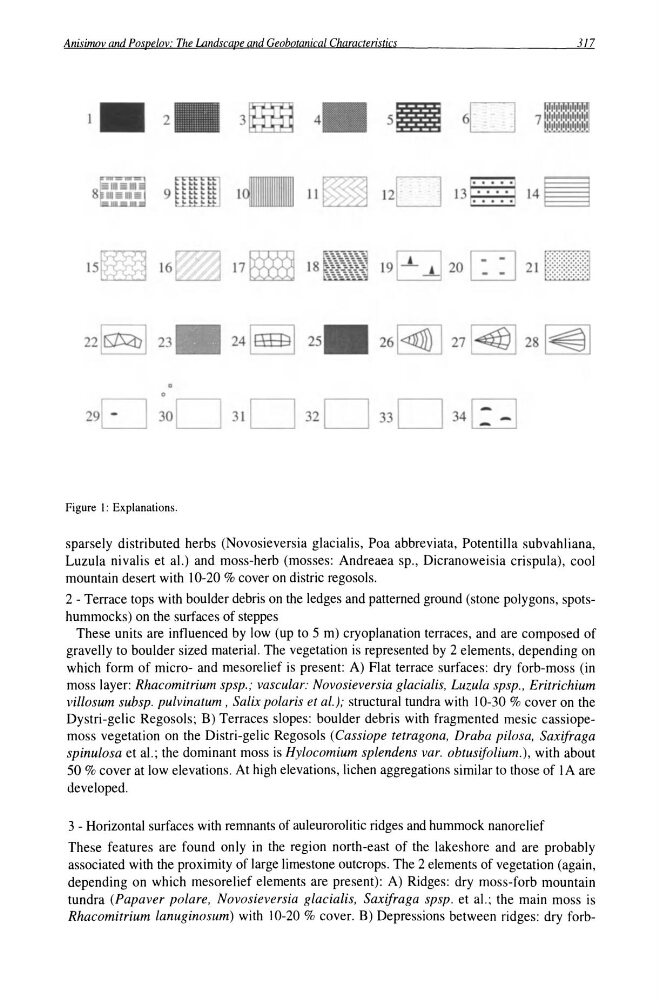
Figure I: Explanations.
sparsely distributed herbs (Novosieversia glacialis, Poa abbreviata, Potentilla subvahliana,
Luzula nivalis et al.) and moss-herb (mosses: Andreaea sp., Dicranoweisia crispula), cool
mountain desert with 10-20 % cover on distric regosols.
2 - Terrace tops with boulder debris on the ledges and patterned ground (stone polygons, spotshummocks) on the surfaces of steppes
These units are influenced by low (up to 5 m) cryoplanation terraces, and are composed of
gravelly to boulder sized material. The vegetation is represented by 2 elements, depending on
which form of micro- and mesorelief is present: A) Flat terrace surfaces: dry forb-moss (in
moss layer: Rhacomitrium spsp.; vascular: Novosieversia glacialis, Lumia spsp., Eritrichium
villosum subsp. pulvinatum, Salix polaris et al.); structural tundra with 10-30 % cover on the
Dystri-gelic Regosols; B) Terraces slopes: boulder debris with fragmented mesic cassiopemoss vegetation on the Distri-gelic Regosols (Cassiope tetragona, Draba pilosa, Saxifraga
spinulosa et al.; the dominant moss is Hylocomium splendens var. obtusifolium.), with about
50 % cover at low elevations. At high elevations, lichen aggregations similar to those of 1 A are
developed.
3 - Horizontal surfaces with remnants of auleurorolitic ridges and hummock nanorelief
These features are found only in the region north-east of the lakeshore and are probably
associated with the proximity of large limestone outcrops. The 2 elements of vegetation (again,
depending on which mesorelief elements are present): A) Ridges: dry moss-forb mountain
tundra (Papaver polare, Novosieversia glacialis, Saxifraga spsp. et al.; the main moss is
Rhacomitrium lanuginosum) with 10-20 % cover. B) Depressions between ridges: dry forb-
317
2
9
15
22 ,~ 23
241 8 I Idl 25 261 <1J2]) 1 27 1~ 1 28 1~ 1
o
291- ~ 30 I
131 0 32 0 330 341:-1
Figure I: Explanations.
sparsely distributed herbs (Novosieversia glacialis, Poa abbreviata, Potentilla subvahliana,
Luzula nivalis et al.) and moss-herb (mosses: Andreaea sp., Dicranoweisia crispula), cool
mountain desert with 10-20 % cover on distric regosols.
2 - Terrace tops with boulder debris on the ledges and patterned ground (stone polygons, spotshummocks) on the surfaces of steppes
These units are influenced by low (up to 5 m) cryoplanation terraces, and are composed of
gravelly to boulder sized material. The vegetation is represented by 2 elements, depending on
which form of micro- and mesorelief is present: A) Flat terrace surfaces: dry forb-moss (in
moss layer: Rhacomitrium spsp.; vascular: Novosieversia glacialis, Lumia spsp., Eritrichium
villosum subsp. pulvinatum, Salix polaris et al.); structural tundra with 10-30 % cover on the
Dystri-gelic Regosols; B) Terraces slopes: boulder debris with fragmented mesic cassiopemoss vegetation on the Distri-gelic Regosols (Cassiope tetragona, Draba pilosa, Saxifraga
spinulosa et al.; the dominant moss is Hylocomium splendens var. obtusifolium.), with about
50 % cover at low elevations. At high elevations, lichen aggregations similar to those of 1 A are
developed.
3 - Horizontal surfaces with remnants of auleurorolitic ridges and hummock nanorelief
These features are found only in the region north-east of the lakeshore and are probably
associated with the proximity of large limestone outcrops. The 2 elements of vegetation (again,
depending on which mesorelief elements are present): A) Ridges: dry moss-forb mountain
tundra (Papaver polare, Novosieversia glacialis, Saxifraga spsp. et al.; the main moss is
Rhacomitrium lanuginosum) with 10-20 % cover. B) Depressions between ridges: dry forb-