

300
Land-Ocean Systems in the Siberian Arctic: Dynamics and History
energy is transported downward (Hinkel and Outcalt, 1994). The extent of the saturated zone
(,suprapermafrost groundwater') depends on the hydrological inputs (precipitation, lateral
inflow, thaw of ice) and outputs (evaporation, lateral discharge) and is limited by the depth of
frozen ground. Transport through convection cells, driven by the density anomaly of water, has
been postulated for coarse, water saturated soils (Ray et al., 1983; Hallet, 1990). In the fall, net
radiation becomes negative, the active layer cools, freeze back is initiated and, as a result,
energy is produced and transported towards regions of lower temperatures. Outcalt et al. (1990)
suggest that internal distillation - evaporation of water, convection in the vapour phase and
subsequent condensation - is the dominant heat transfer process during this time. Although
several studies (e.g. Outcalt et al., 1990; Hinkel and Outcalt, 1994) have focused on the
S
0
I
L
I
N
P
U
T
S
s
0
L
U
T
I
0
N
0
U
T
P
U
T
S
Antecedent
solute
concentration
Release of
solutes from
vegetation
Precipitation
Soil water influx
to system
Decomposition
of litter
Particle Matrix
Leaching
from
exposed
surfaces
Exchange
sites
~
Frozen
Liquid
......
:: I Thin film b.
phase +- phase
"
Adsorbed
Soil water
Plant
Evaporation,
Precipitates,
efflux from
uptake,
evapocoatings,
system
(microbial,
transpiration
brines
root action)
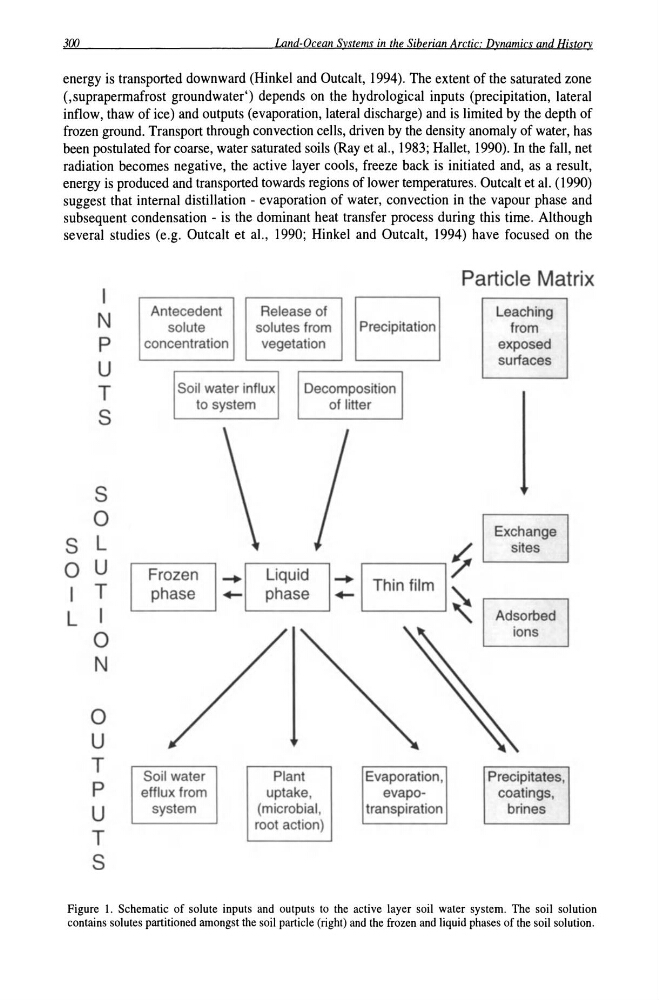
Figure I. Schematic of solute inputs and outputs to the active layer soil water system. The soil solution
contains solutes partitioned amongst the soil particle (right) and the frozen and liquid phases of the soil solution.
Land-Ocean Systems in the Siberian Arctic: Dynamics and History
energy is transported downward (Hinkel and Outcalt, 1994). The extent of the saturated zone
(,suprapermafrost groundwater') depends on the hydrological inputs (precipitation, lateral
inflow, thaw of ice) and outputs (evaporation, lateral discharge) and is limited by the depth of
frozen ground. Transport through convection cells, driven by the density anomaly of water, has
been postulated for coarse, water saturated soils (Ray et al., 1983; Hallet, 1990). In the fall, net
radiation becomes negative, the active layer cools, freeze back is initiated and, as a result,
energy is produced and transported towards regions of lower temperatures. Outcalt et al. (1990)
suggest that internal distillation - evaporation of water, convection in the vapour phase and
subsequent condensation - is the dominant heat transfer process during this time. Although
several studies (e.g. Outcalt et al., 1990; Hinkel and Outcalt, 1994) have focused on the
S
0
I
L
I
N
P
U
T
S
s
0
L
U
T
I
0
N
0
U
T
P
U
T
S
Antecedent
solute
concentration
Release of
solutes from
vegetation
Precipitation
Soil water influx
to system
Decomposition
of litter
Particle Matrix
Leaching
from
exposed
surfaces
Exchange
sites
~
Frozen
Liquid
......
:: I Thin film b.
phase +- phase
"
Adsorbed
Soil water
Plant
Evaporation,
Precipitates,
efflux from
uptake,
evapocoatings,
system
(microbial,
transpiration
brines
root action)
Figure I. Schematic of solute inputs and outputs to the active layer soil water system. The soil solution
contains solutes partitioned amongst the soil particle (right) and the frozen and liquid phases of the soil solution.