

266
,
Sediment-laden sea ice
and icebergs
Bottom
curre~
Deep Sea
Land-Ocean Systems in the Siberian Arctic: Dynamics and History
Aeolian sediment supply
+Fluvial sediment supply
Polynya
. . . . .
Eurasian
Continental Margin
Geology of the
hinterland
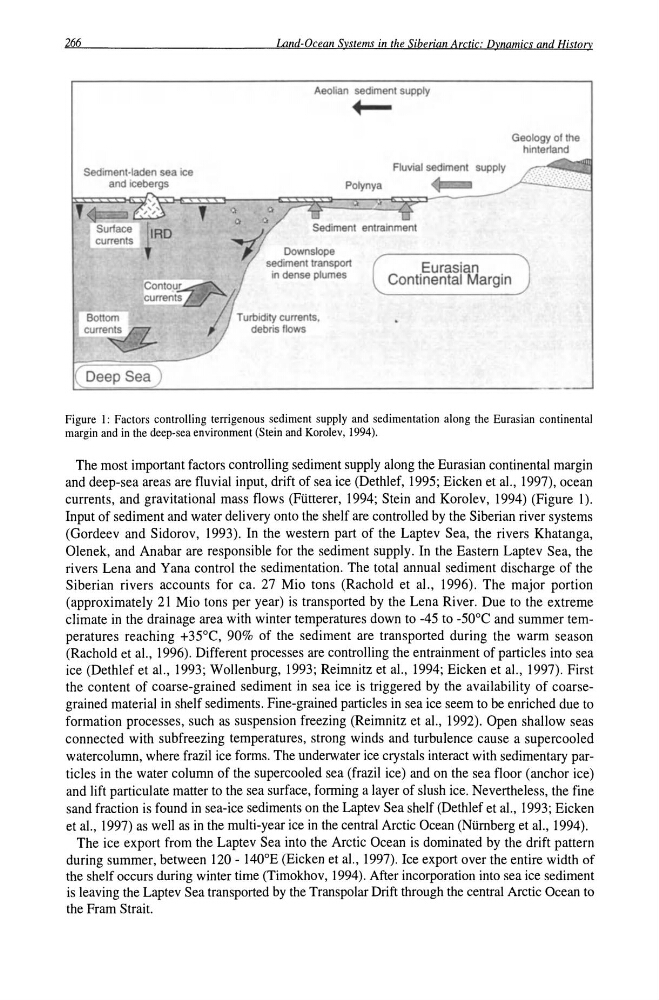
Figure I: Factors controlling terrigenous sediment supply and sedimentation along the Eurasian continental
margin and in the deep-sea environment (Stein and Korolev, 1994).
The most important factors controlling sediment supply along the Eurasian continental margin
and deep-sea areas are fluvial input, drift of sea ice (Dethlef, 1995; Eicken et a!., 1997), ocean
currents, and gravitational mass flows (Ftitterer, 1994; Stein and Korolev, 1994) (Figure 1).
Input of sediment and water delivery onto the shelf are controlled by the Siberian river systems
(Gordeev and Sidorov, 1993). In the western part of the Laptev Sea, the rivers Khatanga,
Olenek, and Anabar are responsible for the sediment supply. In the Eastern Laptev Sea, the
rivers Lena and Yana control the sedimentation. The total annual sediment discharge of the
Siberian rivers accounts for ca. 27 Mio tons (Rachold et aI., 1996). The major portion
(approximately 21 Mio tons per year) is transported by the Lena River. Due to the extreme
climate in the drainage area with winter temperatures down to -45 to -50°C and summer temperatures reaching +35°C, 90% of the sediment are transported during the warm season
(Rachold et a!., 1996). Different processes are controlling the entrainment of particles into sea
ice (Dethlef et aI., 1993; Wollenburg, 1993; Reimnitz et a!., 1994; Eicken et a!., 1997). First
the content of coarse-grained sediment in sea ice is triggered by the availability of coarsegrained material in shelf sediments. Fine-grained particles in sea ice seem to be enriched due to
formation processes, such as suspension freezing (Reimnitz et a!., 1992). Open shallow seas
connected with subfreezing temperatures, strong winds and turbulence cause a supercooled
watercolumn, where frazil ice forms. The underwater ice crystals interact with sedimentary particles in the water column of the supercooled sea (frazil ice) and on the sea floor (anchor ice)
and lift particulate matter to the sea surface, forming a layer of slush ice. Nevertheless, the fine
sand fraction is found in sea-ice sediments on the Laptev Sea shelf (Dethlef et a!., 1993; Eicken
et a!., 1997) as well as in the multi-year ice in the central Arctic Ocean (Ntirnberg et a!., 1994).
The ice export from the Laptev Sea into the Arctic Ocean is dominated by the drift pattern
during summer, between 120 - 1400E (Eicken et aI., 1997). Ice export over the entire width of
the shelf occurs during winter time (Timokhov, 1994). After incorporation into sea ice sediment
is leaving the Laptev Sea transported by the Transpolar Drift through the central Arctic Ocean to
the Fram Strait.
,
Sediment-laden sea ice
and icebergs
Bottom
curre~
Deep Sea
Land-Ocean Systems in the Siberian Arctic: Dynamics and History
Aeolian sediment supply
+Fluvial sediment supply
Polynya
. . . . .
Eurasian
Continental Margin
Geology of the
hinterland
Figure I: Factors controlling terrigenous sediment supply and sedimentation along the Eurasian continental
margin and in the deep-sea environment (Stein and Korolev, 1994).
The most important factors controlling sediment supply along the Eurasian continental margin
and deep-sea areas are fluvial input, drift of sea ice (Dethlef, 1995; Eicken et a!., 1997), ocean
currents, and gravitational mass flows (Ftitterer, 1994; Stein and Korolev, 1994) (Figure 1).
Input of sediment and water delivery onto the shelf are controlled by the Siberian river systems
(Gordeev and Sidorov, 1993). In the western part of the Laptev Sea, the rivers Khatanga,
Olenek, and Anabar are responsible for the sediment supply. In the Eastern Laptev Sea, the
rivers Lena and Yana control the sedimentation. The total annual sediment discharge of the
Siberian rivers accounts for ca. 27 Mio tons (Rachold et aI., 1996). The major portion
(approximately 21 Mio tons per year) is transported by the Lena River. Due to the extreme
climate in the drainage area with winter temperatures down to -45 to -50°C and summer temperatures reaching +35°C, 90% of the sediment are transported during the warm season
(Rachold et a!., 1996). Different processes are controlling the entrainment of particles into sea
ice (Dethlef et aI., 1993; Wollenburg, 1993; Reimnitz et a!., 1994; Eicken et a!., 1997). First
the content of coarse-grained sediment in sea ice is triggered by the availability of coarsegrained material in shelf sediments. Fine-grained particles in sea ice seem to be enriched due to
formation processes, such as suspension freezing (Reimnitz et a!., 1992). Open shallow seas
connected with subfreezing temperatures, strong winds and turbulence cause a supercooled
watercolumn, where frazil ice forms. The underwater ice crystals interact with sedimentary particles in the water column of the supercooled sea (frazil ice) and on the sea floor (anchor ice)
and lift particulate matter to the sea surface, forming a layer of slush ice. Nevertheless, the fine
sand fraction is found in sea-ice sediments on the Laptev Sea shelf (Dethlef et a!., 1993; Eicken
et a!., 1997) as well as in the multi-year ice in the central Arctic Ocean (Ntirnberg et a!., 1994).
The ice export from the Laptev Sea into the Arctic Ocean is dominated by the drift pattern
during summer, between 120 - 1400E (Eicken et aI., 1997). Ice export over the entire width of
the shelf occurs during winter time (Timokhov, 1994). After incorporation into sea ice sediment
is leaving the Laptev Sea transported by the Transpolar Drift through the central Arctic Ocean to
the Fram Strait.