

12
Land-Ocean Systems in the Siberian Arctic: Dynamics and History
Winter
Summer
: ~ -_::-: , I I I , \ .................... \ \ \ , .. ...
',
. , I I , . . . . . _ , , , ,,' \ , , _
.I/JI ... ___ .......... \,\' ......
. 1\' 1. _ __ ___ . . . . . . . . , , __
.
, \ . . . .-. ".". - _ ........... "", -~
1
\ ..... .,.,,, ............ , \ \ , ..... ~
... ,
• I t \ ..... #' .. I .. . . . . ~ , I I j I .,,,..
. , \ , . . . . . ~
• • I , 1 ;//_ .. t
•
I
\
,
•
. . ' •
, I II... ... I'
...
t r . . . . ... _ ... ~ / //~ I' 'I
· ~\i;:-~::;r// -' ,
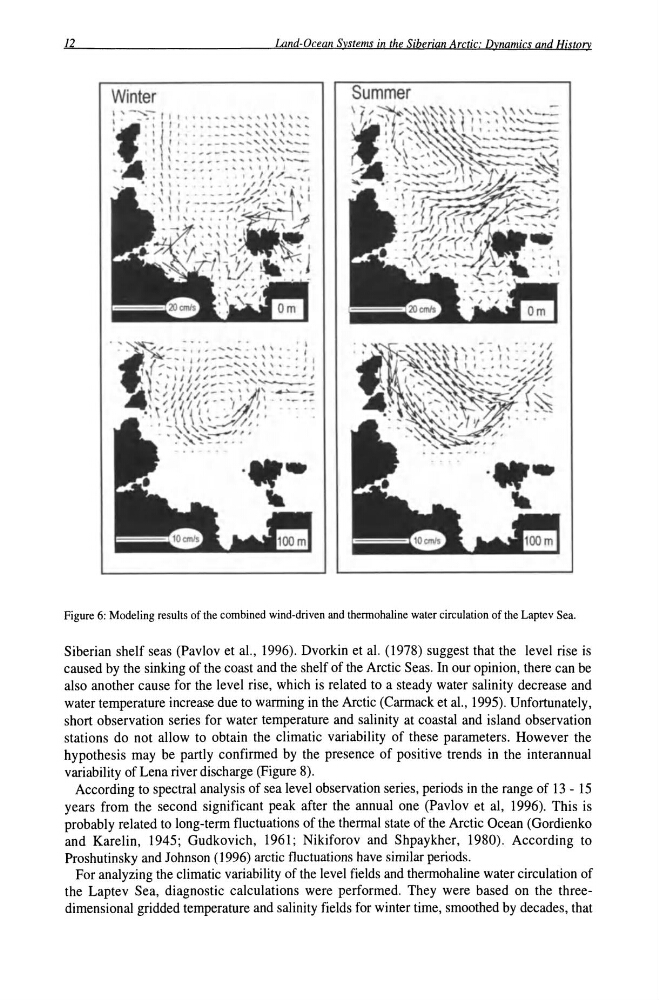
Figure 6: Modeling results of the combined wind-driven and thermohaline water circulation of the Laptev Sea.
Siberian shelf seas (Pavlov et aI., 1996). Dvorkin et al. (1978) suggest that the level rise is
caused by the sinking of the coast and the shelf of the Arctic Seas. In our opinion, there can be
also another cause for the level rise, which is related to a steady water salinity decrease and
water temperature increase due to warming in the Arctic (Carmack et aI., 1995). Unfortunately,
short observation series for water temperature and salinity at coastal and island observation
stations do not allow to obtain the climatic variability of these parameters. However the
hypothesis may be partly confirmed by the presence of positive trends in the interannual
variability of Lena river discharge (Figure 8).
According to spectral analysis of sea level observation series, periods in the range of 13 - 15
years from the second significant peak after the annual one (Pavlov et ai, 1996). This is
probably related to long-term fluctuations of the thermal state of the Arctic Ocean (Gordienko
and Karelin, 1945; Gudkovich, 1961; Nikiforov and Shpaykher, 1980). According to
Proshutinsky and Johnson (1996) arctic fluctuations have similar periods.
For analyzing the climatic variability of the level fields and thermohaline water circulation of
the Laptev Sea, diagnostic calculations were performed. They were based on the threedimensional gridded temperature and salinity fields for winter time, smoothed by decades, that
Land-Ocean Systems in the Siberian Arctic: Dynamics and History
Winter
Summer
: ~ -_::-: , I I I , \ .................... \ \ \ , .. ...
',
. , I I , . . . . . _ , , , ,,' \ , , _
.I/JI ... ___ .......... \,\' ......
. 1\' 1. _ __ ___ . . . . . . . . , , __
.
, \ . . . .-. ".". - _ ........... "", -~
1
\ ..... .,.,,, ............ , \ \ , ..... ~
... ,
• I t \ ..... #' .. I .. . . . . ~ , I I j I .,,,..
. , \ , . . . . . ~
• • I , 1 ;//_ .. t
•
I
\
,
•
. . ' •
, I II... ... I'
...
t r . . . . ... _ ... ~ / //~ I' 'I
· ~\i;:-~::;r// -' ,
Figure 6: Modeling results of the combined wind-driven and thermohaline water circulation of the Laptev Sea.
Siberian shelf seas (Pavlov et aI., 1996). Dvorkin et al. (1978) suggest that the level rise is
caused by the sinking of the coast and the shelf of the Arctic Seas. In our opinion, there can be
also another cause for the level rise, which is related to a steady water salinity decrease and
water temperature increase due to warming in the Arctic (Carmack et aI., 1995). Unfortunately,
short observation series for water temperature and salinity at coastal and island observation
stations do not allow to obtain the climatic variability of these parameters. However the
hypothesis may be partly confirmed by the presence of positive trends in the interannual
variability of Lena river discharge (Figure 8).
According to spectral analysis of sea level observation series, periods in the range of 13 - 15
years from the second significant peak after the annual one (Pavlov et ai, 1996). This is
probably related to long-term fluctuations of the thermal state of the Arctic Ocean (Gordienko
and Karelin, 1945; Gudkovich, 1961; Nikiforov and Shpaykher, 1980). According to
Proshutinsky and Johnson (1996) arctic fluctuations have similar periods.
For analyzing the climatic variability of the level fields and thermohaline water circulation of
the Laptev Sea, diagnostic calculations were performed. They were based on the threedimensional gridded temperature and salinity fields for winter time, smoothed by decades, that