

174
Land-Ocean SYstems in the Siberian Arctic: Dynamics and History
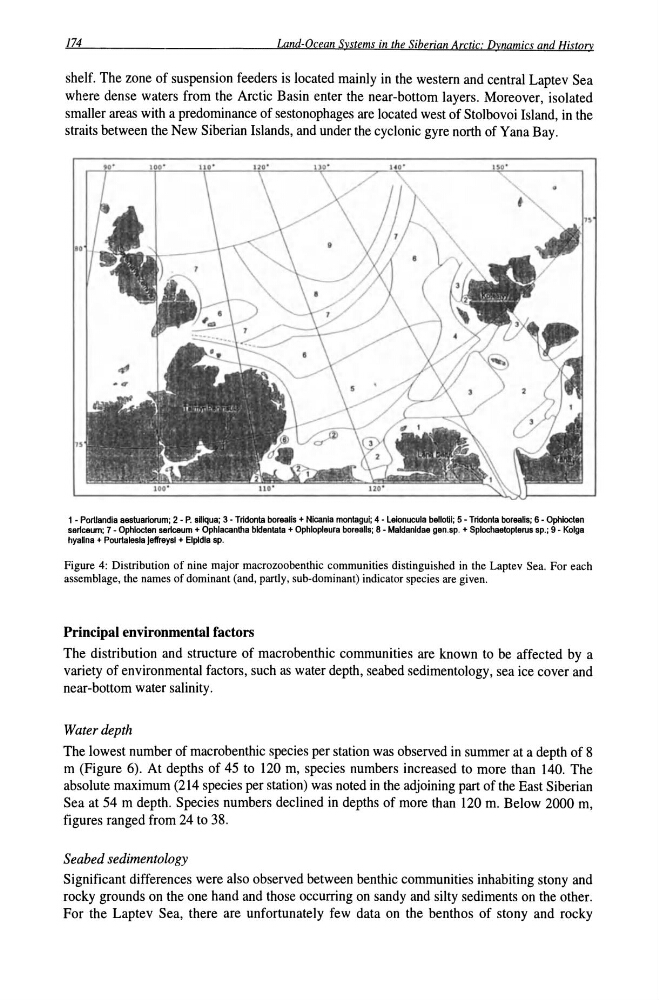
shelf. The zone of suspension feeders is located mainly in the western and central Laptev Sea
where dense waters from the Arctic Basin enter the near-bottom layers. Moreover, isolated
smaller areas with a predominance of sestonophages are located west of Stolbovoi Island, in the
straits between the New Siberian Islands, and under the cyclonic gyre north of Yana Bay.
1 - Portlandia aestuariorum; 2 - P. siliqua; 3 - Tridonla borealis + Nicania montagui; 4 - Leionucuta bellotii; 5 - Tridonta borealis; 6 - Ophiocten
serlceum; 7 - Ophloctan serlceum + Ophlacantha bldenlala + Ophlopleura borealis; 8 - Maldanldae gen.sp. + Splochaetopterus sp.; 9 - Koiga
hyallna + Pourlalesla Jeffreysl + Elpldla sp.
Figure 4: Distribution of nine major macrozoobenthic communities distinguished in the Laptev Sea. For each
assemblage, the names of dominant (and, partly, sub-dominant) indicator species are given.
Principal environmental factors
The distribution and structure of macro benthic communities are known to be affected by a
variety of environmental factors, such as water depth, seabed sedimentology, sea ice cover and
near-bottom water salinity.
Water depth
The lowest number of macrobenthic species per station was observed in summer at a depth of 8
m (Figure 6). At depths of 45 to 120 m, species numbers increased to more than 140. The
absolute maximum (214 species per station) was noted in the adjoining part of the East Siberian
Sea at 54 m depth. Species numbers declined in depths of more than 120 m. Below 2000 m,
figures ranged from 24 to 38.
Seabed sedimentology
Significant differences were also observed between benthic communities inhabiting stony and
rocky grounds on the one hand and those occurring on sandy and silty sediments on the other.
For the Laptev Sea, there are unfortunately few data on the benthos of stony and rocky
Land-Ocean SYstems in the Siberian Arctic: Dynamics and History
shelf. The zone of suspension feeders is located mainly in the western and central Laptev Sea
where dense waters from the Arctic Basin enter the near-bottom layers. Moreover, isolated
smaller areas with a predominance of sestonophages are located west of Stolbovoi Island, in the
straits between the New Siberian Islands, and under the cyclonic gyre north of Yana Bay.
1 - Portlandia aestuariorum; 2 - P. siliqua; 3 - Tridonla borealis + Nicania montagui; 4 - Leionucuta bellotii; 5 - Tridonta borealis; 6 - Ophiocten
serlceum; 7 - Ophloctan serlceum + Ophlacantha bldenlala + Ophlopleura borealis; 8 - Maldanldae gen.sp. + Splochaetopterus sp.; 9 - Koiga
hyallna + Pourlalesla Jeffreysl + Elpldla sp.
Figure 4: Distribution of nine major macrozoobenthic communities distinguished in the Laptev Sea. For each
assemblage, the names of dominant (and, partly, sub-dominant) indicator species are given.
Principal environmental factors
The distribution and structure of macro benthic communities are known to be affected by a
variety of environmental factors, such as water depth, seabed sedimentology, sea ice cover and
near-bottom water salinity.
Water depth
The lowest number of macrobenthic species per station was observed in summer at a depth of 8
m (Figure 6). At depths of 45 to 120 m, species numbers increased to more than 140. The
absolute maximum (214 species per station) was noted in the adjoining part of the East Siberian
Sea at 54 m depth. Species numbers declined in depths of more than 120 m. Below 2000 m,
figures ranged from 24 to 38.
Seabed sedimentology
Significant differences were also observed between benthic communities inhabiting stony and
rocky grounds on the one hand and those occurring on sandy and silty sediments on the other.
For the Laptev Sea, there are unfortunately few data on the benthos of stony and rocky