

166
Land-Ocean Systems in the Siberian Arctic: Dynamics and History
of population proceeds until November. Later only mature males and females are encountered,
evidently producing resting eggs. Early nauplii of new generation appear in June. Life cycle of
1. tolii may be probably similar.
600 -
M
E 500
- "C
C 400 '
or
(,)
C 300
ca
"C
C
::::J 200
.a
«
100
o
--- ----- .---_ l!3 1iiiiI ~ ~ t
is,
1 2 3 4 5 6 7 8 9 10 11 12 13 14 15 16 17 18 19 20 21 22 23 24 25
Stations
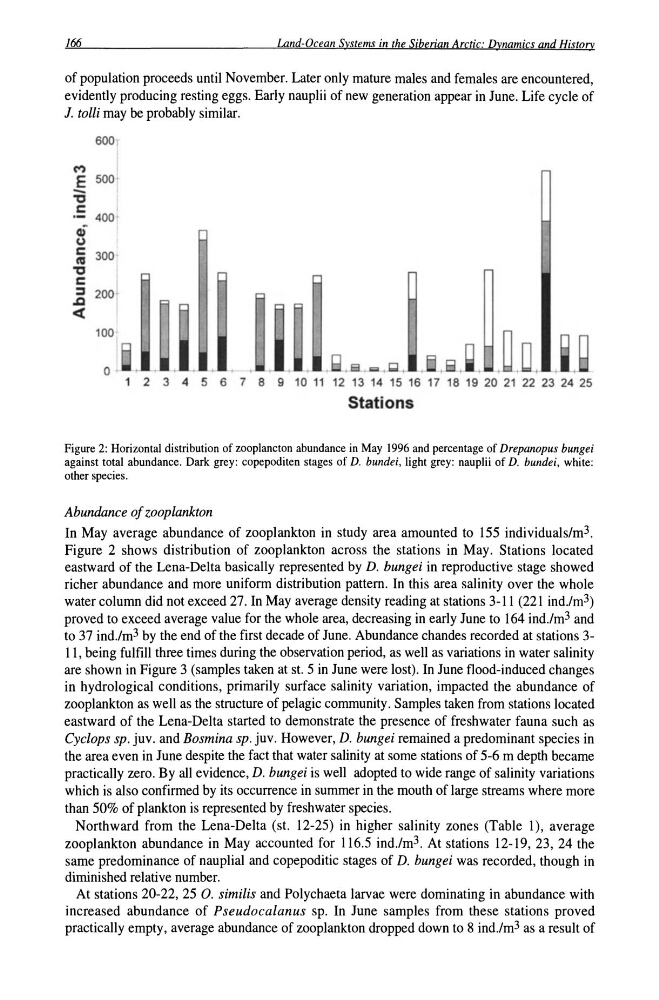
Figure 2: Horizontal distribution of zooplancton abundance in May 1996 and percentage of Drepanopus bungei
against total abundance. Dark grey: copepoditen stages of D_ bundei, light grey: nauplii of D. bundei, white:
other species.
Abundance of zooplankton
In May average abundance of zooplankton in study area amounted to 155 individuals/m 3 .
Figure 2 shows distribution of zooplankton across the stations in May. Stations located
eastward of the Lena-Delta basically represented by D. bungei in reproductive stage showed
richer abundance and more uniform distribution pattern. In this area salinity over the whole
water column did not exceed 27. In May average density reading at stations 3-11 (221 ind.lm 3 )
proved to exceed average value for the whole area, decreasing in early June to 164 ind.lm3 and
to 37 ind.lm 3 by the end of the first decade of June. Abundance chandes recorded at stations 311, being fulfill three times during the observation period, as well as variations in water salinity
are shown in Figure 3 (samples taken at st. 5 in June were lost). In June flood-induced changes
in hydrological conditions, primarily surface salinity variation, impacted the abundance of
zooplankton as well as the structure of pelagic community. Samples taken from stations located
eastward of the Lena-Delta started to demonstrate the presence of freshwater fauna such as
Cyclops sp. juv. and Bosmina sp. juv. However, D. bungei remained a predominant species in
the area even in June despite the fact that water salinity at some stations of 5-6 m depth became
practically zero. By all evidence, D. bungei is well adopted to wide range of salinity variations
which is also confirmed by its occurrence in summer in the mouth of large streams where more
than 50% of plankton is represented by freshwater species.
Northward from the Lena-Delta (st. 12-25) in higher salinity zones (Table 1), average
zooplankton abundance in May accounted for 116.5 ind.lm 3 . At stations 12-19,23,24 the
same predominance of nauplial and copepoditic stages of D. bungei was recorded, though in
diminished relative number.
At stations 20-22, 25 O. similis and Polychaeta larvae were dominating in abundance with
increased abundance of Pseudocalanus sp. In June samples from these stations proved
practically empty, average abundance of zooplankton dropped down to 8 ind.lm 3 as a result of
Land-Ocean Systems in the Siberian Arctic: Dynamics and History
of population proceeds until November. Later only mature males and females are encountered,
evidently producing resting eggs. Early nauplii of new generation appear in June. Life cycle of
1. tolii may be probably similar.
600 -
M
E 500
- "C
C 400 '
or
(,)
C 300
ca
"C
C
::::J 200
.a
«
100
o
--- ----- .---_ l!3 1iiiiI ~ ~ t
is,
1 2 3 4 5 6 7 8 9 10 11 12 13 14 15 16 17 18 19 20 21 22 23 24 25
Stations
Figure 2: Horizontal distribution of zooplancton abundance in May 1996 and percentage of Drepanopus bungei
against total abundance. Dark grey: copepoditen stages of D_ bundei, light grey: nauplii of D. bundei, white:
other species.
Abundance of zooplankton
In May average abundance of zooplankton in study area amounted to 155 individuals/m 3 .
Figure 2 shows distribution of zooplankton across the stations in May. Stations located
eastward of the Lena-Delta basically represented by D. bungei in reproductive stage showed
richer abundance and more uniform distribution pattern. In this area salinity over the whole
water column did not exceed 27. In May average density reading at stations 3-11 (221 ind.lm 3 )
proved to exceed average value for the whole area, decreasing in early June to 164 ind.lm3 and
to 37 ind.lm 3 by the end of the first decade of June. Abundance chandes recorded at stations 311, being fulfill three times during the observation period, as well as variations in water salinity
are shown in Figure 3 (samples taken at st. 5 in June were lost). In June flood-induced changes
in hydrological conditions, primarily surface salinity variation, impacted the abundance of
zooplankton as well as the structure of pelagic community. Samples taken from stations located
eastward of the Lena-Delta started to demonstrate the presence of freshwater fauna such as
Cyclops sp. juv. and Bosmina sp. juv. However, D. bungei remained a predominant species in
the area even in June despite the fact that water salinity at some stations of 5-6 m depth became
practically zero. By all evidence, D. bungei is well adopted to wide range of salinity variations
which is also confirmed by its occurrence in summer in the mouth of large streams where more
than 50% of plankton is represented by freshwater species.
Northward from the Lena-Delta (st. 12-25) in higher salinity zones (Table 1), average
zooplankton abundance in May accounted for 116.5 ind.lm 3 . At stations 12-19,23,24 the
same predominance of nauplial and copepoditic stages of D. bungei was recorded, though in
diminished relative number.
At stations 20-22, 25 O. similis and Polychaeta larvae were dominating in abundance with
increased abundance of Pseudocalanus sp. In June samples from these stations proved
practically empty, average abundance of zooplankton dropped down to 8 ind.lm 3 as a result of