

150
Land-Ocean Systems in the Siberian Arctic: Dynamics and History
movement of the ice edge can lead to upwelling processes near the ice edge (Fennel, 1997) and
thus to nutrient replenishment in the surface layeL Wind stress at the ice edge is mediated to the
water below and can cause Ekman transport showing similarities to the processes at coastal
boundaries. During summer 1993, several shifts of the ice edge across the upper slope section
of transect H were detected by comparing satellite images provided by 1. Kolatschek and T.
Martin (AWl Physik I). The differences in the pigment concentrations and enzyme activity at
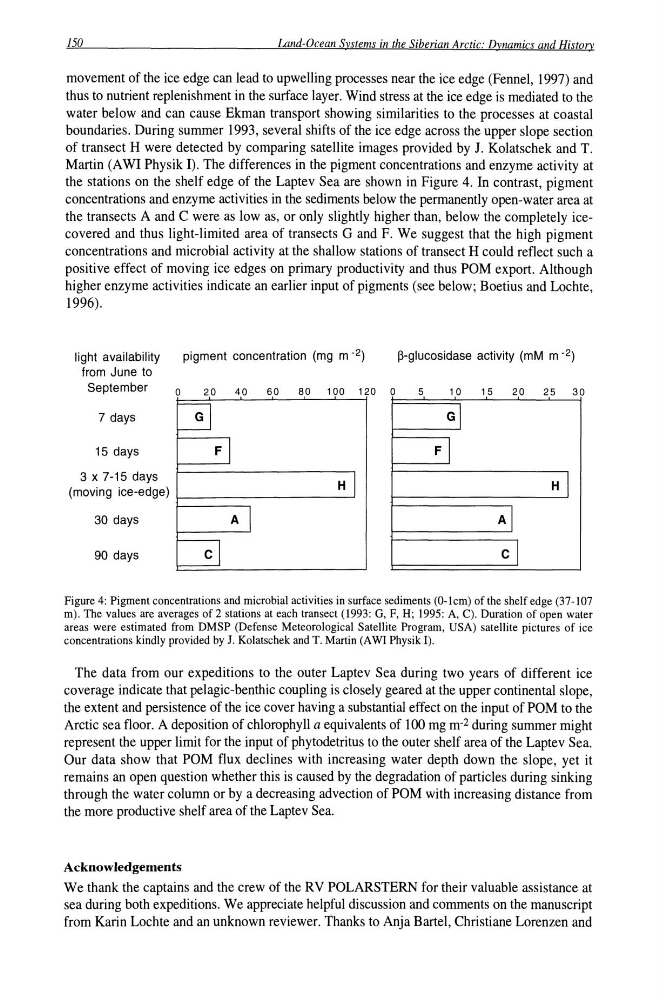
the stations on the shelf edge of the Laptev Sea are shown in Figure 4. In contrast, pigment
concentrations and enzyme activities in the sediments below the permanently open-water area at
the transects A and C were as low as, or only slightly higher than, below the completely icecovered and thus light-limited area of transects G and F. We suggest that the high pigment
concentrations and microbial activity at the shallow stations of transect H could reflect such a
positive effect of moving ice edges on primary productivity and thus POM export. Although
higher enzyme activities indicate an earlier input of pigments (see below; Boetius and Lochte,
1996).
light availability
from June to
September
7 days
15 days
3 x 7-15 days
(moving ice-edge)
30 days
90 days
pigment concentration (mg m -2)
o 20 40 60 80 100 120 0
G
Fl
HI
AI
G
~-glucosidase activity (mM m -2)
5
10
15
20
25
30
GI
FI
HI
AI
cl
Figure 4: Pigment concentrations and microbial activities in surface sediments (O-lcm) of the shelf edge (37-107
m). The values are averages of 2 stations at each transect (1993: G, F, H; 1995: A, C). Duration of open water
areas were estimated from DMSP (Defense Meteorological Satellite Program, USA) satellite pictures of ice
concentrations kindly provided by J. Kolatschek and T. Martin (A WI Physik I).
The data from our expeditions to the outer Laptev Sea during two years of different ice
coverage indicate that pelagic-benthic coupling is closely geared at the upper continental slope,
the extent and persistence of the ice cover having a substantial effect on the input of POM to the
Arctic sea flOOL A deposition of chlorophyll a equivalents of 100 mg m- 2 during summer might
represent the upper limit for the input of phytodetritus to the outer shelf area of the Laptev Sea.
Our data show that POM flux declines with increasing water depth down the slope, yet it
remains an open question whether this is caused by the degradation of particles during sinking
through the water column or by a decreasing advection of POM with increasing distance from
the more productive shelf area of the Laptev Sea.
Acknowledgements
We thank the captains and the crew of the RV POLARSTERN for their valuable assistance at
sea during both expeditions. We appreciate helpful discussion and comments on the manuscript
from Karin Lochte and an unknown reviewer. Thanks to Anja Bartel, Christiane Lorenzen and
Land-Ocean Systems in the Siberian Arctic: Dynamics and History
movement of the ice edge can lead to upwelling processes near the ice edge (Fennel, 1997) and
thus to nutrient replenishment in the surface layeL Wind stress at the ice edge is mediated to the
water below and can cause Ekman transport showing similarities to the processes at coastal
boundaries. During summer 1993, several shifts of the ice edge across the upper slope section
of transect H were detected by comparing satellite images provided by 1. Kolatschek and T.
Martin (AWl Physik I). The differences in the pigment concentrations and enzyme activity at
the stations on the shelf edge of the Laptev Sea are shown in Figure 4. In contrast, pigment
concentrations and enzyme activities in the sediments below the permanently open-water area at
the transects A and C were as low as, or only slightly higher than, below the completely icecovered and thus light-limited area of transects G and F. We suggest that the high pigment
concentrations and microbial activity at the shallow stations of transect H could reflect such a
positive effect of moving ice edges on primary productivity and thus POM export. Although
higher enzyme activities indicate an earlier input of pigments (see below; Boetius and Lochte,
1996).
light availability
from June to
September
7 days
15 days
3 x 7-15 days
(moving ice-edge)
30 days
90 days
pigment concentration (mg m -2)
o 20 40 60 80 100 120 0
G
Fl
HI
AI
G
~-glucosidase activity (mM m -2)
5
10
15
20
25
30
GI
FI
HI
AI
cl
Figure 4: Pigment concentrations and microbial activities in surface sediments (O-lcm) of the shelf edge (37-107
m). The values are averages of 2 stations at each transect (1993: G, F, H; 1995: A, C). Duration of open water
areas were estimated from DMSP (Defense Meteorological Satellite Program, USA) satellite pictures of ice
concentrations kindly provided by J. Kolatschek and T. Martin (A WI Physik I).
The data from our expeditions to the outer Laptev Sea during two years of different ice
coverage indicate that pelagic-benthic coupling is closely geared at the upper continental slope,
the extent and persistence of the ice cover having a substantial effect on the input of POM to the
Arctic sea flOOL A deposition of chlorophyll a equivalents of 100 mg m- 2 during summer might
represent the upper limit for the input of phytodetritus to the outer shelf area of the Laptev Sea.
Our data show that POM flux declines with increasing water depth down the slope, yet it
remains an open question whether this is caused by the degradation of particles during sinking
through the water column or by a decreasing advection of POM with increasing distance from
the more productive shelf area of the Laptev Sea.
Acknowledgements
We thank the captains and the crew of the RV POLARSTERN for their valuable assistance at
sea during both expeditions. We appreciate helpful discussion and comments on the manuscript
from Karin Lochte and an unknown reviewer. Thanks to Anja Bartel, Christiane Lorenzen and