

Grahl et al.: Pelagic-Benthic Coupling in the Laptev Sea
145
170
140'
130'
75
....
Ice edge In 1993
1 I
Ice edge In 1993
80 )~
120
5
110'
100'
90'
w
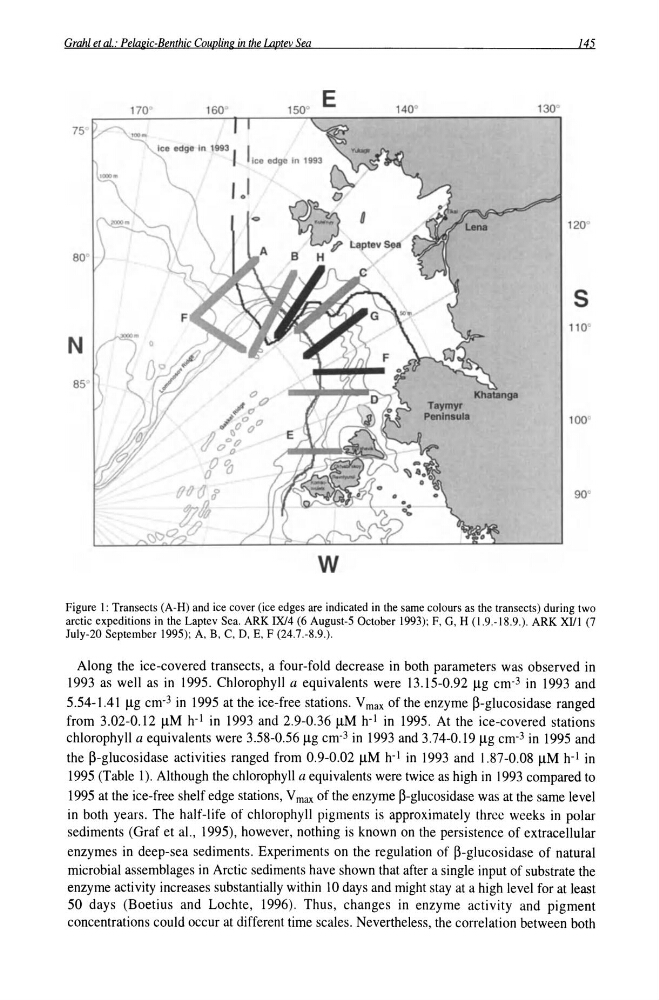
Figure 1: Transects (A-H) and ice cover (ice edges are indicated in the same colours as the transects) during two
arctic expeditions in the Laptev Sea. ARK IXl4 (6 August-5 October 1993); F, G, H (1.9.-18.9.). ARK XVI (7
luly-20 September 1995); A, B, C, D, E, F (24.7.-8.9.).
Along the ice-covered transects, a four-fold decrease in both parameters was observed in
1993 as well as in 1995. Chlorophyll a equivalents were l3.15-0.92 Ilg cm-3 in 1993 and
5.54-1.41 Ilg cm- 3 in 1995 at the ice-free stations. V max of the enzyme p-glucosidase ranged
from 3.02-0.12 11M h- i in 1993 and 2.9-0.36 11M h- i in 1995. At the ice-covered stations
chlorophyll a equivalents were 3.58-0.56 Ilg cm- 3 in 1993 and 3.74-0.19 Ilg cm-3 in 1995 and
the p-glucosidase activities ranged from 0.9-0.02 11M h- i in 1993 and 1.87-0.08 11M h- i in
1995 (Table 1). Although the chlorophyll a equivalents were twice as high in 1993 compared to
1995 at the ice-free shelf edge stations, V max of the enzyme p-glucosidase was at the same level
in both years. The half-life of chlorophyll pigments is approximately three weeks in polar
sediments (Graf et aI., 1995), however, nothing is known on the persistence of extracellular
enzymes in deep-sea sediments. Experiments on the regulation of p-glucosidase of natural
microbial assemblages in Arctic sediments have shown that after a single input of substrate the
enzyme activity increases substantially within 10 days and might stay at a high level for at least
50 days (Boetius and Lochte, 1996). Thus, changes in enzyme activity and pigment
concentrations could occur at different time scales. Nevertheless, the correlation between both
145
170
140'
130'
75
....
Ice edge In 1993
1 I
Ice edge In 1993
80 )~
120
5
110'
100'
90'
w
Figure 1: Transects (A-H) and ice cover (ice edges are indicated in the same colours as the transects) during two
arctic expeditions in the Laptev Sea. ARK IXl4 (6 August-5 October 1993); F, G, H (1.9.-18.9.). ARK XVI (7
luly-20 September 1995); A, B, C, D, E, F (24.7.-8.9.).
Along the ice-covered transects, a four-fold decrease in both parameters was observed in
1993 as well as in 1995. Chlorophyll a equivalents were l3.15-0.92 Ilg cm-3 in 1993 and
5.54-1.41 Ilg cm- 3 in 1995 at the ice-free stations. V max of the enzyme p-glucosidase ranged
from 3.02-0.12 11M h- i in 1993 and 2.9-0.36 11M h- i in 1995. At the ice-covered stations
chlorophyll a equivalents were 3.58-0.56 Ilg cm- 3 in 1993 and 3.74-0.19 Ilg cm-3 in 1995 and
the p-glucosidase activities ranged from 0.9-0.02 11M h- i in 1993 and 1.87-0.08 11M h- i in
1995 (Table 1). Although the chlorophyll a equivalents were twice as high in 1993 compared to
1995 at the ice-free shelf edge stations, V max of the enzyme p-glucosidase was at the same level
in both years. The half-life of chlorophyll pigments is approximately three weeks in polar
sediments (Graf et aI., 1995), however, nothing is known on the persistence of extracellular
enzymes in deep-sea sediments. Experiments on the regulation of p-glucosidase of natural
microbial assemblages in Arctic sediments have shown that after a single input of substrate the
enzyme activity increases substantially within 10 days and might stay at a high level for at least
50 days (Boetius and Lochte, 1996). Thus, changes in enzyme activity and pigment
concentrations could occur at different time scales. Nevertheless, the correlation between both