

128
Land-Ocean Systems in the Siberian Arctic: Dynamics and History
5
10
2
3
4
5
e 6
.r::. 7
' "'
0..,
B
~
9
10
11
12
.0.05
0.00
A
B
salinity
salinity
15
2S
0
5
10
2
3
4
5
6
7
8
9
10
11
12
0.05
0.10
0.15
0.20
43
.0.2
.0.1
0.0
T- Tf
c
T-Tf 1°C]
2
3
4
e
5
6
.r::.
' "' 7
0..,
1:l 8
9
10
11
12
salinity
0
5
10
1S
20
25
f"aat .i.e.
LN9610b
11.06
~
5
.0.8 .0.7 .0.6 .0.5 44 .0.3 42 .0.1 0.0 0.1 0.2 0.3
T-Tf [0C]
15
0.1
1°C]
20
2S
5
0.2
0.3
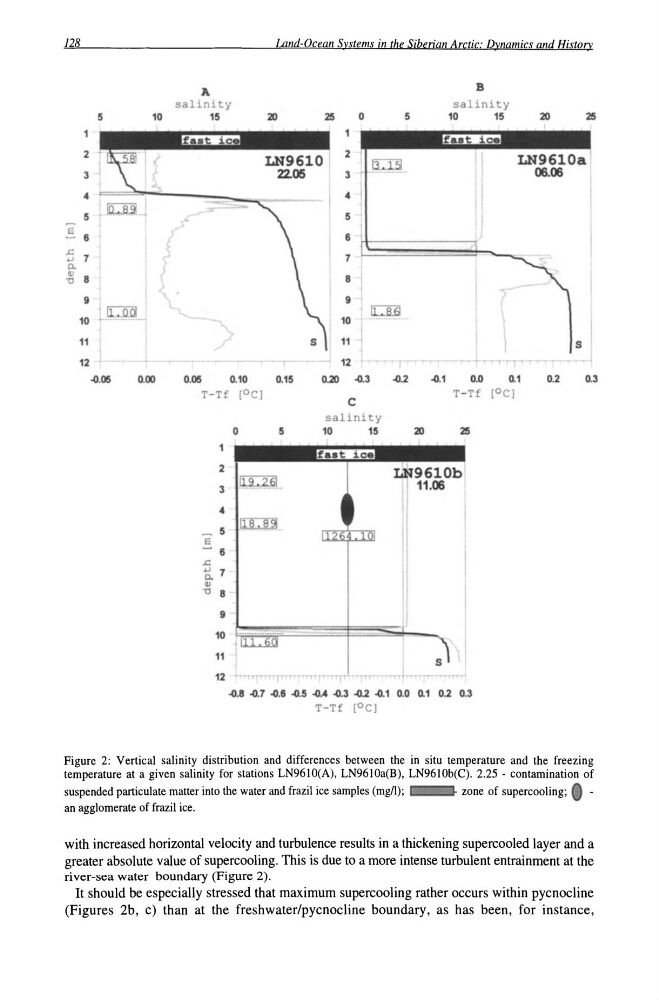
Figure 2: Vertical salinity distribution and differences between the in situ temperature and the freezing
temperature at a given salinity for stations LN961O(A), LN961Oa(B), LN961Ob(C). 2.25 - contamination of
suspended particulate matter into the water and frazil ice samples (mg/l); w~:::J.. zone of supercooling;
an agglomerate of frazil ice.
with increased horizontal velocity and turbulence results in a thickening supercooled layer and a
greater absolute value of supercooling. This is due to a more intense turbulent entrainment at the
river-sea water boundary (Figure 2).
It should be especially stressed that maximum supercooling rather occurs within pycnocline
(Figures 2b, c) than at the freshwater/pycnocline boundary, as has been, for instance,
Land-Ocean Systems in the Siberian Arctic: Dynamics and History
5
10
2
3
4
5
e 6
.r::. 7
' "'
0..,
B
~
9
10
11
12
.0.05
0.00
A
B
salinity
salinity
15
2S
0
5
10
2
3
4
5
6
7
8
9
10
11
12
0.05
0.10
0.15
0.20
43
.0.2
.0.1
0.0
T- Tf
c
T-Tf 1°C]
2
3
4
e
5
6
.r::.
' "' 7
0..,
1:l 8
9
10
11
12
salinity
0
5
10
1S
20
25
f"aat .i.e.
LN9610b
11.06
~
5
.0.8 .0.7 .0.6 .0.5 44 .0.3 42 .0.1 0.0 0.1 0.2 0.3
T-Tf [0C]
15
0.1
1°C]
20
2S
5
0.2
0.3
Figure 2: Vertical salinity distribution and differences between the in situ temperature and the freezing
temperature at a given salinity for stations LN961O(A), LN961Oa(B), LN961Ob(C). 2.25 - contamination of
suspended particulate matter into the water and frazil ice samples (mg/l); w~:::J.. zone of supercooling;
an agglomerate of frazil ice.
with increased horizontal velocity and turbulence results in a thickening supercooled layer and a
greater absolute value of supercooling. This is due to a more intense turbulent entrainment at the
river-sea water boundary (Figure 2).
It should be especially stressed that maximum supercooling rather occurs within pycnocline
(Figures 2b, c) than at the freshwater/pycnocline boundary, as has been, for instance,