

126
Land-Ocean Systems in the Siberian Arctic: Dvnamics and Histo[),
The main cause for supercooling of water freshened by river runoff and the subsequent
formation of frazil ice is a more effective loss of heat to the underlying cold and saline sea
water, than gain of salt via the countering salt flux. The different efficiencies of heat and salt
exchanges are governed by the fact that the molecular temperature conductivity coefficient Ktm
exceeds the molecular salt diffusion coefficient KS m by two orders of magnitude
(KtnfKsm= 1 0 2 ). This allows us to call the mechanism of supercooling and frazil ice formation
under consideration "double-diffusion" (Martin and Kauffman, 1974; Krylov and Zatsepin,
1992) or contact mechanism (Timokhov, 1989).
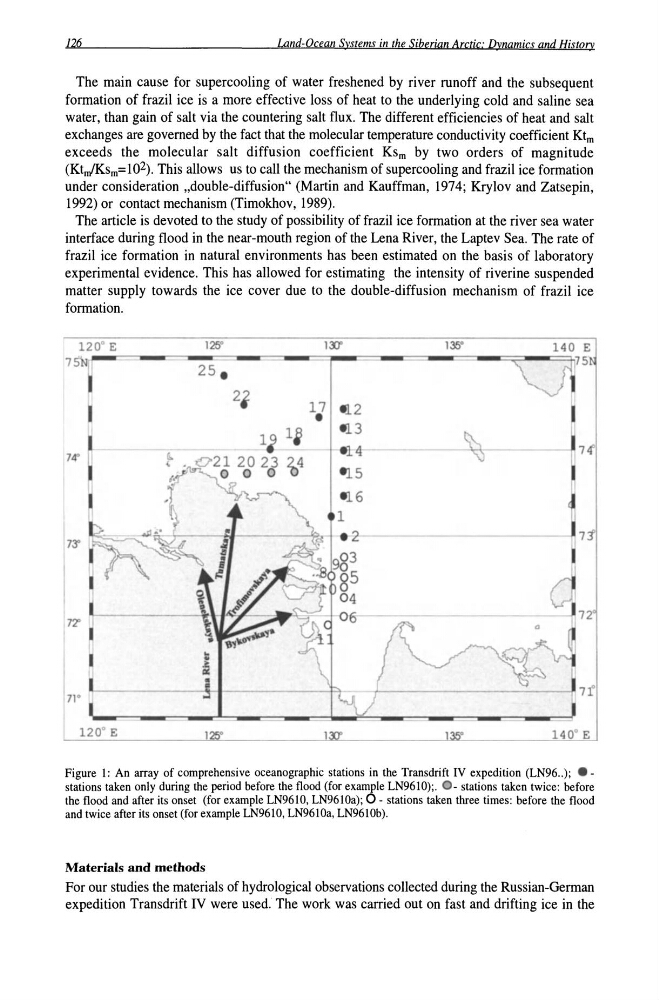
The article is devoted to the study of possibility of frazil ice formation at the river sea water
interface during flood in the near-mouth region of the Lena River, the Laptev Sea. The rate of
frazil ice formation in natural environments has been estimated on the basis of laboratory
experimental evidence. This has allowed for estimating the intensity of riverine suspended
matter supply towards the ice cover due to the double-diffusion mechanism of frazil ice
formation.
120 E
75N
~
74'
7'Z'
125'
25 .
2j
12 1~
0 21 20 23 ~4
0 0 0
71°
• I----~--I
120' E
13)'
135'
HOE
75
17 '1. 2
• -:I. 3
-:I. 4
e.I. 5
-:I. 6
72
7f
140' E
Figure 1: An array of comprehensive oceanographic stations in the Transdrift IV expedition (LN96 .. ); . -
stations taken only during the period before the flood (for example LN961O);. - stations taken twice: before
the flood and after its onset (for example LN961O. LN961Oa); 0 - stations taken three times: before the flood
and twice after its onset (for example LN9610. LN9610a. LN9610b).
Materials and methods
For our studies the materials of hydrological observations collected during the Russian-German
expedition Transdrift IV were used. The work was carried out on fast and drifting ice in the
Land-Ocean Systems in the Siberian Arctic: Dvnamics and Histo[),
The main cause for supercooling of water freshened by river runoff and the subsequent
formation of frazil ice is a more effective loss of heat to the underlying cold and saline sea
water, than gain of salt via the countering salt flux. The different efficiencies of heat and salt
exchanges are governed by the fact that the molecular temperature conductivity coefficient Ktm
exceeds the molecular salt diffusion coefficient KS m by two orders of magnitude
(KtnfKsm= 1 0 2 ). This allows us to call the mechanism of supercooling and frazil ice formation
under consideration "double-diffusion" (Martin and Kauffman, 1974; Krylov and Zatsepin,
1992) or contact mechanism (Timokhov, 1989).
The article is devoted to the study of possibility of frazil ice formation at the river sea water
interface during flood in the near-mouth region of the Lena River, the Laptev Sea. The rate of
frazil ice formation in natural environments has been estimated on the basis of laboratory
experimental evidence. This has allowed for estimating the intensity of riverine suspended
matter supply towards the ice cover due to the double-diffusion mechanism of frazil ice
formation.
120 E
75N
~
74'
7'Z'
125'
25 .
2j
12 1~
0 21 20 23 ~4
0 0 0
71°
• I----~--I
120' E
13)'
135'
HOE
75
17 '1. 2
• -:I. 3
-:I. 4
e.I. 5
-:I. 6
72
7f
140' E
Figure 1: An array of comprehensive oceanographic stations in the Transdrift IV expedition (LN96 .. ); . -
stations taken only during the period before the flood (for example LN961O);. - stations taken twice: before
the flood and after its onset (for example LN961O. LN961Oa); 0 - stations taken three times: before the flood
and twice after its onset (for example LN9610. LN9610a. LN9610b).
Materials and methods
For our studies the materials of hydrological observations collected during the Russian-German
expedition Transdrift IV were used. The work was carried out on fast and drifting ice in the