

J08
Land-Ocean Systems in the Siberian Arctic: Dvnamics and HistoQ'
zone between cold freshwater and saline water masses near the freezing point (Dmitrenko et a!.,
1996). Rising frazil can effectively scavenge suspended matter from a turbid water column and
subsequently transport it to the newly forming sea ice cover (Weeks and Ackley, 1982;
Reimnitz et aI., 1992).
During the initial phase of the freeze up period sea ice can float rather fast from coastal areas
to offshore regions with higher salinities of the underlying water column. This would increase
the salinity within the porous young ice and as a consequence influence the adsorption
processes of trace elements like Cd. (Salomons, 1980).
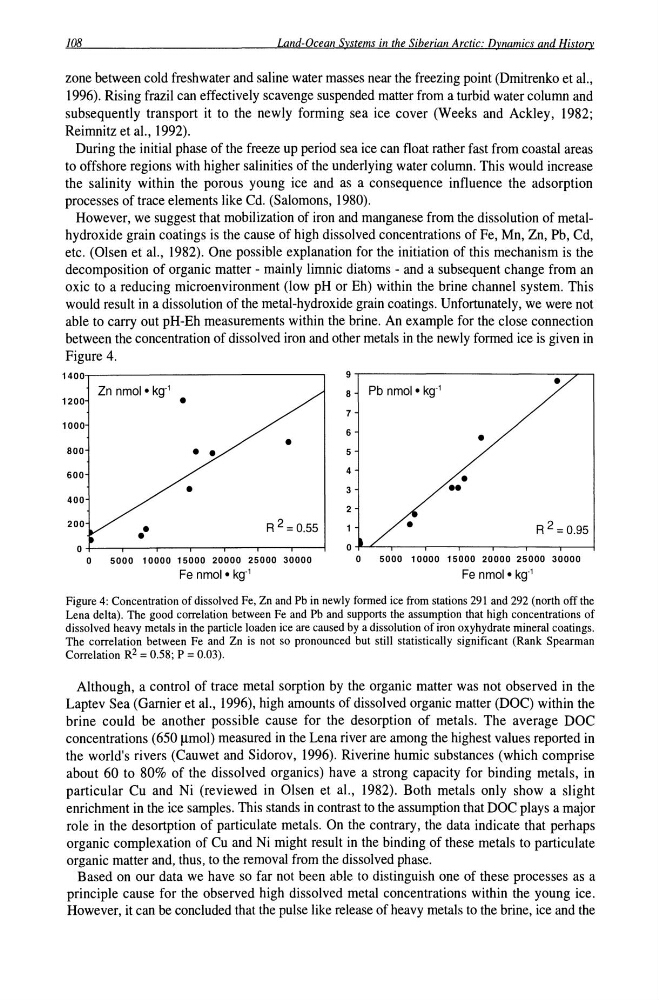
However, we suggest that mobilization of iron and manganese from the dissolution of metalhydroxide grain coatings is the cause of high dissolved concentrations of Fe, Mn, Zn, Pb, Cd,
etc. (Olsen et a!., 1982). One possible explanation for the initiation of this mechanism is the
decomposition of organic matter - mainly limnic diatoms - and a subsequent change from an
oxic to a reducing microenvironment (low pH or Eh) within the brine channel system. This
would result in a dissolution of the metal-hydroxide grain coatings. Unfortunately, we were not
able to carry out pH-Eh measurements within the brine. An example for the close connection
between the concentration of dissolved iron and other metals in the newly formed ice is given in
Figure 4.
1400
9
•
Zn nmol • kg- 1
8
Pb nmol • kg- 1
1200
•
7
1000
6
•
•
800
• •
5
600
4
•
•
3
••
400
200
•
R 2 = 0.55
•
R 2 = 0_95
•
0
0
0
5000 10000 15000 20000 25000 30000
0
5000 10000 15000 20000 25000 30000
Fe nmol • kg- 1
Fe nmol • kg- 1
Figure 4: Concentration of dissolved Fe, Zn and Pb in newly formed ice from stations 291 and 292 (north off the
Lena delta). The good correlation between Fe and Pb and supports the assumption that high concentrations of
dissolved heavy metals in the particle loaden ice are caused by a dissolution of iron oxyhydrate mineral coatings.
The correlation between Fe and Zn is not so pronounced but still statistically significant (Rank Spearman
Correlation R2 = 058; P = 0.03).
Although, a control of trace metal sorption by the organic matter was not observed in the
Laptev Sea (Garnier et a!., 1996), high amounts of dissolved organic matter (DOC) within the
brine could be another possible cause for the desorption of metals. The average DOC
concentrations (650 /-lmol) measured in the Lena river are among the highest values reported in
the world's rivers (Cauwet and Sidorov, 1996). Riverine humic substances (which comprise
about 60 to 80% of the dissolved organics) have a strong capacity for binding metals, in
particular Cu and Ni (reviewed in Olsen et a!., 1982). Both metals only show a slight
enrichment in the ice samples. This stands in contrast to the assumption that DOC plays a major
role in the desortption of particulate metals. On the contrary, the data indicate that perhaps
organic complexation of Cu and Ni might result in the binding of these metals to particulate
organic matter and, thus, to the removal from the dissolved phase.
Based on our data we have so far not been able to distinguish one of these processes as a
principle cause for the observed high dissolved metal concentrations within the young ice.
However, it can be concluded that the pulse like release of heavy metals to the brine, ice and the
Land-Ocean Systems in the Siberian Arctic: Dvnamics and HistoQ'
zone between cold freshwater and saline water masses near the freezing point (Dmitrenko et a!.,
1996). Rising frazil can effectively scavenge suspended matter from a turbid water column and
subsequently transport it to the newly forming sea ice cover (Weeks and Ackley, 1982;
Reimnitz et aI., 1992).
During the initial phase of the freeze up period sea ice can float rather fast from coastal areas
to offshore regions with higher salinities of the underlying water column. This would increase
the salinity within the porous young ice and as a consequence influence the adsorption
processes of trace elements like Cd. (Salomons, 1980).
However, we suggest that mobilization of iron and manganese from the dissolution of metalhydroxide grain coatings is the cause of high dissolved concentrations of Fe, Mn, Zn, Pb, Cd,
etc. (Olsen et a!., 1982). One possible explanation for the initiation of this mechanism is the
decomposition of organic matter - mainly limnic diatoms - and a subsequent change from an
oxic to a reducing microenvironment (low pH or Eh) within the brine channel system. This
would result in a dissolution of the metal-hydroxide grain coatings. Unfortunately, we were not
able to carry out pH-Eh measurements within the brine. An example for the close connection
between the concentration of dissolved iron and other metals in the newly formed ice is given in
Figure 4.
1400
9
•
Zn nmol • kg- 1
8
Pb nmol • kg- 1
1200
•
7
1000
6
•
•
800
• •
5
600
4
•
•
3
••
400
200
•
R 2 = 0.55
•
R 2 = 0_95
•
0
0
0
5000 10000 15000 20000 25000 30000
0
5000 10000 15000 20000 25000 30000
Fe nmol • kg- 1
Fe nmol • kg- 1
Figure 4: Concentration of dissolved Fe, Zn and Pb in newly formed ice from stations 291 and 292 (north off the
Lena delta). The good correlation between Fe and Pb and supports the assumption that high concentrations of
dissolved heavy metals in the particle loaden ice are caused by a dissolution of iron oxyhydrate mineral coatings.
The correlation between Fe and Zn is not so pronounced but still statistically significant (Rank Spearman
Correlation R2 = 058; P = 0.03).
Although, a control of trace metal sorption by the organic matter was not observed in the
Laptev Sea (Garnier et a!., 1996), high amounts of dissolved organic matter (DOC) within the
brine could be another possible cause for the desorption of metals. The average DOC
concentrations (650 /-lmol) measured in the Lena river are among the highest values reported in
the world's rivers (Cauwet and Sidorov, 1996). Riverine humic substances (which comprise
about 60 to 80% of the dissolved organics) have a strong capacity for binding metals, in
particular Cu and Ni (reviewed in Olsen et a!., 1982). Both metals only show a slight
enrichment in the ice samples. This stands in contrast to the assumption that DOC plays a major
role in the desortption of particulate metals. On the contrary, the data indicate that perhaps
organic complexation of Cu and Ni might result in the binding of these metals to particulate
organic matter and, thus, to the removal from the dissolved phase.
Based on our data we have so far not been able to distinguish one of these processes as a
principle cause for the observed high dissolved metal concentrations within the young ice.
However, it can be concluded that the pulse like release of heavy metals to the brine, ice and the