

ridges, have been recognized at many slow-spreading
Mid-Atlantic Ridge (MAR) spreading segments (e.g., Ballard and Van Andel, 1977; Karson et al., 1987; Smith and
Cann, 1992; Parson et al., 1993; Sempere et al., 1993;
Lawson et al., 1996; Bideau et al., 1998; Gracia et al.,
1998; Navin et al., 1998; Briais et al., 2000; Peirce and
Sinha, 2008; Searle et al., 2010) and some ultraslowspreading segments elsewhere (Mendel et al., 2003).
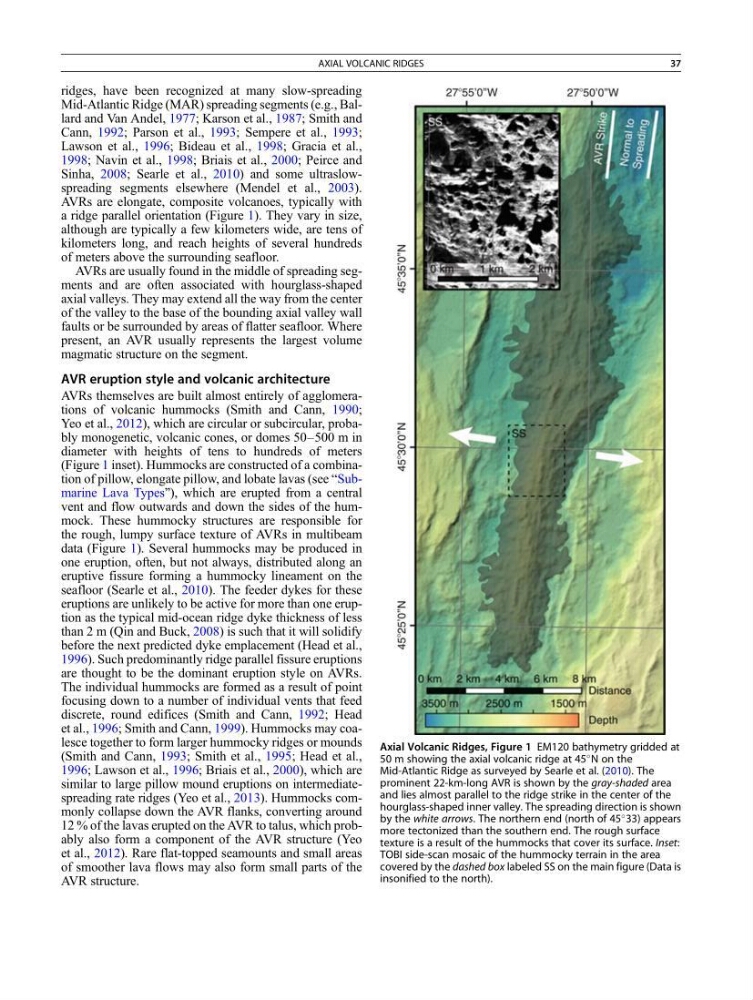
AVRs are elongate, composite volcanoes, typically with
a ridge parallel orientation (Figure 1). They vary in size,
although are typically a few kilometers wide, are tens of
kilometers long, and reach heights of several hundreds
of meters above the surrounding seafloor.
AVRs are usually found in the middle of spreading segments and are often associated with hourglass-shaped
axial valleys. They may extend all the way from the center
of the valley to the base of the bounding axial valley wall
faults or be surrounded by areas of flatter seafloor. Where
present, an AVR usually represents the largest volume
magmatic structure on the segment.
AVR eruption style and volcanic architecture
AVRs themselves are built almost entirely of agglomerations of volcanic hummocks (Smith and Cann, 1990;
Yeo et al., 2012), which are circular or subcircular, probably monogenetic, volcanic cones, or domes 50–500 m in
diameter with heights of tens to hundreds of meters
(Figure 1 inset). Hummocks are constructed of a combination of pillow, elongate pillow, and lobate lavas (see “Submarine Lava Types”), which are erupted from a central
vent and flow outwards and down the sides of the hummock. These hummocky structures are responsible for
the rough, lumpy surface texture of AVRs in multibeam
data (Figure 1). Several hummocks may be produced in
one eruption, often, but not always, distributed along an
eruptive fissure forming a hummocky lineament on the
seafloor (Searle et al., 2010). The feeder dykes for these
eruptions are unlikely to be active for more than one eruption as the typical mid-ocean ridge dyke thickness of less
than 2 m (Qin and Buck, 2008) is such that it will solidify
before the next predicted dyke emplacement (Head et al.,
1996). Such predominantly ridge parallel fissure eruptions
are thought to be the dominant eruption style on AVRs.
The individual hummocks are formed as a result of point
focusing down to a number of individual vents that feed
discrete, round edifices (Smith and Cann, 1992; Head
et al., 1996; Smith and Cann, 1999). Hummocks may coalesce together to form larger hummocky ridges or mounds
(Smith and Cann, 1993; Smith et al., 1995; Head et al.,
1996; Lawson et al., 1996; Briais et al., 2000), which are
similar to large pillow mound eruptions on intermediatespreading rate ridges (Yeo et al., 2013). Hummocks commonly collapse down the AVR flanks, converting around
12 % of the lavas erupted on the AVR to talus, which probably also form a component of the AVR structure (Yeo
et al., 2012). Rare flat-topped seamounts and small areas
of smoother lava flows may also form small parts of the
AVR structure.
Axial Volcanic Ridges, Figure 1 EM120 bathymetry gridded at
50 m showing the axial volcanic ridge at 45
N on the
Mid-Atlantic Ridge as surveyed by Searle et al. (2010). The
prominent 22-km-long AVR is shown by the gray-shaded area
and lies almost parallel to the ridge strike in the center of the
hourglass-shaped inner valley. The spreading direction is shown
by the white arrows. The northern end (north of 45
33) appears
more tectonized than the southern end. The rough surface
texture is a result of the hummocks that cover its surface. Inset:
TOBI side-scan mosaic of the hummocky terrain in the area
covered by the dashed box labeled SS on the main figure (Data is
insonified to the north).
AXIAL VOLCANIC RIDGES
37
Mid-Atlantic Ridge (MAR) spreading segments (e.g., Ballard and Van Andel, 1977; Karson et al., 1987; Smith and
Cann, 1992; Parson et al., 1993; Sempere et al., 1993;
Lawson et al., 1996; Bideau et al., 1998; Gracia et al.,
1998; Navin et al., 1998; Briais et al., 2000; Peirce and
Sinha, 2008; Searle et al., 2010) and some ultraslowspreading segments elsewhere (Mendel et al., 2003).
AVRs are elongate, composite volcanoes, typically with
a ridge parallel orientation (Figure 1). They vary in size,
although are typically a few kilometers wide, are tens of
kilometers long, and reach heights of several hundreds
of meters above the surrounding seafloor.
AVRs are usually found in the middle of spreading segments and are often associated with hourglass-shaped
axial valleys. They may extend all the way from the center
of the valley to the base of the bounding axial valley wall
faults or be surrounded by areas of flatter seafloor. Where
present, an AVR usually represents the largest volume
magmatic structure on the segment.
AVR eruption style and volcanic architecture
AVRs themselves are built almost entirely of agglomerations of volcanic hummocks (Smith and Cann, 1990;
Yeo et al., 2012), which are circular or subcircular, probably monogenetic, volcanic cones, or domes 50–500 m in
diameter with heights of tens to hundreds of meters
(Figure 1 inset). Hummocks are constructed of a combination of pillow, elongate pillow, and lobate lavas (see “Submarine Lava Types”), which are erupted from a central
vent and flow outwards and down the sides of the hummock. These hummocky structures are responsible for
the rough, lumpy surface texture of AVRs in multibeam
data (Figure 1). Several hummocks may be produced in
one eruption, often, but not always, distributed along an
eruptive fissure forming a hummocky lineament on the
seafloor (Searle et al., 2010). The feeder dykes for these
eruptions are unlikely to be active for more than one eruption as the typical mid-ocean ridge dyke thickness of less
than 2 m (Qin and Buck, 2008) is such that it will solidify
before the next predicted dyke emplacement (Head et al.,
1996). Such predominantly ridge parallel fissure eruptions
are thought to be the dominant eruption style on AVRs.
The individual hummocks are formed as a result of point
focusing down to a number of individual vents that feed
discrete, round edifices (Smith and Cann, 1992; Head
et al., 1996; Smith and Cann, 1999). Hummocks may coalesce together to form larger hummocky ridges or mounds
(Smith and Cann, 1993; Smith et al., 1995; Head et al.,
1996; Lawson et al., 1996; Briais et al., 2000), which are
similar to large pillow mound eruptions on intermediatespreading rate ridges (Yeo et al., 2013). Hummocks commonly collapse down the AVR flanks, converting around
12 % of the lavas erupted on the AVR to talus, which probably also form a component of the AVR structure (Yeo
et al., 2012). Rare flat-topped seamounts and small areas
of smoother lava flows may also form small parts of the
AVR structure.
Axial Volcanic Ridges, Figure 1 EM120 bathymetry gridded at
50 m showing the axial volcanic ridge at 45
N on the
Mid-Atlantic Ridge as surveyed by Searle et al. (2010). The
prominent 22-km-long AVR is shown by the gray-shaded area
and lies almost parallel to the ridge strike in the center of the
hourglass-shaped inner valley. The spreading direction is shown
by the white arrows. The northern end (north of 45
33) appears
more tectonized than the southern end. The rough surface
texture is a result of the hummocks that cover its surface. Inset:
TOBI side-scan mosaic of the hummocky terrain in the area
covered by the dashed box labeled SS on the main figure (Data is
insonified to the north).
AXIAL VOLCANIC RIDGES
37