

which together relate to vegetation belt displacement on
adjacent continents in response to climatic changes (e.g.,
Hooghiemstra et al., 2006).
The use of pollen and spores in marine
geosciences
Pollen and spores are generally well preserved in
sediments that contain a fine silt or clay-sized matrix.
While oxidation can be an issue in some continental
deposits, marine sediments are usually suitable for a good
conservation of pollen grains and spores. Because pollen
and spores originate from land vegetation, their occurrence relates to biogenic inputs from the continent. Hence,
the ratio of pollen and spore versus marine palynomorphs
such as dinocysts has been used to document the origin of
organic matter, allochthonous versus pelagic, as the d
13 Cvalues or C/N ratios, which also serve to identify organic
input from land (e.g., Thibodeau et al., 2006; de Vernal,
2009). Since the sporopollenin of palynomorphs is less
affected by early diagenetic processes than other organic
compounds, the use of pollen/dinocyst ratio is particularly
suitable to document the source of biogenic matter in sedimentary sequences. Moreover, the nature of pollen and
spores recovered in sediment may give a clue on erosional
activity, notably from the occurrence of spores and pollen
reworked from old sedimentary rocks (e.g., de Vernal and
Mudie, 1989).
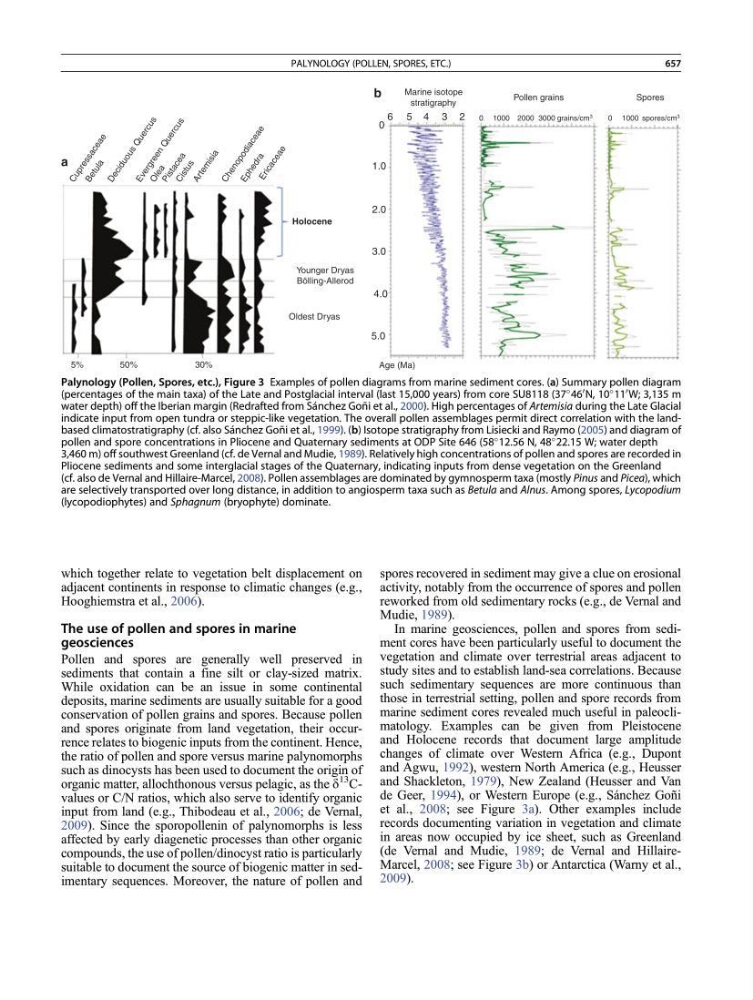
In marine geosciences, pollen and spores from sediment cores have been particularly useful to document the
vegetation and climate over terrestrial areas adjacent to
study sites and to establish land-sea correlations. Because
such sedimentary sequences are more continuous than
those in terrestrial setting, pollen and spore records from
marine sediment cores revealed much useful in paleoclimatology. Examples can be given from Pleistocene
and Holocene records that document large amplitude
changes of climate over Western Africa (e.g., Dupont
and Agwu, 1992), western North America (e.g., Heusser
and Shackleton, 1979), New Zealand (Heusser and Van
de Geer, 1994), or Western Europe (e.g., Sánchez Goñi
et al., 2008; see Figure 3a). Other examples include
records documenting variation in vegetation and climate
in areas now occupied by ice sheet, such as Greenland
(de Vernal and Mudie, 1989; de Vernal and HillaireMarcel, 2008; see Figure 3b) or Antarctica (Warny et al.,
2009).
Holocene
Younger Dryas
Bölling-Allerod
Marine isotope
stratigraphy
a
b
6
0
1.0
2.0
3.0
4.0
5.0
Age (Ma)
5 4 3 2 0 1000
0 1000
2000 3000 grains/cm 3
spores/cm 3
Pollen grains
Spores
E r ic a c e a e
C h e n o p o d ia c e a e
A r t e m is ia
C is t u s
P is t a c e a
O le a
D e c id u o u s Q u e r c u s
C u p r e s s a c e a e
B e t u la
E v e r g r e e n Q u e r c u s
E p h e d r a
Oldest Dryas
30%
50%
5%
Palynology (Pollen, Spores, etc.), Figure 3 Examples of pollen diagrams from marine sediment cores. (a) Summary pollen diagram
(percentages of the main taxa) of the Late and Postglacial interval (last 15,000 years) from core SU8118 (37
46
0 N, 10
11
0 W; 3,135 m
water depth) off the Iberian margin (Redrafted from Sa ´nchez Gon ˜ i et al., 2000). High percentages of Artemisia during the Late Glacial
indicate input from open tundra or steppic-like vegetation. The overall pollen assemblages permit direct correlation with the landbased climatostratigraphy (cf. also Sa ´nchez Gon ˜ i et al., 1999). (b) Isotope stratigraphy from Lisiecki and Raymo (2005) and diagram of
pollen and spore concentrations in Pliocene and Quaternary sediments at ODP Site 646 (58
12.56 N, 48
22.15 W; water depth
3,460 m) off southwest Greenland (cf. de Vernal and Mudie, 1989). Relatively high concentrations of pollen and spores are recorded in
Pliocene sediments and some interglacial stages of the Quaternary, indicating inputs from dense vegetation on the Greenland
(cf. also de Vernal and Hillaire-Marcel, 2008). Pollen assemblages are dominated by gymnosperm taxa (mostly Pinus and Picea), which
are selectively transported over long distance, in addition to angiosperm taxa such as Betula and Alnus. Among spores, Lycopodium
(lycopodiophytes) and Sphagnum (bryophyte) dominate.
PALYNOLOGY (POLLEN, SPORES, ETC.)
657