

magnification. Ideally, a minimum of 200 or 300 pollen
grains are identified and counted for calculation of concentration (number of pollen grains per dry weight or volume) and percentages of taxa. The resulting spectrum
(pollen representation in a given sample) is then combined
with others to prepare a diagram of pollen assemblages
against depth or age, which provides a picture of pollen
input changes through time. Concentration can be estimated from the analyses of an aliquot of the sample from
the marker-grain method, which consists in adding a
known number of exotic grains to the sample (e.g., Matthews, 1969; de Vernal et al., 2010).
Systematics, biology, and morphology of spores
and pollen grains
Spores and pollen grains directly relate to the reproductive
stage in the life cycle of land plants also designated as
embryophytes. Hence, the systematics of pollen grains
and spores follow that of the plant kingdom, with taxa designated after the botanical name of their corresponding
plants.
Spores are produced by seedless plants, including
mosses (bryophytes), club mosses (lycophytes), and ferns
(pteridophytes). They develop in capsule or sporangium
on the sporophyte and are adapted for dispersal and survival over extended periods. Spore germination produces
gametophytes, which in turn produce the sperms and eggs
merging into a zygote to form a new sporophyte. Spore
size ranges from 5 to 150 mm. The content of the spore
is protected by a membrane composed of sporopollenin,
which can fossilize. The membrane or sporoderm is
usually characterized by a simple shape (round, triangular,
ellipsoid, or bean shaped) and by an aperture,
which can be simple (monolete slot) or triaxial (trilete slot)
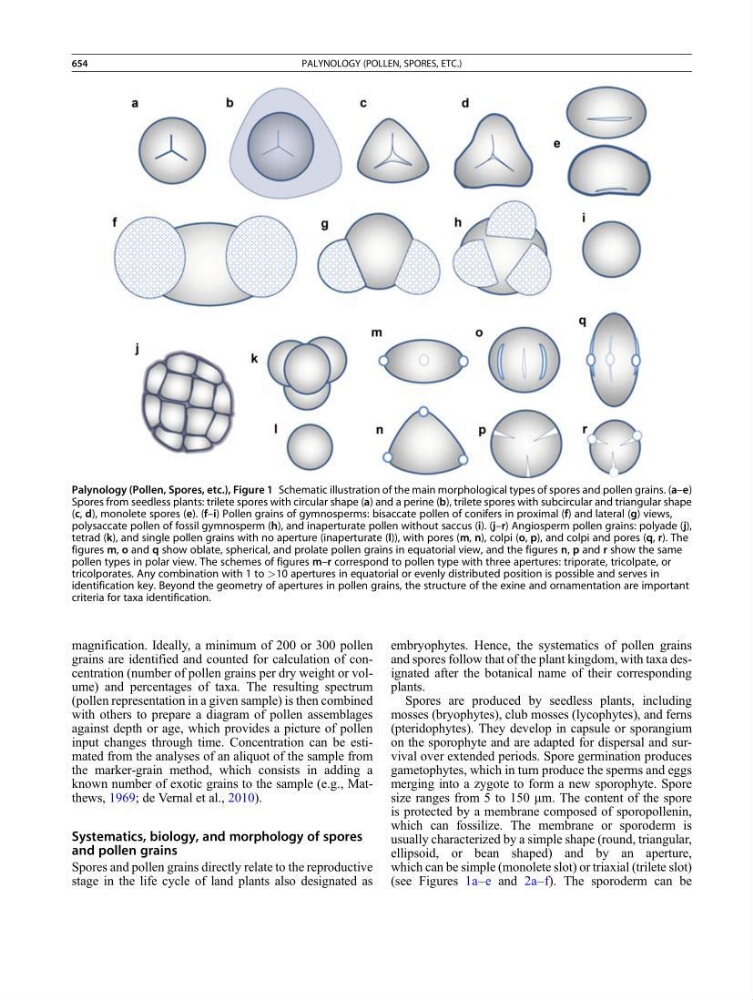
(see Figures 1a–e and 2a–f). The sporoderm can be
Palynology (Pollen, Spores, etc.), Figure 1 Schematic illustration of the main morphological types of spores and pollen grains. (a–e)
Spores from seedless plants: trilete spores with circular shape (a) and a perine (b), trilete spores with subcircular and triangular shape
(c, d), monolete spores (e). (f–i) Pollen grains of gymnosperms: bisaccate pollen of conifers in proximal (f) and lateral (g) views,
polysaccate pollen of fossil gymnosperm (h), and inaperturate pollen without saccus (i). (j–r) Angiosperm pollen grains: polyade (j),
tetrad (k), and single pollen grains with no aperture (inaperturate (l)), with pores (m, n), colpi (o, p), and colpi and pores (q, r). The
figures m, o and q show oblate, spherical, and prolate pollen grains in equatorial view, and the figures n, p and r show the same
pollen types in polar view. The schemes of figures m–r correspond to pollen type with three apertures: triporate, tricolpate, or
tricolporates. Any combination with 1 to >10 apertures in equatorial or evenly distributed position is possible and serves in
identification key. Beyond the geometry of apertures in pollen grains, the structure of the exine and ornamentation are important
criteria for taxa identification.
654
PALYNOLOGY (POLLEN, SPORES, ETC.)