

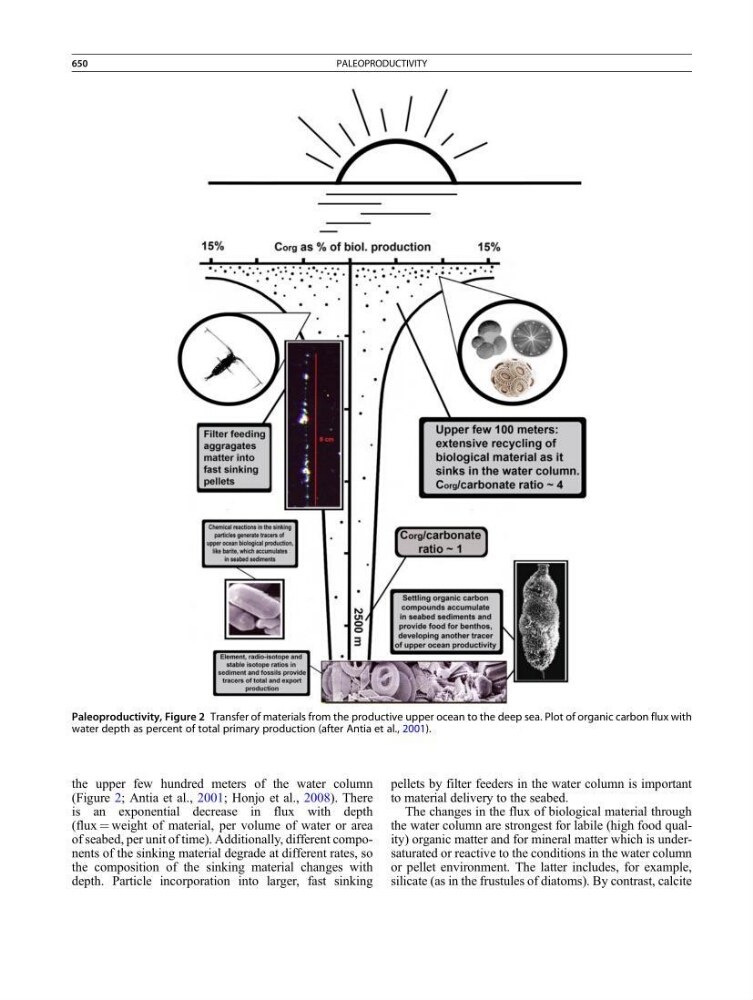
the upper few hundred meters of the water column
(Figure 2; Antia et al., 2001; Honjo et al., 2008). There
is an exponential decrease in flux with depth
(flux ¼ weight of material, per volume of water or area
of seabed, per unit of time). Additionally, different components of the sinking material degrade at different rates, so
the composition of the sinking material changes with
depth. Particle incorporation into larger, fast sinking
pellets by filter feeders in the water column is important
to material delivery to the seabed.
The changes in the flux of biological material through
the water column are strongest for labile (high food quality) organic matter and for mineral matter which is undersaturated or reactive to the conditions in the water column
or pellet environment. The latter includes, for example,
silicate (as in the frustules of diatoms). By contrast, calcite
Paleoproductivity, Figure 2 Transfer of materials from the productive upper ocean to the deep sea. Plot of organic carbon flux with
water depth as percent of total primary production (after Antia et al., 2001).
650
PALEOPRODUCTIVITY