

the seasons varies in time according to Kepler’s second
law, the solstices and equinoxes occur at different calendar
dates during the geological past and in the future. Presently in the Northern Hemisphere, the longest seasons
are spring (92.8 days) and summer (93.6 days), while
autumn (89.8 days) and winter (89 days) are notably
shorter. In 1250 CE, spring and summer have had the same
length (as did autumn and winter) because the winter solstice occurred at perihelion. About 4,500 years into the
future, the Northern Hemisphere spring and winter will
have the same short length and consequently summer
and fall will be equally long.
Summary and conclusions
The most important periods of the three astronomical
parameters which drive the long-term variations of climate
are 400 and 100 kyr for eccentricity, 41 kyr for obliquity,
and 23 and 19 kyr for precession. Although they are often
called Milankovitch periods, they are not originating from
his work. For example, the 41-kyr obliquity cycle and the
average period of climatic precession, 21 kyr, date from
the mid-nineteenth century. Among the properties of these
astronomical parameters, some are less known and are
stressed here again.
The term climatic precession has been introduced in the
1970s to avoid the too often confusion made at these early
times with the astronomical precession.
The first theoretical period of eccentricity, about
400 kyr, and the double precessional peaks, 23 and
19 kyr, were only discovered in the early 1970s and play
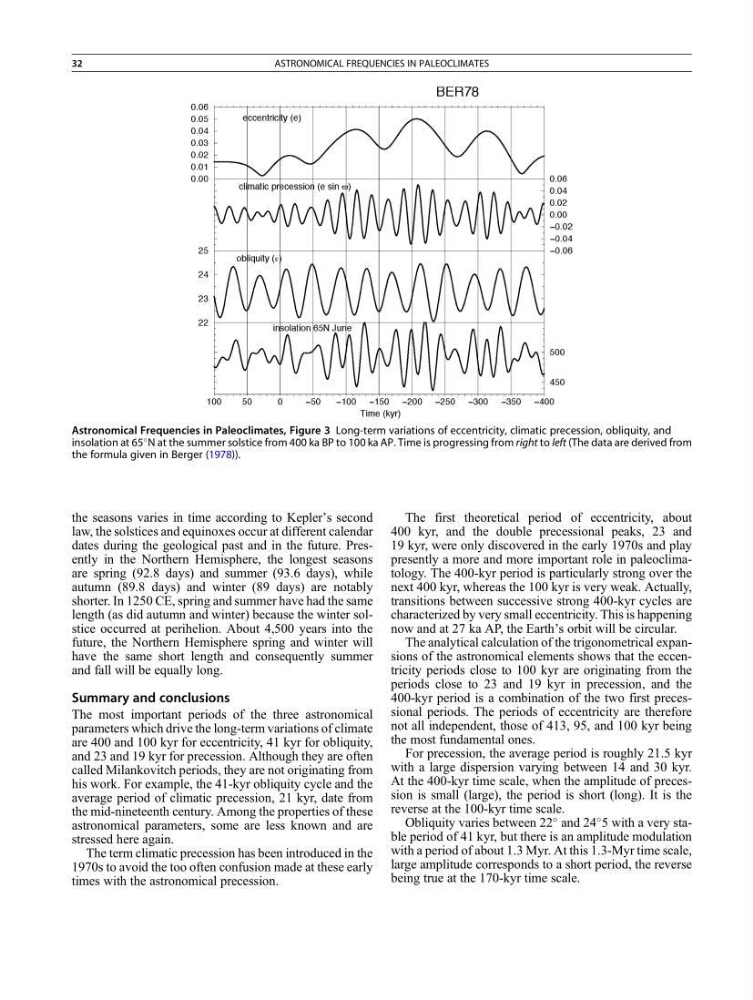
presently a more and more important role in paleoclimatology. The 400-kyr period is particularly strong over the
next 400 kyr, whereas the 100 kyr is very weak. Actually,
transitions between successive strong 400-kyr cycles are
characterized by very small eccentricity. This is happening
now and at 27 ka AP, the Earth’s orbit will be circular.
The analytical calculation of the trigonometrical expansions of the astronomical elements shows that the eccentricity periods close to 100 kyr are originating from the
periods close to 23 and 19 kyr in precession, and the
400-kyr period is a combination of the two first precessional periods. The periods of eccentricity are therefore
not all independent, those of 413, 95, and 100 kyr being
the most fundamental ones.
For precession, the average period is roughly 21.5 kyr
with a large dispersion varying between 14 and 30 kyr.
At the 400-kyr time scale, when the amplitude of precession is small (large), the period is short (long). It is the
reverse at the 100-kyr time scale.
Obliquity varies between 22
and 24
5 with a very stable period of 41 kyr, but there is an amplitude modulation
with a period of about 1.3 Myr. At this 1.3-Myr time scale,
large amplitude corresponds to a short period, the reverse
being true at the 170-kyr time scale.
Astronomical Frequencies in Paleoclimates, Figure 3 Long-term variations of eccentricity, climatic precession, obliquity, and
insolation at 65
N at the summer solstice from 400 ka BP to 100 ka AP. Time is progressing from right to left (The data are derived from
the formula given in Berger (1978)).
32
ASTRONOMICAL FREQUENCIES IN PALEOCLIMATES
law, the solstices and equinoxes occur at different calendar
dates during the geological past and in the future. Presently in the Northern Hemisphere, the longest seasons
are spring (92.8 days) and summer (93.6 days), while
autumn (89.8 days) and winter (89 days) are notably
shorter. In 1250 CE, spring and summer have had the same
length (as did autumn and winter) because the winter solstice occurred at perihelion. About 4,500 years into the
future, the Northern Hemisphere spring and winter will
have the same short length and consequently summer
and fall will be equally long.
Summary and conclusions
The most important periods of the three astronomical
parameters which drive the long-term variations of climate
are 400 and 100 kyr for eccentricity, 41 kyr for obliquity,
and 23 and 19 kyr for precession. Although they are often
called Milankovitch periods, they are not originating from
his work. For example, the 41-kyr obliquity cycle and the
average period of climatic precession, 21 kyr, date from
the mid-nineteenth century. Among the properties of these
astronomical parameters, some are less known and are
stressed here again.
The term climatic precession has been introduced in the
1970s to avoid the too often confusion made at these early
times with the astronomical precession.
The first theoretical period of eccentricity, about
400 kyr, and the double precessional peaks, 23 and
19 kyr, were only discovered in the early 1970s and play
presently a more and more important role in paleoclimatology. The 400-kyr period is particularly strong over the
next 400 kyr, whereas the 100 kyr is very weak. Actually,
transitions between successive strong 400-kyr cycles are
characterized by very small eccentricity. This is happening
now and at 27 ka AP, the Earth’s orbit will be circular.
The analytical calculation of the trigonometrical expansions of the astronomical elements shows that the eccentricity periods close to 100 kyr are originating from the
periods close to 23 and 19 kyr in precession, and the
400-kyr period is a combination of the two first precessional periods. The periods of eccentricity are therefore
not all independent, those of 413, 95, and 100 kyr being
the most fundamental ones.
For precession, the average period is roughly 21.5 kyr
with a large dispersion varying between 14 and 30 kyr.
At the 400-kyr time scale, when the amplitude of precession is small (large), the period is short (long). It is the
reverse at the 100-kyr time scale.
Obliquity varies between 22
and 24
5 with a very stable period of 41 kyr, but there is an amplitude modulation
with a period of about 1.3 Myr. At this 1.3-Myr time scale,
large amplitude corresponds to a short period, the reverse
being true at the 170-kyr time scale.
Astronomical Frequencies in Paleoclimates, Figure 3 Long-term variations of eccentricity, climatic precession, obliquity, and
insolation at 65
N at the summer solstice from 400 ka BP to 100 ka AP. Time is progressing from right to left (The data are derived from
the formula given in Berger (1978)).
32
ASTRONOMICAL FREQUENCIES IN PALEOCLIMATES