

of continental crust carried with the subducted material
experience high-pressure metamorphism. Basalts and sediments contribute significantly to the dewatering in a subduction zone. Water released in the subduction zone
causes intense changes in the mantle above and, from a
certain depth, interacts with hot asthenospheric material
and triggers melting processes which are responsible for
magmatism above the subduction zone (Figure 3). The rising magmas cause increasing temperatures in the magmatic belt above a subduction zone, where Abukumatype metamorphism occurs.
Abukuma-type metamorphism
The magmatic zones of island arcs and active continental
margins are characterized by high geothermal gradients
generated by the rising magmas. Whereas the temperature
increases downward in the subduction zone and in the
forearc area by less than 10
C per kilometer, the geothermal gradient in the upper crust at the magmatic front
jumps to 35–50
C/km. Consequently, rocks of the crust
below the volcanic belt experience completely different
metamorphism than rocks in the subduction zone.
Metamorphism in the magmatic zone is characterized
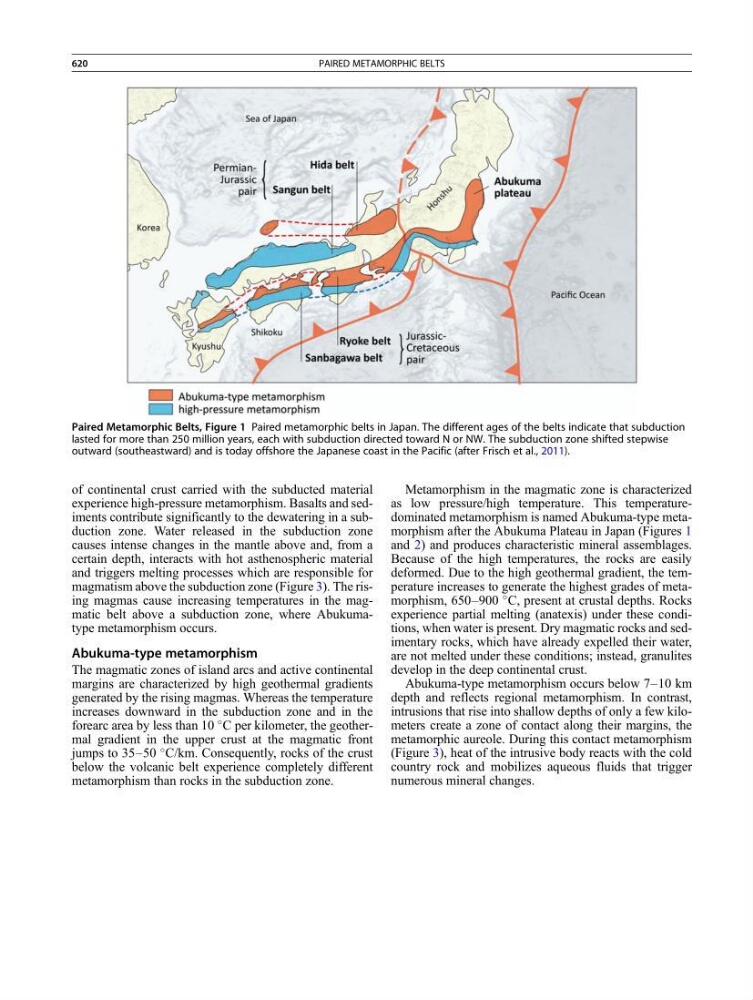
as low pressure/high temperature. This temperaturedominated metamorphism is named Abukuma-type metamorphism after the Abukuma Plateau in Japan (Figures 1
and 2) and produces characteristic mineral assemblages.
Because of the high temperatures, the rocks are easily
deformed. Due to the high geothermal gradient, the temperature increases to generate the highest grades of metamorphism, 650–900
C, present at crustal depths. Rocks
experience partial melting (anatexis) under these conditions, when water is present. Dry magmatic rocks and sedimentary rocks, which have already expelled their water,
are not melted under these conditions; instead, granulites
develop in the deep continental crust.
Abukuma-type metamorphism occurs below 7–10 km
depth and reflects regional metamorphism. In contrast,
intrusions that rise into shallow depths of only a few kilometers create a zone of contact along their margins, the
metamorphic aureole. During this contact metamorphism
(Figure 3), heat of the intrusive body reacts with the cold
country rock and mobilizes aqueous fluids that trigger
numerous mineral changes.
Paired Metamorphic Belts, Figure 1 Paired metamorphic belts in Japan. The different ages of the belts indicate that subduction
lasted for more than 250 million years, each with subduction directed toward N or NW. The subduction zone shifted stepwise
outward (southeastward) and is today offshore the Japanese coast in the Pacific (after Frisch et al., 2011).
620
PAIRED METAMORPHIC BELTS