

reference becomes geocentric instead of heliocentric, and
the vernal point is in the direction of the spring equinox.
The principal cause of the seasons is not the lack of uniformity of the apparent annual motion of the Sun but
rather the tilting of the Earth’s axis at an angle, e, presently
23
27
0 away from a vertical drawn to the plane of the orbit.
e is therefore also the inclination (tilt) of the equator on the
ecliptic and is called the obliquity. Seasons occur because
the orientation of that axis of rotation remains approximately fixed in space as the Earth revolves about the Sun
in 1 year. Each season begins at a particular point in the
Earth’s orbit. Today these points are reached roughly on
20 or 21 March (spring equinox also called vernal or
March equinox), 21 or 22 June (summer solstice also
called June solstice), 22 or 23 September (fall equinox
also called autumnal or September equinox), and 21 or
22 December (winter solstice also called December solstice). Their respective longitudes differ by a multiple of
90
with the longitude at spring equinox being zero by
definition.
In the Northern Hemisphere, winter solstice marks the
beginning of winter because the North Pole is tipped farthest away from the Sun on that day, making it the shortest
day of the year in the entire Northern Hemisphere. Six
months later, at summer solstice, the Earth reaches the
point at which summer begins in the Northern Hemisphere. At this point, the North Pole is tipped toward the
Sun, making the day of the summer solstice the longest
day of the year in the Northern Hemisphere. From geometrical consideration, it can be shown that the Sun reaches
the zenith at the June-summer solstice at noon of the true
solar time (a time similar to the time read on a sundial)
at the latitude now of 23
27
0 which defines the tropics of
Cancer; it reaches the December-winter solstice at the latitude now of À23
27
0 which defines the tropics of Capricorn. Between the tropics, the Sun reaches the zenith at
noon of the true solar time twice a year. North of the northern polar circle (which latitude is 90
À23
27
0
¼ 66
33
0 ),
at the summer (winter) solstice, the day (night) is 24-h
long. At the winter solstice, the Earth is today near perihelion (this approximate coincidence has nothing to do with
the beginning of the calendar year).
At the spring and fall equinoxes, the two poles are equidistant from the Sun. On these dates, the number of daylight
hours equals the number of hours of darkness at every
point on the globe. These two points on the Earth’s orbit
are therefore known as the equinoxes (the term equinox is
indeed derived from the Latin aequus (equal) and nox
(night)). In the Northern Hemisphere, the spring/vernal/
March equinox marks the beginning of spring and the
fall/autumnal/September equinox the beginning of fall. In
the Southern Hemisphere the seasons are reversed.
Orbital elements of a planet
In astronomy, it is usual to define an orbit and the position
of the body describing that orbit by six quantities called
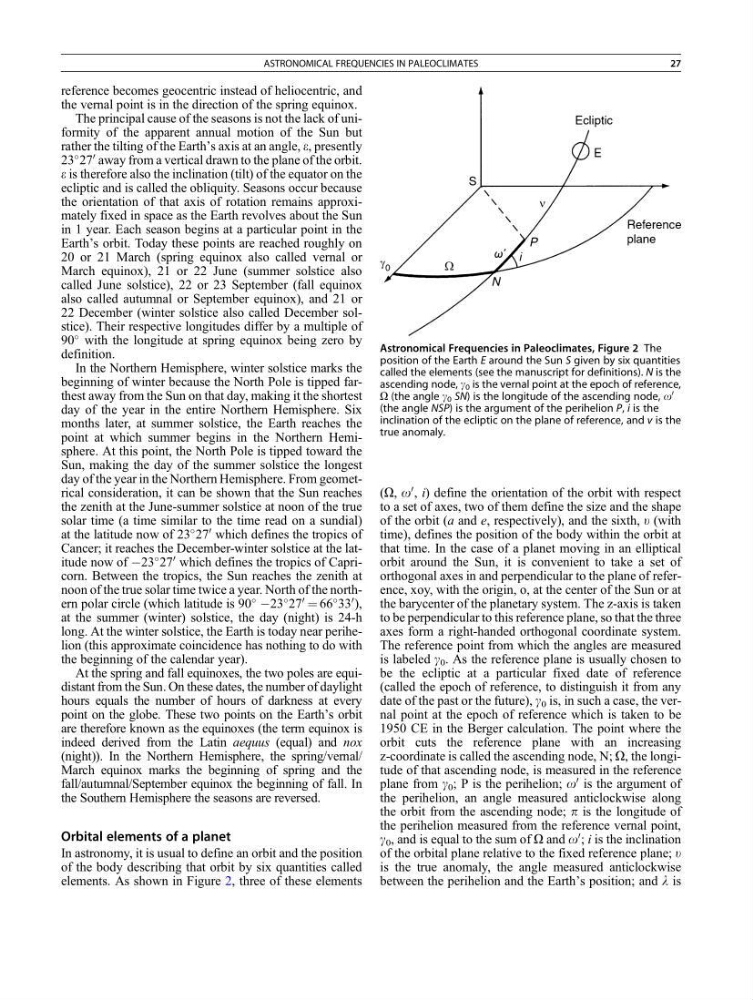
elements. As shown in Figure 2, three of these elements
(O, o
0 , i) define the orientation of the orbit with respect
to a set of axes, two of them define the size and the shape
of the orbit (a and e, respectively), and the sixth, u (with
time), defines the position of the body within the orbit at
that time. In the case of a planet moving in an elliptical
orbit around the Sun, it is convenient to take a set of
orthogonal axes in and perpendicular to the plane of reference, xoy, with the origin, o, at the center of the Sun or at
the barycenter of the planetary system. The z-axis is taken
to be perpendicular to this reference plane, so that the three
axes form a right-handed orthogonal coordinate system.
The reference point from which the angles are measured
is labeled g 0 . As the reference plane is usually chosen to
be the ecliptic at a particular fixed date of reference
(called the epoch of reference, to distinguish it from any
date of the past or the future), g 0 is, in such a case, the vernal point at the epoch of reference which is taken to be
1950 CE in the Berger calculation. The point where the
orbit cuts the reference plane with an increasing
z-coordinate is called the ascending node, N; O, the longitude of that ascending node, is measured in the reference
plane from g 0 ; P is the perihelion; o
0 is the argument of
the perihelion, an angle measured anticlockwise along
the orbit from the ascending node; p is the longitude of
the perihelion measured from the reference vernal point,
g 0 , and is equal to the sum of O and o
0 ; i is the inclination
of the orbital plane relative to the fixed reference plane; u
is the true anomaly, the angle measured anticlockwise
between the perihelion and the Earth’s position; and l is
Astronomical Frequencies in Paleoclimates, Figure 2 The
position of the Earth E around the Sun S given by six quantities
called the elements (see the manuscript for definitions). N is the
ascending node, g 0 is the vernal point at the epoch of reference,
O (the angle g 0 SN) is the longitude of the ascending node, o
0
(the angle NSP) is the argument of the perihelion P, i is the
inclination of the ecliptic on the plane of reference, and v is the
true anomaly.
ASTRONOMICAL FREQUENCIES IN PALEOCLIMATES
27
the vernal point is in the direction of the spring equinox.
The principal cause of the seasons is not the lack of uniformity of the apparent annual motion of the Sun but
rather the tilting of the Earth’s axis at an angle, e, presently
23
27
0 away from a vertical drawn to the plane of the orbit.
e is therefore also the inclination (tilt) of the equator on the
ecliptic and is called the obliquity. Seasons occur because
the orientation of that axis of rotation remains approximately fixed in space as the Earth revolves about the Sun
in 1 year. Each season begins at a particular point in the
Earth’s orbit. Today these points are reached roughly on
20 or 21 March (spring equinox also called vernal or
March equinox), 21 or 22 June (summer solstice also
called June solstice), 22 or 23 September (fall equinox
also called autumnal or September equinox), and 21 or
22 December (winter solstice also called December solstice). Their respective longitudes differ by a multiple of
90
with the longitude at spring equinox being zero by
definition.
In the Northern Hemisphere, winter solstice marks the
beginning of winter because the North Pole is tipped farthest away from the Sun on that day, making it the shortest
day of the year in the entire Northern Hemisphere. Six
months later, at summer solstice, the Earth reaches the
point at which summer begins in the Northern Hemisphere. At this point, the North Pole is tipped toward the
Sun, making the day of the summer solstice the longest
day of the year in the Northern Hemisphere. From geometrical consideration, it can be shown that the Sun reaches
the zenith at the June-summer solstice at noon of the true
solar time (a time similar to the time read on a sundial)
at the latitude now of 23
27
0 which defines the tropics of
Cancer; it reaches the December-winter solstice at the latitude now of À23
27
0 which defines the tropics of Capricorn. Between the tropics, the Sun reaches the zenith at
noon of the true solar time twice a year. North of the northern polar circle (which latitude is 90
À23
27
0
¼ 66
33
0 ),
at the summer (winter) solstice, the day (night) is 24-h
long. At the winter solstice, the Earth is today near perihelion (this approximate coincidence has nothing to do with
the beginning of the calendar year).
At the spring and fall equinoxes, the two poles are equidistant from the Sun. On these dates, the number of daylight
hours equals the number of hours of darkness at every
point on the globe. These two points on the Earth’s orbit
are therefore known as the equinoxes (the term equinox is
indeed derived from the Latin aequus (equal) and nox
(night)). In the Northern Hemisphere, the spring/vernal/
March equinox marks the beginning of spring and the
fall/autumnal/September equinox the beginning of fall. In
the Southern Hemisphere the seasons are reversed.
Orbital elements of a planet
In astronomy, it is usual to define an orbit and the position
of the body describing that orbit by six quantities called
elements. As shown in Figure 2, three of these elements
(O, o
0 , i) define the orientation of the orbit with respect
to a set of axes, two of them define the size and the shape
of the orbit (a and e, respectively), and the sixth, u (with
time), defines the position of the body within the orbit at
that time. In the case of a planet moving in an elliptical
orbit around the Sun, it is convenient to take a set of
orthogonal axes in and perpendicular to the plane of reference, xoy, with the origin, o, at the center of the Sun or at
the barycenter of the planetary system. The z-axis is taken
to be perpendicular to this reference plane, so that the three
axes form a right-handed orthogonal coordinate system.
The reference point from which the angles are measured
is labeled g 0 . As the reference plane is usually chosen to
be the ecliptic at a particular fixed date of reference
(called the epoch of reference, to distinguish it from any
date of the past or the future), g 0 is, in such a case, the vernal point at the epoch of reference which is taken to be
1950 CE in the Berger calculation. The point where the
orbit cuts the reference plane with an increasing
z-coordinate is called the ascending node, N; O, the longitude of that ascending node, is measured in the reference
plane from g 0 ; P is the perihelion; o
0 is the argument of
the perihelion, an angle measured anticlockwise along
the orbit from the ascending node; p is the longitude of
the perihelion measured from the reference vernal point,
g 0 , and is equal to the sum of O and o
0 ; i is the inclination
of the orbital plane relative to the fixed reference plane; u
is the true anomaly, the angle measured anticlockwise
between the perihelion and the Earth’s position; and l is
Astronomical Frequencies in Paleoclimates, Figure 2 The
position of the Earth E around the Sun S given by six quantities
called the elements (see the manuscript for definitions). N is the
ascending node, g 0 is the vernal point at the epoch of reference,
O (the angle g 0 SN) is the longitude of the ascending node, o
0
(the angle NSP) is the argument of the perihelion P, i is the
inclination of the ecliptic on the plane of reference, and v is the
true anomaly.
ASTRONOMICAL FREQUENCIES IN PALEOCLIMATES
27