

with the catastrophic release of methane hydrates from
ocean floor sediments and would have substantially contributed to global warming and oceanic anoxia in the
mid-Aptian (Jahren et al., 2005).
Significant black shale formations are found throughout the Mesozoic and these usually correlate with oceanic
plateau (or rifted margin) volcanism, e.g., Kimmeridgian
to Tithonian (155–146 Ma) black shales formed at the
same time as the Sorachi Plateau in the Western
Pacific. Furthermore, Toarcian (187–178 Ma) black
shales are coeval with the eruption of the Karoo, Ferrar,
and Weddell Sea large igneous province during the
breakup of Gondwana (Kerr, 2003). Furthermore, Condie
et al. (2001) have proposed that the correlation between
black shales, paleoclimatic disturbance, and mantle
superplume events extends into the Precambrian and have
noted that there is a particularly good correspondence
between these events at 1.9 and 2.7 Ga.
The recognition that oceanic anoxia and black shale
deposition may have been a result of oceanic plateau formation has important implications for the location of
potential oil source rocks in the geological record. It is
probable that many of the world’s Cretaceous oil source
rocks owe their existence to the emplacement of oceanic
plateaus that caused widespread global anoxia (Kerr
et al., 2003).
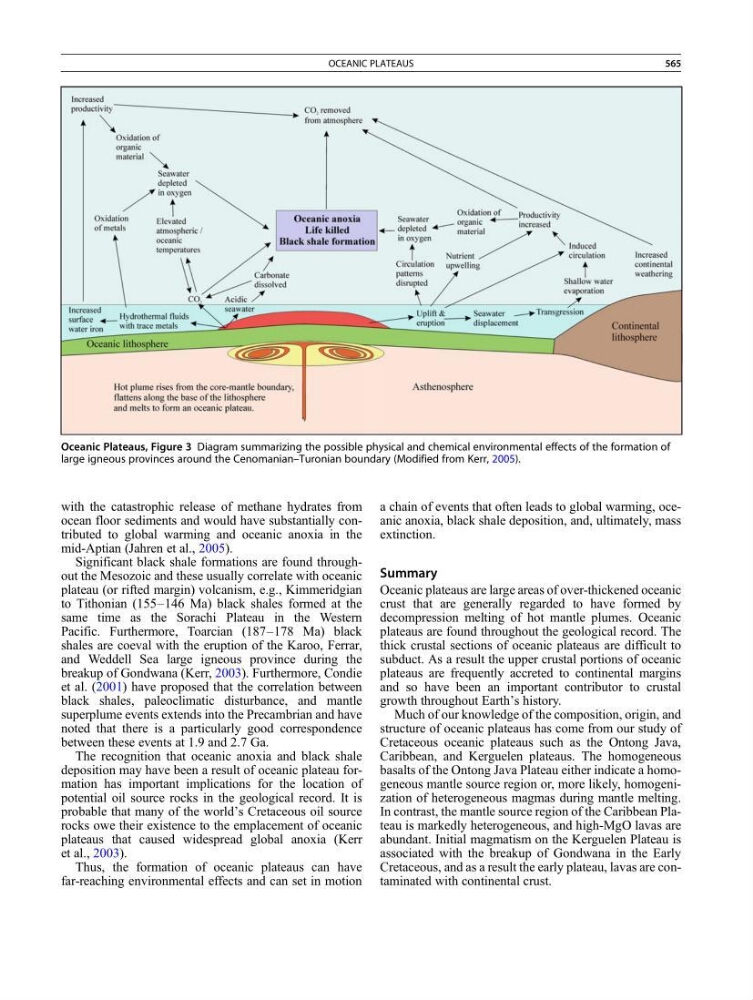
Thus, the formation of oceanic plateaus can have
far-reaching environmental effects and can set in motion
a chain of events that often leads to global warming, oceanic anoxia, black shale deposition, and, ultimately, mass
extinction.
Summary
Oceanic plateaus are large areas of over-thickened oceanic
crust that are generally regarded to have formed by
decompression melting of hot mantle plumes. Oceanic
plateaus are found throughout the geological record. The
thick crustal sections of oceanic plateaus are difficult to
subduct. As a result the upper crustal portions of oceanic
plateaus are frequently accreted to continental margins
and so have been an important contributor to crustal
growth throughout Earth’s history.
Much of our knowledge of the composition, origin, and
structure of oceanic plateaus has come from our study of
Cretaceous oceanic plateaus such as the Ontong Java,
Caribbean, and Kerguelen plateaus. The homogeneous
basalts of the Ontong Java Plateau either indicate a homogeneous mantle source region or, more likely, homogenization of heterogeneous magmas during mantle melting.
In contrast, the mantle source region of the Caribbean Plateau is markedly heterogeneous, and high-MgO lavas are
abundant. Initial magmatism on the Kerguelen Plateau is
associated with the breakup of Gondwana in the Early
Cretaceous, and as a result the early plateau, lavas are contaminated with continental crust.
Oceanic Plateaus, Figure 3 Diagram summarizing the possible physical and chemical environmental effects of the formation of
large igneous provinces around the Cenomanian–Turonian boundary (Modified from Kerr, 2005).
OCEANIC PLATEAUS
565