

of similar thickness that encounters a subduction zone
many millions of years later (e.g., Cloos, 1993). This is
related to the fact that oceanic crust becomes less buoyant
as it cools.
The Caribbean Plateau largely resisted subduction
because it collided with an arc at the entrance to the
proto-Caribbean seaway only a few million years after
the plateau formed at ~93–89 Ma (Kerr et al., 2003). In
contrast, the Ontong Java Plateau, most of which formed
at ~120 Ma, collided with the Solomon Islands subduction
zone ~100 m.y. after its formation (e.g., Petterson et al.,
1997). In this case, the plateau has resisted subduction
because of a combination of very thick crust (Cloos,
1993), an anomalously small amount of postemplacement subsidence, and a >300 km-thick mantle
“root” that has helped to choke subduction (Wessel and
Kroenke, 2000). Thus, only the topmost 3–4 km of the
Ontong Java Plateau are uplifted and exposed on the Solomon Islands (Petterson et al., 1997), whereas the much
deeper crustal regions of the more buoyant Caribbean Plateau are exposed in accreted sections around its margins
and in Colombia (Kerr et al., 2003).
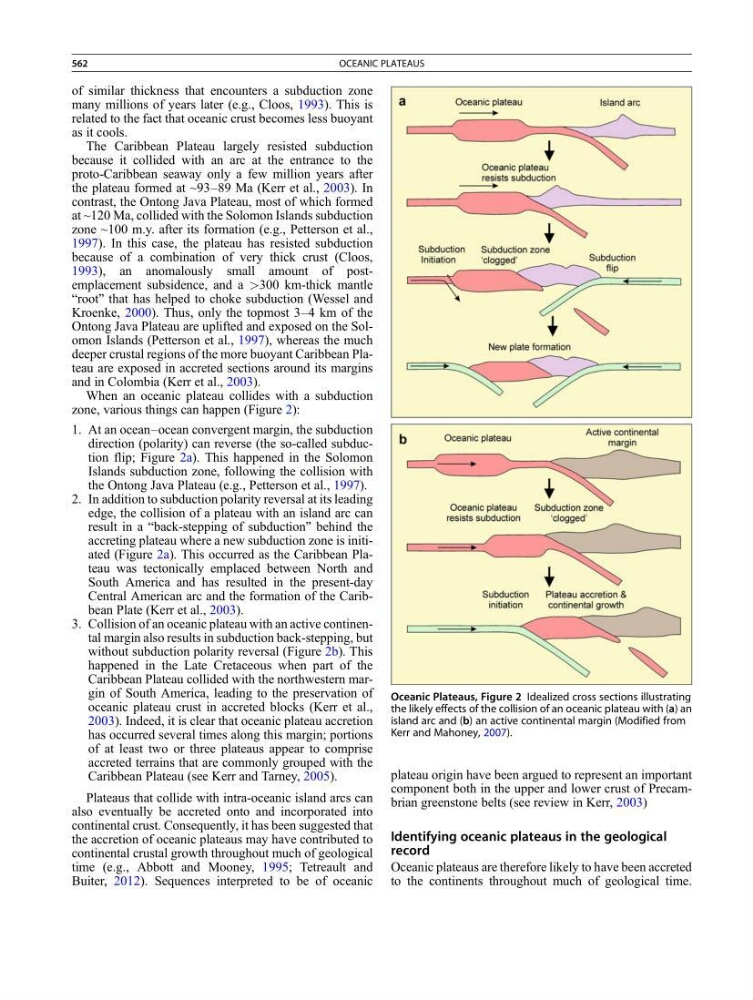
When an oceanic plateau collides with a subduction
zone, various things can happen (Figure 2):
1. At an ocean–ocean convergent margin, the subduction
direction (polarity) can reverse (the so-called subduction flip; Figure 2a). This happened in the Solomon
Islands subduction zone, following the collision with
the Ontong Java Plateau (e.g., Petterson et al., 1997).
2. In addition to subduction polarity reversal at its leading
edge, the collision of a plateau with an island arc can
result in a “back-stepping of subduction” behind the
accreting plateau where a new subduction zone is initiated (Figure 2a). This occurred as the Caribbean Plateau was tectonically emplaced between North and
South America and has resulted in the present-day
Central American arc and the formation of the Caribbean Plate (Kerr et al., 2003).
3. Collision of an oceanic plateau with an active continental margin also results in subduction back-stepping, but
without subduction polarity reversal (Figure 2b). This
happened in the Late Cretaceous when part of the
Caribbean Plateau collided with the northwestern margin of South America, leading to the preservation of
oceanic plateau crust in accreted blocks (Kerr et al.,
2003). Indeed, it is clear that oceanic plateau accretion
has occurred several times along this margin; portions
of at least two or three plateaus appear to comprise
accreted terrains that are commonly grouped with the
Caribbean Plateau (see Kerr and Tarney, 2005).
Plateaus that collide with intra-oceanic island arcs can
also eventually be accreted onto and incorporated into
continental crust. Consequently, it has been suggested that
the accretion of oceanic plateaus may have contributed to
continental crustal growth throughout much of geological
time (e.g., Abbott and Mooney, 1995; Tetreault and
Buiter, 2012). Sequences interpreted to be of oceanic
plateau origin have been argued to represent an important
component both in the upper and lower crust of Precambrian greenstone belts (see review in Kerr, 2003)
Identifying oceanic plateaus in the geological
record
Oceanic plateaus are therefore likely to have been accreted
to the continents throughout much of geological time.
Oceanic Plateaus, Figure 2 Idealized cross sections illustrating
the likely effects of the collision of an oceanic plateau with (a) an
island arc and (b) an active continental margin (Modified from
Kerr and Mahoney, 2007).
562
OCEANIC PLATEAUS