

draw on these examples to illustrate the salient features of
oceanic plateaus and their formation.
Duration of formation
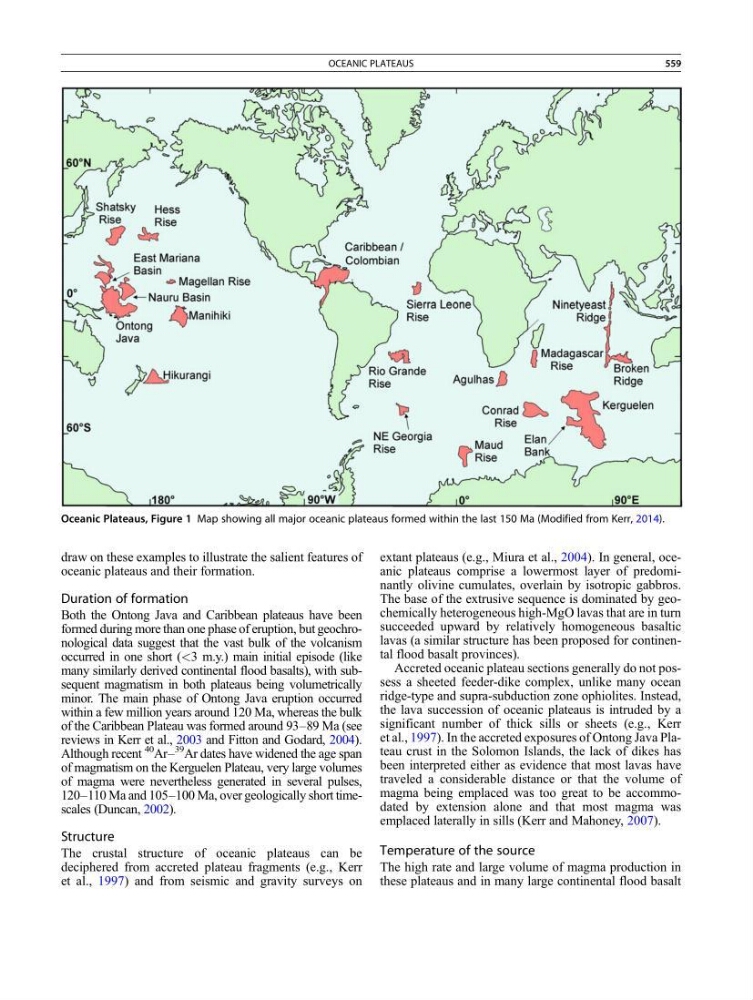
Both the Ontong Java and Caribbean plateaus have been
formed during more than one phase of eruption, but geochronological data suggest that the vast bulk of the volcanism
occurred in one short (<3 m.y.) main initial episode (like
many similarly derived continental flood basalts), with subsequent magmatism in both plateaus being volumetrically
minor. The main phase of Ontong Java eruption occurred
within a few million years around 120 Ma, whereas the bulk
of the Caribbean Plateau was formed around 93–89 Ma (see
reviews in Kerr et al., 2003 and Fitton and Godard, 2004).
Although recent
40
Ar–
39
Ar dates have widened the age span
of magmatism on the Kerguelen Plateau, very large volumes
of magma were nevertheless generated in several pulses,
120–110 Ma and 105–100 Ma, over geologically short timescales (Duncan, 2002).
Structure
The crustal structure of oceanic plateaus can be
deciphered from accreted plateau fragments (e.g., Kerr
et al., 1997) and from seismic and gravity surveys on
extant plateaus (e.g., Miura et al., 2004). In general, oceanic plateaus comprise a lowermost layer of predominantly olivine cumulates, overlain by isotropic gabbros.
The base of the extrusive sequence is dominated by geochemically heterogeneous high-MgO lavas that are in turn
succeeded upward by relatively homogeneous basaltic
lavas (a similar structure has been proposed for continental flood basalt provinces).
Accreted oceanic plateau sections generally do not possess a sheeted feeder-dike complex, unlike many ocean
ridge-type and supra-subduction zone ophiolites. Instead,
the lava succession of oceanic plateaus is intruded by a
significant number of thick sills or sheets (e.g., Kerr
et al., 1997). In the accreted exposures of Ontong Java Plateau crust in the Solomon Islands, the lack of dikes has
been interpreted either as evidence that most lavas have
traveled a considerable distance or that the volume of
magma being emplaced was too great to be accommodated by extension alone and that most magma was
emplaced laterally in sills (Kerr and Mahoney, 2007).
Temperature of the source
The high rate and large volume of magma production in
these plateaus and in many large continental flood basalt
Oceanic Plateaus, Figure 1 Map showing all major oceanic plateaus formed within the last 150 Ma (Modified from Kerr, 2014).
OCEANIC PLATEAUS
559