

Sedimentological features
Benthic boundary layer
An important transition area between water and sediment
is called the benthic boundary layer (BBL), where the
exchange of material takes place. Processes at the BBL
determine the deposition of terrigenous material and
organic substances, as well as the release of nutrients into
the water column. Furthermore, the BBL is important for
the lateral transport of particles at ocean margins, which
is controlled by hydrodynamics within the BBL (see
“Bottom-Boundary Layer”). Within the BBL, but also
deep in the sediments, intensive early diagenetic processes
take place, which are significant for the carbon, nitrogen,
and oxygen cycles in the ocean.
Turbidites
Turbidites often reach the deep ocean regions through various types of submarine canyons. Some canyons are
formed initially in connection with slope slides and then
gradually cut their way upslope, over time, into the shelf
region (see “Turbidites”). Another type originates near
the mouths of glacial rivers (i.e., during low sea-level
stands, especially at the shelf edge) or during high stand
has cut its way back to the inner shelf.
These sedimentation processes, oriented toward the
open ocean, are overprinted by transport processes parallel
to the slope that are driven by bottom currents and can be
either erosive or accumulative, forming contourites or
drift sediment bodies. Because ocean margins include
the active interfaces in such balances, these regions are
critical for understanding of the global mass transport
and transformation of material in the land-atmosphereocean system.
Contourites
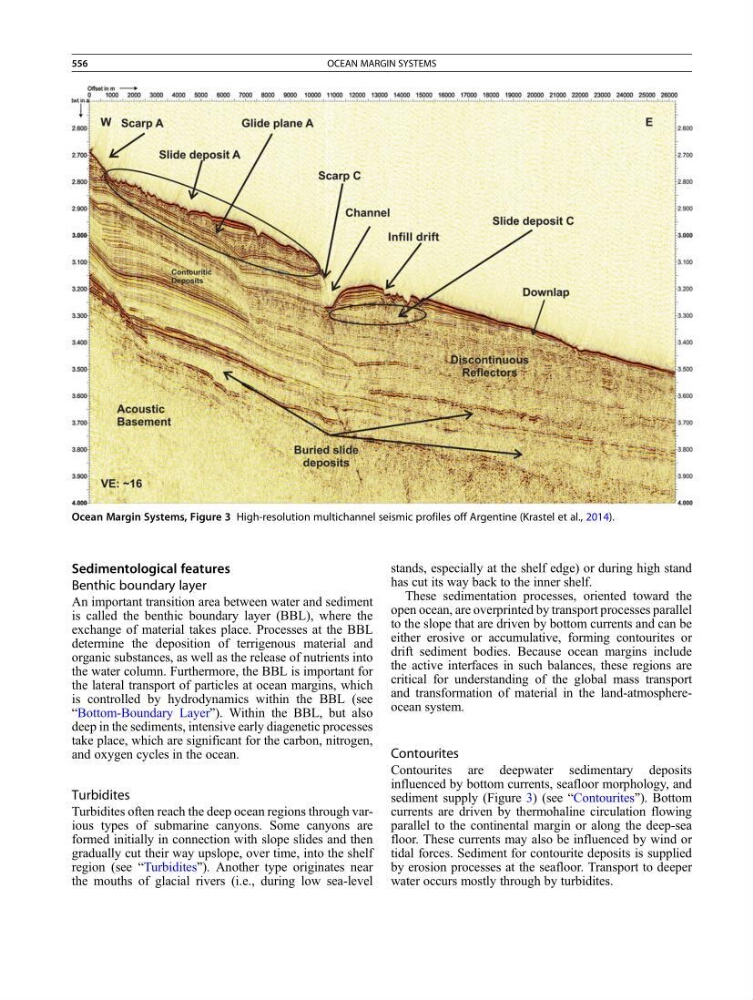
Contourites are deepwater sedimentary deposits
influenced by bottom currents, seafloor morphology, and
sediment supply (Figure 3) (see “Contourites”). Bottom
currents are driven by thermohaline circulation flowing
parallel to the continental margin or along the deep-sea
floor. These currents may also be influenced by wind or
tidal forces. Sediment for contourite deposits is supplied
by erosion processes at the seafloor. Transport to deeper
water occurs mostly through by turbidites.
Ocean Margin Systems, Figure 3 High-resolution multichannel seismic profiles off Argentine (Krastel et al., 2014).
556
OCEAN MARGIN SYSTEMS