

namely, in subduction zones (Kopf et al., 2001), while the
amount of solid mass is usually not as prominent (Kopf,
1999).
Several studies have attempted to estimate the contribution of MVs to global methane emissions and effectively
climate change (Dimitrov, 2002; Kopf, 2003; Milkov
et al., 2003; Judd, 2005); however, and despite considerable variations in the database used and methane volumes
estimated, it has been accepted that methane release is significant and probably has been over significant periods
during Earth’s history. The fate of some of the submarine
methane remains controversial; however, even if a fraction
is fixated as carbonates or oxidized to CO and CO 2 in the
water column, there may be a contribution to global
warming.
Mud volcanoes provide possible microhabitats in the
subsurface, providing pathways for fluid migration and
fracturing sediments through which MVs move sediments
from depth to surface. This process is significant for deep
biosphere research on Earth and may be important for
astrobiological studies elsewhere (Oehler and Allen,
2010, 2011).
The first marine drilling campaign into MVs, Ocean
Drilling Program Leg 160, attested that the initial deposits
in MV formation were clast-supported, coarse sediments,
whereas later stages of eruptive activity showed fewer
clasts, no clasts, or even mousy (i.e., gas-rich) mud comprising almost pure clay (Robertson and Kopf, 1998).
The resulting concept assumes that in fault-bound MVs,
the initial deposit represents the fault breccia, and once
that is removed, the underlying mud reservoir is depleted.
Current investigations
Microbial turnover rates at active MVs are fuelled by
seepage at enhanced rates (e.g., Niemann et al., 2006),
and a growing body of work is clustering around the best
investigated features such as the Haakon Mosby MV off
Norway or features in the Mediterranean, Gulf of Cadiz,
or Gulf of Mexico. Given that the flux has been shown
to be highly episodic (e.g., MacDonald et al., 2003), current research often involves long-term monitoring of key
parameters, e.g., methane bubbling, aqueous fluid seepage, or temperature transients, as has recently been shown
for Haakon Mosby MV (de Beer et al., 2006). Similarly,
long-term probes were deployed in the Nile deep sea fan
MVs, on the Mediterranean Ridge, or the Nankai prism
in Japan. These studies build on long-term flux quantification by osmotic samplers, piezometers, or borehole instruments (Kopf et al., 2015) and unravel transient changes in
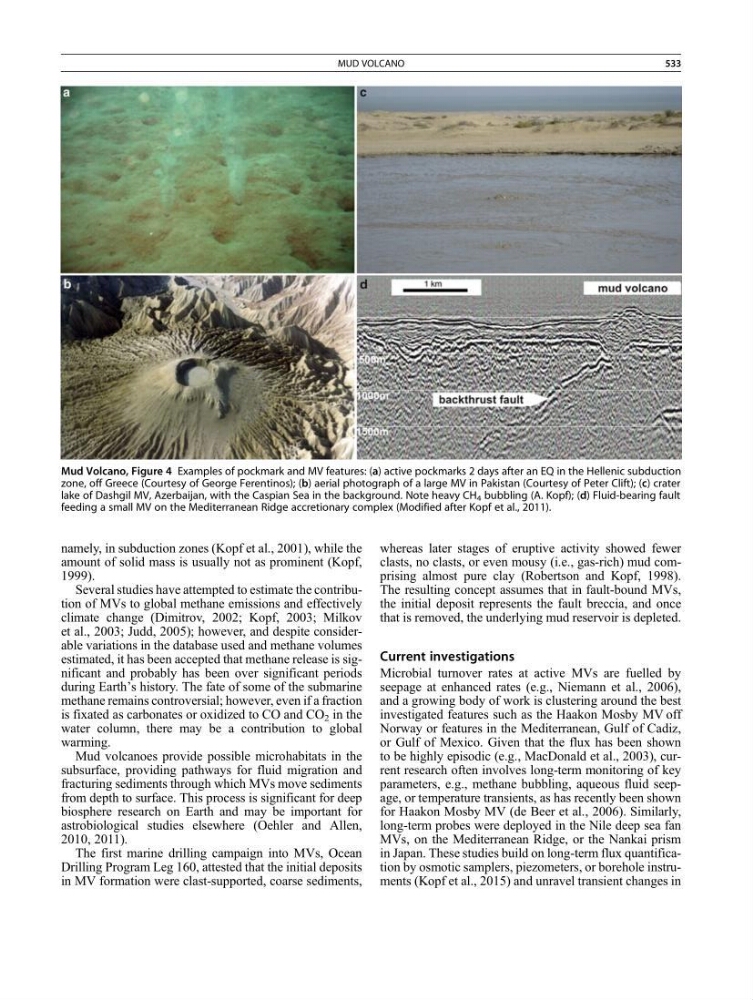
Mud Volcano, Figure 4 Examples of pockmark and MV features: (a) active pockmarks 2 days after an EQ in the Hellenic subduction
zone, off Greece (Courtesy of George Ferentinos); (b) aerial photograph of a large MV in Pakistan (Courtesy of Peter Clift); (c) crater
lake of Dashgil MV, Azerbaijan, with the Caspian Sea in the background. Note heavy CH 4 bubbling (A. Kopf); (d) Fluid-bearing fault
feeding a small MV on the Mediterranean Ridge accretionary complex (Modified after Kopf et al., 2011).
MUD VOLCANO
533