

does not correlate with spreading rate or age. The Moho
appears to form very close to zero age and change little
so that it is fully formed 50,000 years from the ridge crest.
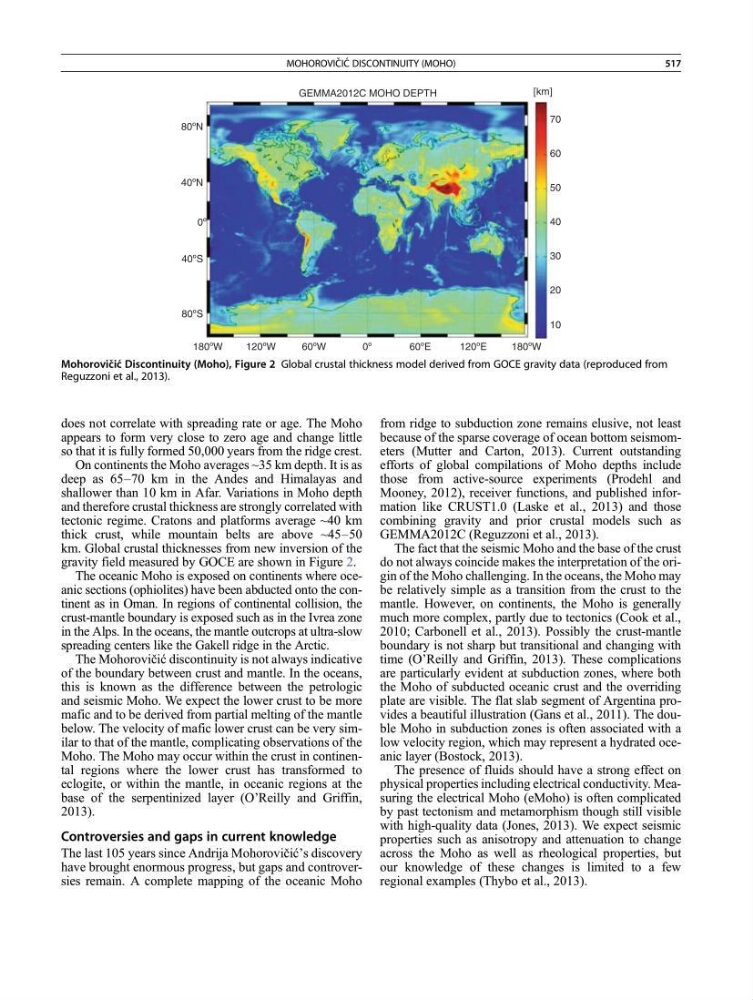
On continents the Moho averages ~35 km depth. It is as
deep as 65–70 km in the Andes and Himalayas and
shallower than 10 km in Afar. Variations in Moho depth
and therefore crustal thickness are strongly correlated with
tectonic regime. Cratons and platforms average ~40 km
thick crust, while mountain belts are above ~45–50
km. Global crustal thicknesses from new inversion of the
gravity field measured by GOCE are shown in Figure 2.
The oceanic Moho is exposed on continents where oceanic sections (ophiolites) have been abducted onto the continent as in Oman. In regions of continental collision, the
crust-mantle boundary is exposed such as in the Ivrea zone
in the Alps. In the oceans, the mantle outcrops at ultra-slow
spreading centers like the Gakell ridge in the Arctic.
The Mohorovičić discontinuity is not always indicative
of the boundary between crust and mantle. In the oceans,
this is known as the difference between the petrologic
and seismic Moho. We expect the lower crust to be more
mafic and to be derived from partial melting of the mantle
below. The velocity of mafic lower crust can be very similar to that of the mantle, complicating observations of the
Moho. The Moho may occur within the crust in continental regions where the lower crust has transformed to
eclogite, or within the mantle, in oceanic regions at the
base of the serpentinized layer (O’Reilly and Griffin,
2013).
Controversies and gaps in current knowledge
The last 105 years since Andrija Mohorovičić’s discovery
have brought enormous progress, but gaps and controversies remain. A complete mapping of the oceanic Moho
from ridge to subduction zone remains elusive, not least
because of the sparse coverage of ocean bottom seismometers (Mutter and Carton, 2013). Current outstanding
efforts of global compilations of Moho depths include
those from active-source experiments (Prodehl and
Mooney, 2012), receiver functions, and published information like CRUST1.0 (Laske et al., 2013) and those
combining gravity and prior crustal models such as
GEMMA2012C (Reguzzoni et al., 2013).
The fact that the seismic Moho and the base of the crust
do not always coincide makes the interpretation of the origin of the Moho challenging. In the oceans, the Moho may
be relatively simple as a transition from the crust to the
mantle. However, on continents, the Moho is generally
much more complex, partly due to tectonics (Cook et al.,
2010; Carbonell et al., 2013). Possibly the crust-mantle
boundary is not sharp but transitional and changing with
time (O’Reilly and Griffin, 2013). These complications
are particularly evident at subduction zones, where both
the Moho of subducted oceanic crust and the overriding
plate are visible. The flat slab segment of Argentina provides a beautiful illustration (Gans et al., 2011). The double Moho in subduction zones is often associated with a
low velocity region, which may represent a hydrated oceanic layer (Bostock, 2013).
The presence of fluids should have a strong effect on
physical properties including electrical conductivity. Measuring the electrical Moho (eMoho) is often complicated
by past tectonism and metamorphism though still visible
with high-quality data (Jones, 2013). We expect seismic
properties such as anisotropy and attenuation to change
across the Moho as well as rheological properties, but
our knowledge of these changes is limited to a few
regional examples (Thybo et al., 2013).
80ºN
80ºS
180ºW
180ºW
10
20
30
40
50
60
70
[km]
120ºW
120ºE
60ºW
60ºE
GEMMA2012C MOHO DEPTH
0º
40ºS
40ºN
0º
Mohorovic ˇic ´ Discontinuity (Moho), Figure 2 Global crustal thickness model derived from GOCE gravity data (reproduced from
Reguzzoni et al., 2013).
MOHOROVIC ˇ IC ´ DISCONTINUITY (MOHO)
517