

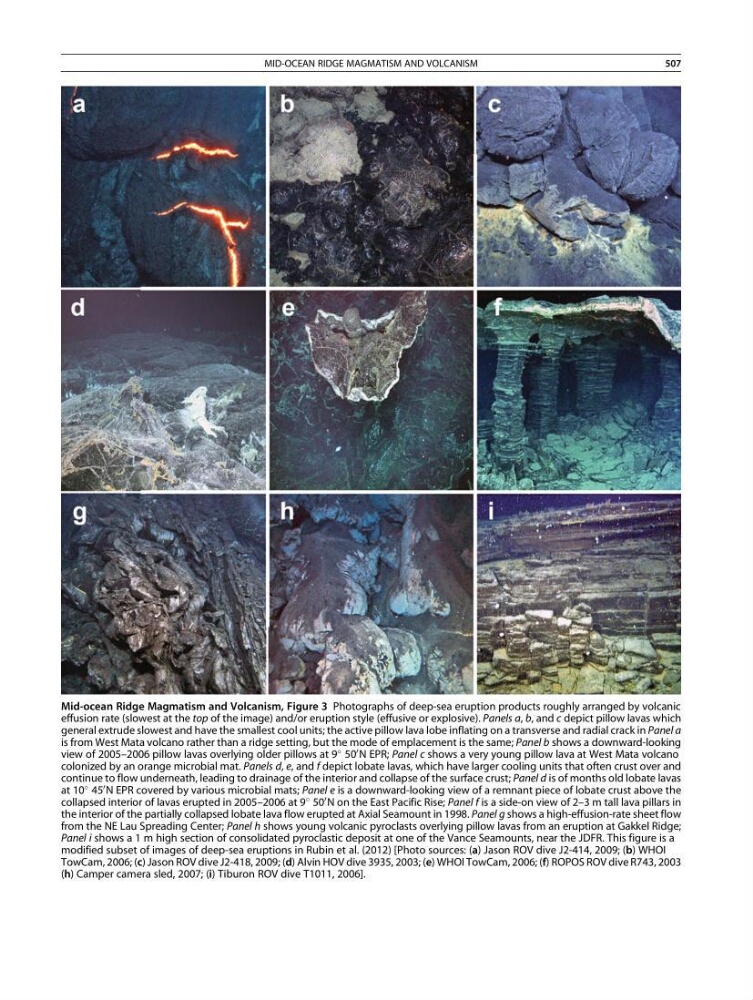
Mid-ocean Ridge Magmatism and Volcanism, Figure 3 Photographs of deep-sea eruption products roughly arranged by volcanic
effusion rate (slowest at the top of the image) and/or eruption style (effusive or explosive). Panels a, b, and c depict pillow lavas which
general extrude slowest and have the smallest cool units; the active pillow lava lobe inflating on a transverse and radial crack in Panel a
is from West Mata volcano rather than a ridge setting, but the mode of emplacement is the same; Panel b shows a downward-looking
view of 2005–2006 pillow lavas overlying older pillows at 9
50
0 N EPR; Panel c shows a very young pillow lava at West Mata volcano
colonized by an orange microbial mat. Panels d, e, and f depict lobate lavas, which have larger cooling units that often crust over and
continue to flow underneath, leading to drainage of the interior and collapse of the surface crust; Panel d is of months old lobate lavas
at 10
45
0 N EPR covered by various microbial mats; Panel e is a downward-looking view of a remnant piece of lobate crust above the
collapsed interior of lavas erupted in 2005–2006 at 9
50
0 N on the East Pacific Rise; Panel f is a side-on view of 2–3 m tall lava pillars in
the interior of the partially collapsed lobate lava flow erupted at Axial Seamount in 1998. Panel g shows a high-effusion-rate sheet flow
from the NE Lau Spreading Center; Panel h shows young volcanic pyroclasts overlying pillow lavas from an eruption at Gakkel Ridge;
Panel i shows a 1 m high section of consolidated pyroclastic deposit at one of the Vance Seamounts, near the JDFR. This figure is a
modified subset of images of deep-sea eruptions in Rubin et al. (2012) [Photo sources: (a) Jason ROV dive J2-414, 2009; (b) WHOI
TowCam, 2006; (c) Jason ROV dive J2-418, 2009; (d) Alvin HOV dive 3935, 2003; (e) WHOI TowCam, 2006; (f) ROPOS ROV dive R743, 2003
(h) Camper camera sled, 2007; (i) Tiburon ROV dive T1011, 2006].
MID-OCEAN RIDGE MAGMATISM AND VOLCANISM
507